Microsatellite instability and DNA mismatch repair protein deficiency in Lynch syndrome colorectal polyps
- PMID: 22262812
- PMCID: PMC3461594
- DOI: 10.1158/1940-6207.CAPR-11-0519
Microsatellite instability and DNA mismatch repair protein deficiency in Lynch syndrome colorectal polyps
Abstract
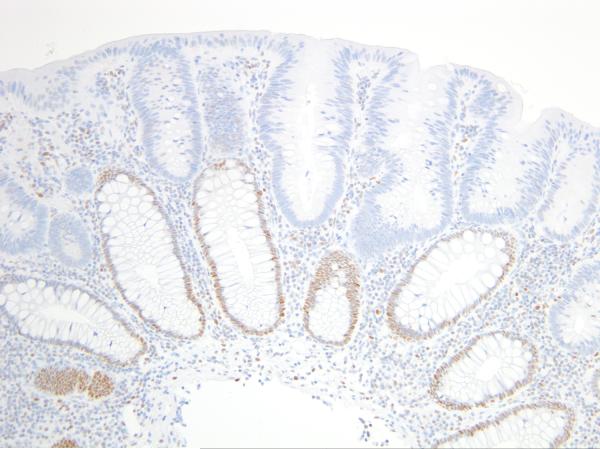
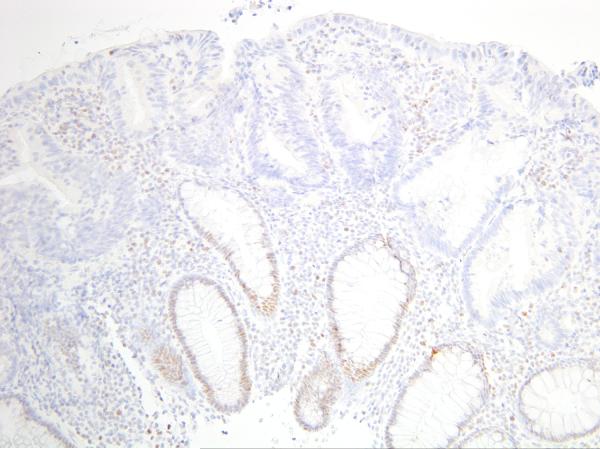
Colorectal cancers associated with Lynch syndrome are characterized by deficient DNA mismatch repair (MMR) function. Our aim was to evaluate the prevalence of microsatellite instability (MSI) and loss of MMR protein expression in Lynch syndrome-associated polyps. Sixty-two colorectal polyps--37 adenomatous polyps, 23 hyperplastic polyps, and 2 sessile serrated polyps (SSP)--from 34 subjects with germline MMR gene mutations were tested for MSI using a single pentaplex PCR for five mononucleotide repeat microsatellite markers, and also for expression of MLH1, MSH2, MSH6, and PMS2 proteins by immunohistochemistry. High-level MSI (MSI-H) was seen in 15 of 37 (41%) adenomatous polyps, one of 23 (4%) hyperplastic polyps, and one of two (50%) SSPs. Loss of MMR protein expression was seen in 18 of 36 (50%) adenomatous polyps, zero of 21 hyperplastic polyps, and zero of two SSPs. Adenomatous polyps 8 mm or larger in size were significantly more likely to show MSI-H [OR, 9.98; 95% confidence interval (CI), 1.52-65.65; P = 0.02] and deficient MMR protein expression (OR, 3.17; 95% CI, 1.20-8.37; P = 0.02) compared with those less than 8 mm in size. All (six of six) adenomatous polyps 10 mm or larger in size showed both MSI-H and loss of MMR protein expression by immunohistochemistry. Our finding that the prevalence of MMR deficiency increases with the size of adenomatous polyps suggests that loss of MMR function is a late event in Lynch syndrome-associated colorectal neoplasia. Although testing large adenomatous polyps may be of value in the diagnostic evaluation of patients with suspected Lynch syndrome, the absence of an MMR-deficient phenotype in an adenoma cannot be considered as a strong evidence against Lynch syndrome, as it is with colorectal carcinomas.
2012 AACR
Figures
Comment in
-
Diagnosing Lynch syndrome: more light at the end of the tunnel.Cancer Prev Res (Phila). 2012 Apr;5(4):507-10. doi: 10.1158/1940-6207.CAPR-12-0087. Cancer Prev Res (Phila). 2012. PMID: 22491516
References
-
- Hampel H, Frankel WL, Martin E, Arnold M, Khanduja K, Kuebler P, et al. Screening for the Lynch syndrome (hereditary nonpolyposis colorectal cancer) N Engl J Med. 2005;352:1851–60. - PubMed
-
- Aarnio M, Mecklin JP, Aaltonen LA, Nystrom-Lahti M, Jarvinen HJ. Life-time risk of different cancers in hereditary non-polyposis colorectal cancer (HNPCC) syndrome. Int J Cancer. 1995;64:430–3. - PubMed
-
- Bronner CE, Baker SM, Morrison PT, Warren G, Smith LG, Lescoe MK, et al. Mutation in the DNA mismatch repair gene homologue hMLH1 is associated with hereditary non-polyposis colon cancer. Nature. 1994;368:258–61. - PubMed
Publication types
MeSH terms
Grants and funding
LinkOut - more resources
Full Text Sources
Medical
Miscellaneous