


The MDRD equation underestimates the prevalence of CKD among blacks and overestimates the prevalence of CKD among whites compared to the CKD-EPI equation: a retrospective cohort study
- PMID: 22264268
- PMCID: PMC3398292
- DOI: 10.1186/1471-2369-13-4
The MDRD equation underestimates the prevalence of CKD among blacks and overestimates the prevalence of CKD among whites compared to the CKD-EPI equation: a retrospective cohort study
Abstract
Background: Black individuals are far more likely than white individuals to develop end stage renal disease (ESRD). However, earlier stages of chronic kidney disease (CKD) have been reported to be less prevalent among blacks. This disparity remains poorly understood. The objective of this study was to evaluate whether the lower prevalence of CKD among blacks in early stages of CKD might be due in part to an inability of the MDRD equation to accurately determine early stages of CKD in both the black and white population.
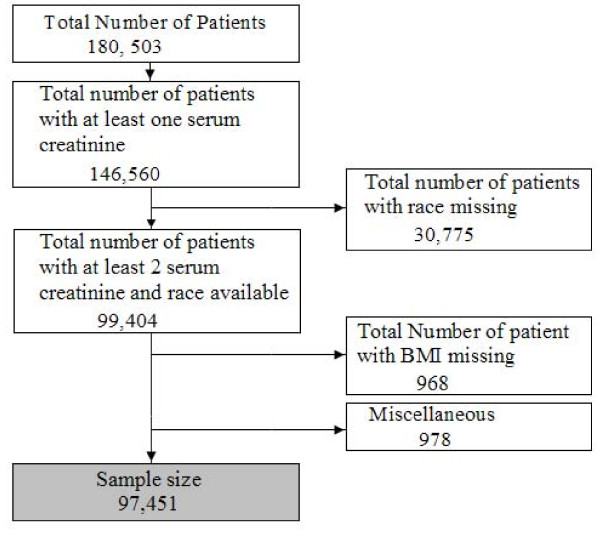
Methods: We conducted a retrospective cohort study of 97, 451 patients seen in primary care clinic in Veterans Integrated Service Network 2 (VISN 2) over a 7 year period to determine the prevalence of CKD using both the Modification of Diet in Renal Disease (MDRD) Study equation and the more recently developed CKD Epidemiology Collaboration (CKD-EPI) equation. Demographic data, comorbid conditions, prescription of medications, and laboratory data were recorded. Logistic regression and quantile regression models were used to compare the prevalence of estimated glomerular filtration rate (eGFR) categories between black and white individuals.
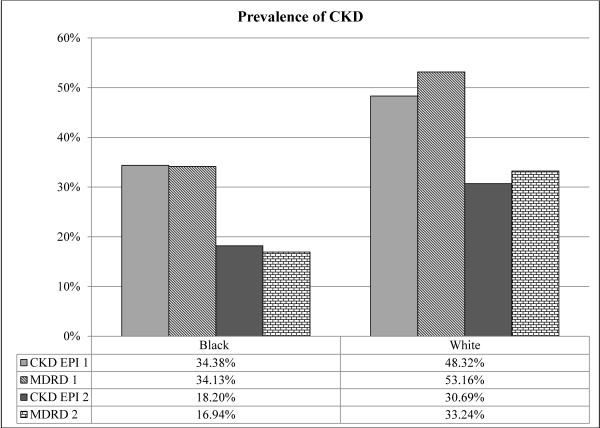
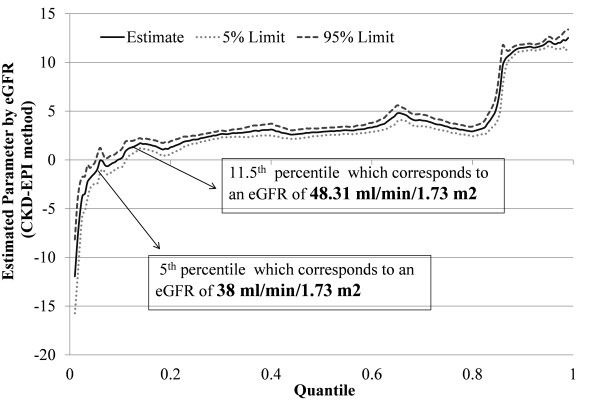
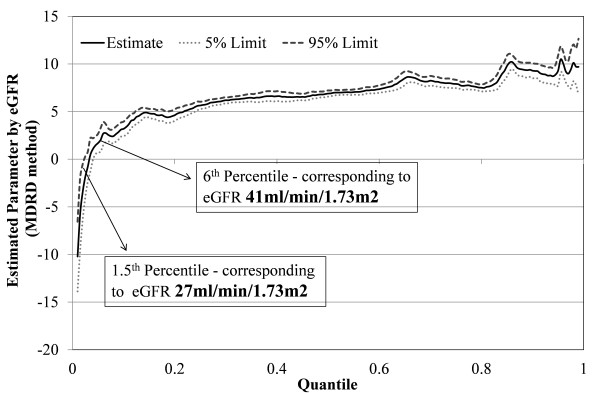
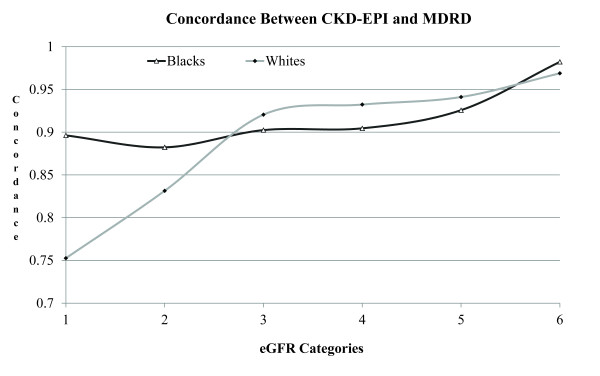
Results: The overall prevalence of CKD was lower when the CKD-EPI equation was used. Prevalence of CKD in whites was 53.2% by MDRD and 48.4% by CKD-EPI, versus 34.1% by MDRD and 34.5% by CKD-EPI in blacks. The cumulative logistic regression and quantile regression showed that when eGFR was calculated by the EPI method, blacks were as likely to present with an eGFR value less than 60 mL/min/1.73 m2 as whites. Using the CKD-EPI equation, blacks were more likely than white individuals to have stage 3b, 4 and 5 CKD. Using the MDRD method, the prevalence in blacks was only higher than in whites for stage 4 and 5 CKD. Similar results were obtained when the analysis was confined to patients over 65 years of age.
Conclusions: The MDRD equation overestimates the prevalence of CKD among whites and underestimates the prevalence of CKD in blacks compared to the CKD-EPI equation.
Figures
References
-
- United States Renal Data System. USRDS 2009: Annual Report: Atlas of Chronic Kidney Disease and End Stage Renal Disease in the United States, Bethesda, MD. National Institutes of Health. National Institute of Diabetes and Digestive and Kidney Diseases. 2009.
-
- McClellan W, Warnock DG, McClure L, Campbell RC, Newsome BB, Howard V, Cushman M, Howard G. Racial differences in the prevalence of chronic kidney disease among participants in the Reasons for Geographic and Racial Differences in Stroke (REGARDS) Cohort Study. J Am Soc Nephrol. 2006;17(6):1710–1715. doi: 10.1681/ASN.2005111200. - DOI - PubMed
-
- Coresh J, Astor BC, Greene T, Eknoyan G, Levey AS. Prevalence of chronic kidney disease and decreased kidney function in the adult US population: Third National Health and Nutrition Examination Survey. Am J Kidney Dis. 2003;41(1):1–12. - PubMed
Publication types
MeSH terms
LinkOut - more resources
Full Text Sources
Medical
Research Materials
Miscellaneous
