


Monitoring protein interactions in living cells with fluorescence lifetime imaging microscopy
- PMID: 22264545
- PMCID: PMC4136481
- DOI: 10.1016/B978-0-12-391857-4.00019-7
Monitoring protein interactions in living cells with fluorescence lifetime imaging microscopy
Abstract
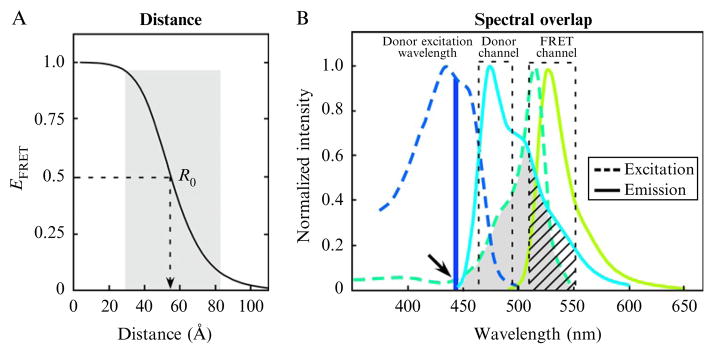
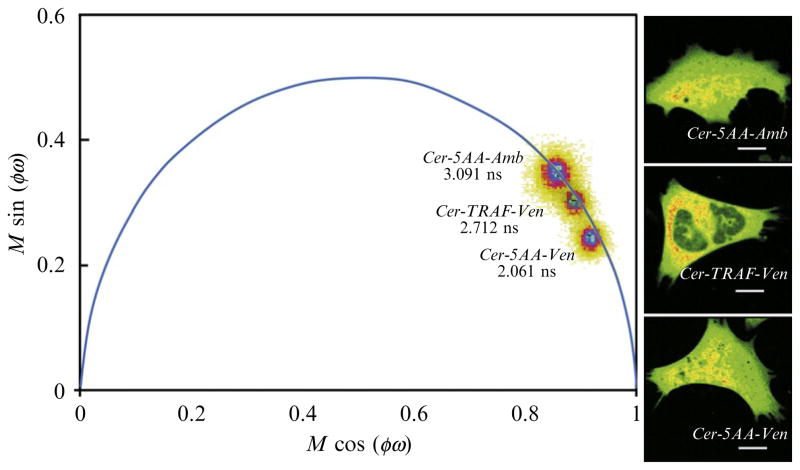
Fluorescence lifetime imaging microscopy (FLIM) is now routinely used for dynamic measurements of signaling events inside single living cells, such as monitoring changes in intracellular ions and detecting protein-protein interactions. Here, we describe the digital frequency domain FLIM data acquisition and analysis. We describe the methods necessary to calibrate the FLIM system and demonstrate how they are used to measure the quenched donor fluorescence lifetime that results from Förster Resonance Energy Transfer (FRET). We show how the "FRET-standard" fusion proteins are used to validate the FLIM system for FRET measurements. We then show how FLIM-FRET can be used to detect the dimerization of the basic leucine zipper (B Zip) domain of the transcription factor CCAAT/enhancer binding protein α in the nuclei of living mouse pituitary cells. Importantly, the factors required for the accurate determination and reproducibility of lifetime measurements are described in detail.
Copyright © 2012 Elsevier Inc. All rights reserved.
Figures



References
-
- Buranachai C, Kamiyama D, Chiba A, Williams BD, Clegg RM. Rapid frequency-domain FLIM spinning disk confocal microscope: Lifetime resolution, image improvement and wavelet analysis. J Fluoresc. 2008;18:929–942. - PubMed
-
- Clegg RM. Fluorescence lifetime-resolved imaging what, why, how—A prologue. In: Clegg RM, Periasamy A, editors. FLIM Microscopy in Biology and Medicine. CRC Press; London: 2010. pp. 3–34.
-
- Cole KS, Cole RH. Dispersion and absorption in dielectrics. I Alternating current characteristics. J Chem Phys. 1941;9:341–351.
Publication types
MeSH terms
Substances
Grants and funding
LinkOut - more resources
Full Text Sources
