


Determinants of plasma 25-hydroxyvitamin D and development of prediction models in three US cohorts
- PMID: 22264926
- PMCID: PMC3346859
- DOI: 10.1017/S0007114511007409
Determinants of plasma 25-hydroxyvitamin D and development of prediction models in three US cohorts
Erratum in
- Br J Nutr. 2013 Nov;110(10):1934
Abstract
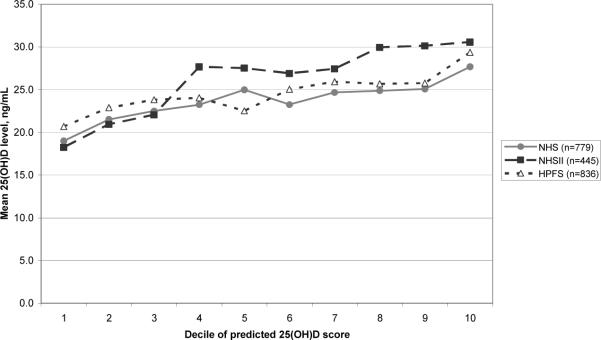
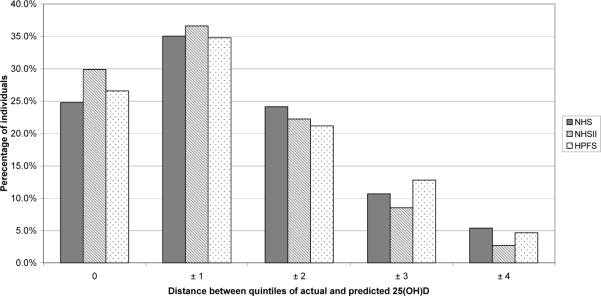
Epidemiological and other evidence suggests that vitamin D may be protective against several chronic diseases. Assessing vitamin D status in epidemiological studies, however, is challenging given finite resources and limitations of commonly used approaches. Using multivariable linear regression, we derived predicted 25-hydroxyvitamin D (25(OH)D) scores based on known determinants of circulating 25(OH)D, including age, race, UV-B radiation flux at residence, dietary and supplementary vitamin D intakes, BMI, physical activity, alcohol intake, post-menopausal hormone use (women only) and season of blood draw, in three nationwide cohorts: the Nurses' Health Study, Nurses' Health Study II and the Health Professionals Follow-up Study. The model r 2 for each cohort ranged from 0·25 to 0·33. We validated the prediction models in independent samples of participants from these studies. Mean measured 25(OH)D levels rose with increasing decile of predicted 25(OH)D score, such that the differences in mean measured 25(OH)D between the extreme deciles of predicted 25(OH)D were in the range 8·7-12·3 ng/ml. Substituting predicted 25(OH)D scores for measured 25(OH)D in a previously published case-control analysis of colorectal cancer yielded similar effect estimates with OR of approximately 0·8 for a 10 ng/ml difference in either plasma or predicted 25(OH)D. We conclude that these data provide reasonable evidence that a predicted 25(OH)D score is an acceptable marker for ranking individuals by long-term vitamin D status and may be particularly useful in research settings where biomarkers are not available for the majority of a study population.
Figures
References
-
- Garland CF, Gorham ED, Mohr SB, et al. Vitamin D and prevention of breast cancer: pooled analysis. J Steroid Biochem Mol Biol. 2007;103:708–711. - PubMed
-
- Giovannucci E. The epidemiology of vitamin D and cancer incidence and mortality: a review (United States) Cancer Causes Control. 2005;16:83–95. - PubMed
-
- Wu K, Feskanich D, Fuchs CS, et al. A nested case control study of plasma 25-hydroxyvitamin D concentrations and risk of colorectal cancer. J Natl Cancer Inst. 2007;99:1120–1129. - PubMed
-
- IARC . IARC Working Group Reports Vol. 5. Vol. 5. International Agency for Research on Cancer; Lyon: 2008. Vitamin D and Cancer. IARC Working Group Reports.
Publication types
MeSH terms
Substances
Grants and funding
- P01 CA087969/CA/NCI NIH HHS/United States
- R01 CA067262/CA/NCI NIH HHS/United States
- CA87969/CA/NCI NIH HHS/United States
- U01 CA067262/CA/NCI NIH HHS/United States
- CA67262/CA/NCI NIH HHS/United States
- R25 CA098566/CA/NCI NIH HHS/United States
- U01 CA049449/CA/NCI NIH HHS/United States
- R01 CA050385/CA/NCI NIH HHS/United States
- CA050385/CA/NCI NIH HHS/United States
- P30 ES000002/ES/NIEHS NIH HHS/United States
- P01 CA055075/CA/NCI NIH HHS/United States
- CA55075/CA/NCI NIH HHS/United States
- CA49449/CA/NCI NIH HHS/United States
- R01 CA049449/CA/NCI NIH HHS/United States
- T32 ES007155/ES/NIEHS NIH HHS/United States
LinkOut - more resources
Full Text Sources
Medical
