Review
. 2013 Mar:51:3-12.
doi: 10.1016/j.nbd.2011.12.057. Epub 2012 Jan 10.

Role of mitochondrial homeostasis and dynamics in Alzheimer's disease

Affiliations
Review

Role of mitochondrial homeostasis and dynamics in Alzheimer's disease

J Eva Selfridge et al. Neurobiol Dis. 2013 Mar.

Abstract

Alzheimer's disease (AD) is a progressive neurodegenerative disease that affects a staggering percentage of the aging population and causes memory loss and cognitive decline. Mitochondrial abnormalities can be observed systemically and in brains of patients suffering from AD, and may account for part of the disease phenotype. In this review, we summarize some of the key findings that indicate mitochondrial dysfunction is present in AD-affected subjects, including cytochrome oxidase deficiency, endophenotype data, and altered mitochondrial morphology. Special attention is given to recently described perturbations in mitochondrial autophagy, fission-fusion dynamics, and biogenesis. We also briefly discuss how mitochondrial dysfunction may influence amyloidosis in Alzheimer's disease, why mitochondria are a valid therapeutic target, and strategies for addressing AD-specific mitochondrial dysfunction.


Figures

Figure 1
Figure 1
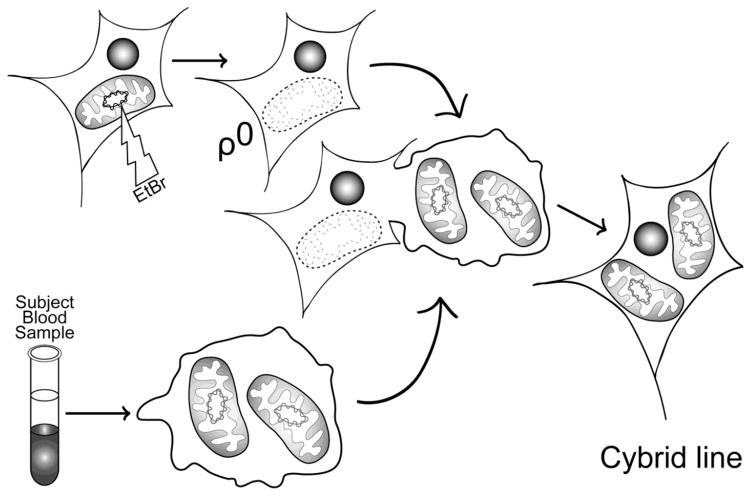
Generation of cybrid cell lines. Tumor or immortalized cell lines are grown in the presence of ethidium bromide, which effectively eliminates functional mtDNA to result in a ρ0 cell line. ρ0 cells are then fused with a patient’s platelets, which contain mitochondria but not nuclei. This creates cytoplasmic hybrid (cybrid) cells that can be isolated and expanded. The expanded cybrid cell cultures are biochemically analyzed. Differences in function between cell lines mostly likely arise through differences in their mtDNA.
Figure 2
Figure 2
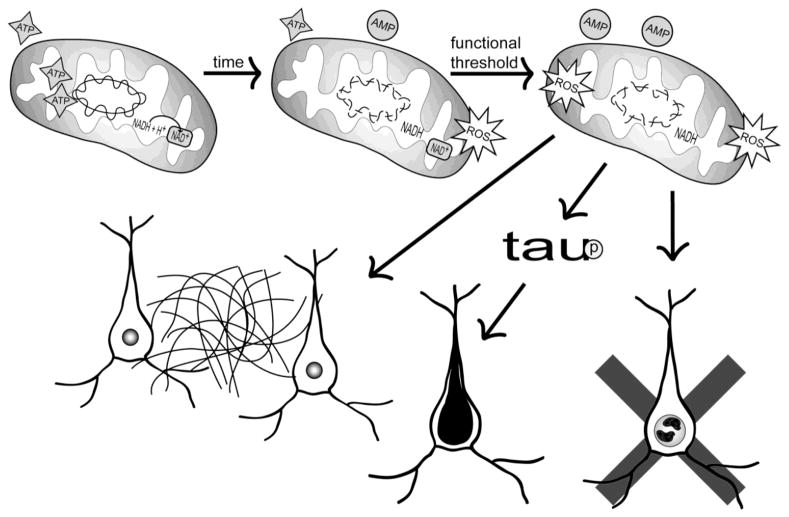
Mitochondrial cascade hypothesis. Bi-parental inheritance of genes required for mitochondrial function and maintenance, as well as the specific maternal inheritance of mitochondrial genes, determines intrinsic mitochondrial function and durability. Over time, mitochondrial injuries accumulate and these injuries perturb mitochondrial function. While these perturbations are initially compensated for, compensatory changes eventually prove inadequate and a critical point is reached where the neuron comes to favor anaerobic over aerobic bioenergetics. Activation of various cell stress pathways, combined with a shift from an aerobic to an anaerobic bioenergetic profile, gives rise to AD-typical histology changes including Aβ accumulation in the brain parenchyma, tau phosphorylation and neurofibrillary tangle formation in neurons, and synaptic degeneration,
Figure 3
Figure 3
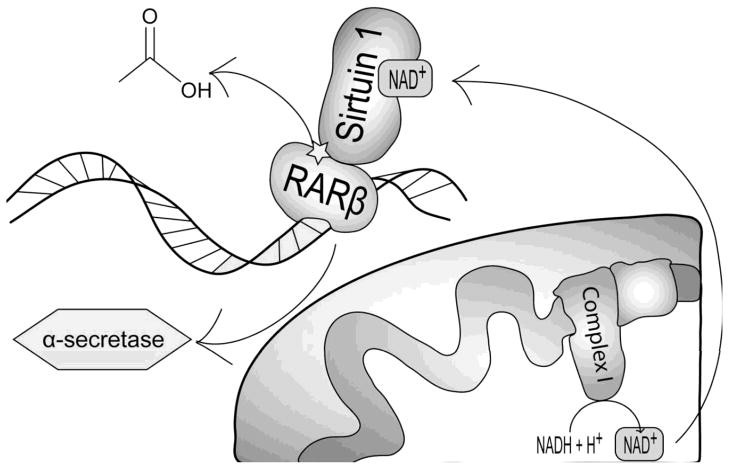
Role of NAD+/NADH in APP processing. In the mitochondria, NADH is oxidized to NAD+, which in turn increases cytosolic NAD+. Cytosolic NAD+ activates sirtuin 1, which leads to de-acetylation of retinoic acid receptor β. De-acetylation of retinoic acid receptor β allows it to interact with the α-secretase promoter and increase α-secretase expression. α-secretase-mediated APP cleavage prevents processing of APP to Aβ.
Figure 4
Figure 4
Role of ROS in APP processing. (A) Excess ROS are produced by dysfunctional mitochondria. (B) ROS oxidizes thioredoxin, releasing it from ASK1. (C) ASK1 causes JNK activation. (D) Alternatively, ROS oxidizes GST, releasing JNK. (E) Activated JNK deacetylates histones and demethylates APP, BACE, and presenilin gene promoters, which leads to increased Aβ production.

References

    1. Adlard PA, et al. Voluntary exercise decreases amyloid load in a transgenic model of Alzheimer’s disease. J Neurosci. 2005;25:4217–21. - PMC - PubMed
    1. Adler V, et al. Regulation of JNK signaling by GSTp. EMBO J. 1999a;18:1321–34. - PMC - PubMed
    1. Adler V, et al. Role of redox potential and reactive oxygen species in stress signaling. Oncogene. 1999b;18:6104–11. - PubMed
    1. Alleyne T, et al. Unraveling the role of metal ions and low catalytic activity of cytochrome C oxidase in Alzheimer’s disease. J Mol Neurosci. 2011;43:284–9. - PubMed
    1. Apostolova N, et al. Autophagy as a rescue mechanism in Efavirenz-induced mitochondrial dysfunction: A lesson from hepatic cells. Autophagy. 2011a;7:1402–4. - PubMed

Publication types