Review
. 2012 Apr;31(3):162-9.
doi: 10.1016/j.matbio.2012.01.005. Epub 2012 Jan 14.

The matricellular protein thrombospondin-1 globally regulates cardiovascular function and responses to stress via CD47

Affiliations
Review

The matricellular protein thrombospondin-1 globally regulates cardiovascular function and responses to stress via CD47

David D Roberts et al. Matrix Biol. 2012 Apr.

Abstract

Matricellular proteins play diverse roles in modulating cell behavior by engaging specific cell surface receptors and interacting with extracellular matrix proteins, secreted enzymes, and growth factors. Studies of such interactions involving thrombospondin-1 have revealed several physiological functions and roles in the pathogenesis of injury responses and cancer, but the relatively mild phenotypes of mice lacking thrombospondin-1 suggested that thrombospondin-1 would not be a central player that could be exploited therapeutically. Recent research focusing on signaling through its receptor CD47, however, has uncovered more critical roles for thrombospondin-1 in acute regulation of cardiovascular dynamics, hemostasis, immunity, and mitochondrial homeostasis. Several of these functions are mediated by potent and redundant inhibition of the canonical nitric oxide pathway. Conversely, elevated tissue thrombospondin-1 levels in major chronic diseases of aging may account for the deficient nitric oxide signaling that characterizes these diseases, and experimental therapeutics targeting CD47 show promise for treating such chronic diseases as well as acute stress conditions that are associated with elevated thrombospondin-1 expression.


Figures

Fig. 1
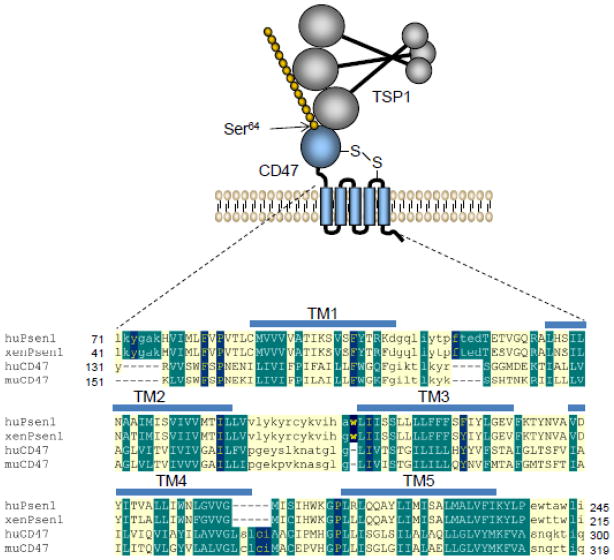
Fig. 1. The TSP1 receptor CD47
A model for the interaction of TSP1 with the heparan sulfate modified isoform of CD47 is presented. Modification of CD47 at Ser64 is required for inhibitory TSP1 signaling in T cells (Kaur et al., 2011). A long range disulfide bond links the extracellular IgV domain (blue) to the extracellular loop between the transmembrane segments TM4 and TM5 and is required for CD47 signaling (Rebres et al., 2001). BLINK Blast analysis of human CD47 identified multiple presenilins that show significant homology with its transmembrane domain. The lower panel shows alignment of transmembrane domains of xenopus and human presenilin-1 with those of human and mouse CD47. CD47 and presenilin-1 sequences were aligned using the Segment Pair Overlap algorithm of MACAW. Capital letters indicate aligned blocks, and shading indicates conserved residues.
Fig. 2
Fig. 2. CD47-mediated regulation of vascular cell signaling by TSP1
Binding of TSP1 to CD47 has a global effect upon the canonical NO pathway. In endothelial cells, TSP1 inhibits VEGFR2 activation through its ability to disrupt the constitutive interactions of CD47 with VEGFR2 (Kaur et al., 2010). This CD47 signal limits Akt-mediated phosphorylation of eNOS at Ser1177 and alters endothelial cell calcium transients to prevent calmodulin-mediated activation of eNOS, thereby redundantly suppressing NO production stimulated by VEGF or acetylcholine. CD47 ligation also controls VEGFR2 signaling through the PLCγ pathway and the TSAd adapter to Src that mediate NO-independent endothelial cell growth, migration, and permeability responses. The TSP1/CD47 signal also inhibits heme-dependent and hem-independent activation of the NO cellular target sGC in all vascular cells and T cells (Miller et al., 2010a). TSP1/CD47 signaling independently inhibits the cGMP-stimulated activation of the cGMP target cGK-1. Thus, the TSP1/CD47 axis is a global inhibitor of endogenous and exogenous NO, NO-pro-drugs such as nitrite (Isenberg et al., 2009d), and cGMP promoting drugs such as synthetic activators of sCG (YC-1, BAY 41-2272; (Miller et al., 2010a) and cGMP phosphodiesterase inhibitors (e.g. sildenafil).
Fig. 3
Fig. 3. Physiological and pathological functions of TSP1/CD47 signaling
At physiological levels of TSP1, signaling through CD47 limits NO/cGMP signaling to support blood pressure, limit tissue perfusion, promote platelet hemostasis, and control mitochondrial biogenesis. Acute or chronic elevation of TSP1 levels in circulation or in tissues contributes to a deficit in NO/cGMP signaling associated with fixed ischemic injuries, ischemia/reperfusion, and several chronic diseases of aging. TSP1/CD47 signaling through cGMP-independent pathways also plays significant roles in some adaptive responses to stress, which involve signaling through additional TSP1 receptors including integrins, CD36, and calreticulin/LRP1.

References

    1. Arnold WP, Mittal CK, Katsuki S, Murad F. Nitric oxide activates guanylate cyclase and increases guanosine 3':5'-cyclic monophosphate levels in various tissue preparations. Proc Natl Acad Sci U S A. 1977;74:3203–3207. - PMC - PubMed
    1. Bamberger ME, Harris ME, McDonald DR, Husemann J, Landreth GE. A cell surface receptor complex for fibrillar beta-amyloid mediates microglial activation. J Neurosci. 2003;23:2665–2674. - PMC - PubMed
    1. Bauer EM, Qin Y, Miller TW, Bandle RW, Csanyi G, Pagano PJ, Bauer PM, Schnermann J, Roberts DD, Isenberg JS. Thrombospondin-1 supports blood pressure by limiting eNOS activation and endothelial-dependent vasorelaxation. Cardiovasc Res. 2010;88:471–481. - PMC - PubMed
    1. Bornstein P. Diversity of function is inherent in matricellular proteins: an appraisal of thrombospondin 1. J Cell Biol. 1995;130:503–506. - PMC - PubMed
    1. Bras M, Yuste VJ, Roue G, Barbier S, Sancho P, Virely C, Rubio M, Baudet S, Esquerda JE, Merle-Beral H, Sarfati M, Susin SA. Drp1 mediates caspase-independent type III cell death in normal and leukemic cells. Mol Cell Biol. 2007;27:7073–7088. - PMC - PubMed

Publication types