. 2012 Aug;64(11):1021-30.
doi: 10.1016/j.addr.2012.01.003. Epub 2012 Jan 14.

Engineering nanomedicines using stimuli-responsive biomaterials

Affiliations

Engineering nanomedicines using stimuli-responsive biomaterials

Yapei Wang et al. Adv Drug Deliv Rev. 2012 Aug.

Abstract

The ability to engineer particles has the potential to shift the paradigm in the creation of new medicines and diagnostics. Complete control over particle characteristics, such as size, shape, mechanical property, and surface chemistry, can enable rapid translation and facilitate the US Food and Drug Administration (FDA) approval of particle technologies for the treatment of cancer, infectious diseases, diabetes, and a host of other major illnesses. The incorporation of natural and artificial external stimuli to trigger the release of drugs enables exquisite control over the release profiles of drugs in a given environment. In this article, we examine several readily scalable top-down methods for the fabrication of shape-specific particles that utilize stimuli-responsive biomaterials for controlled drug delivery. Special attention is given to Particle Replication In Nonwetting Templates (PRINT®) technology and the application of novel triggered-release synthetic and natural polymers.


Figures

Fig.1
Fig.1
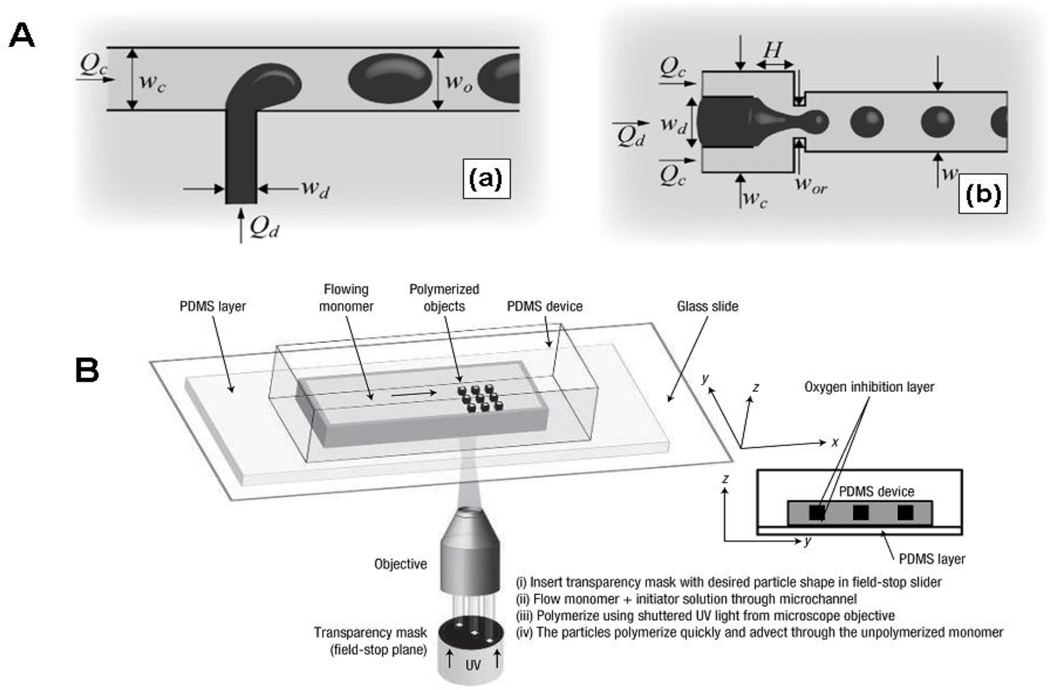
(A) Microfluidic devices for the fabrication of monodisperse emulsion droplets (a) T-junction type; (b) Flow focusing Device (FFD). Reproduced from Ref. with permission of Institute of Physics. (B) An experimental setup of Continuous Flow Lithography (CFL). Polymerized particles are generated in the monomer stream flowing through the channel, by a mask-defined UV light beam emanating from the objective. Reproduced from Ref. with permission of Nature Publishing Group.
Fig.2
Fig.2
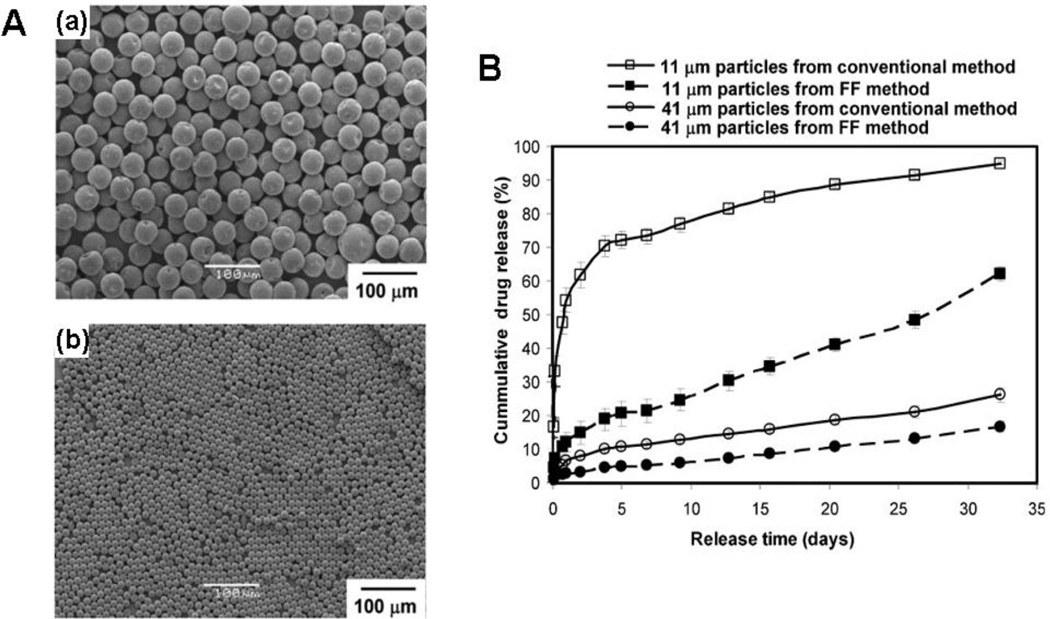
(A) Microparticles prepared via microfluidics with average size of: (a) 41 µm, (b) 11 µm. (B) The comparison of drug-release profiles from monodisperse microparticles prepared with microfluidic devices and polydisperse microparticles prepared using the conventional single emulsion technique. Reproduced from Ref. with permission of John Wiley & Sons, Inc.
Fig.3
Fig.3
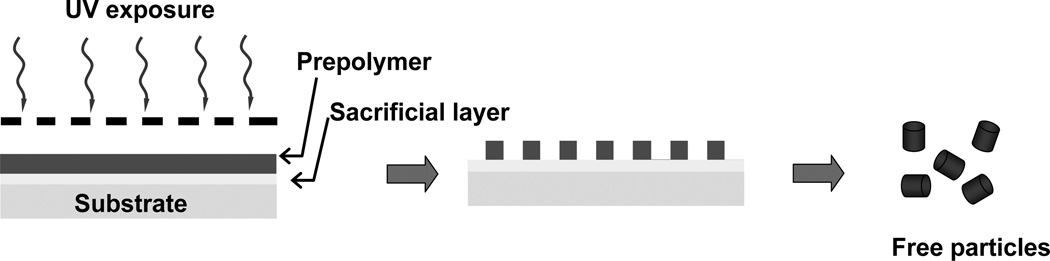
Schematic illustration of the photolithography method to engineer shape and size specific particles.
Fig. 4
Fig. 4
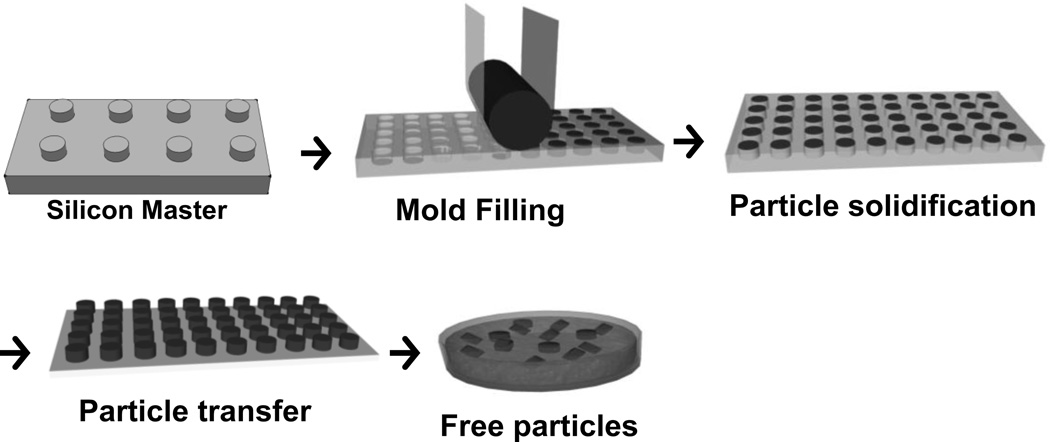
General schematic representation of Particle Replication In Non-wetting Templates (PRINT).
Fig. 5
Fig. 5
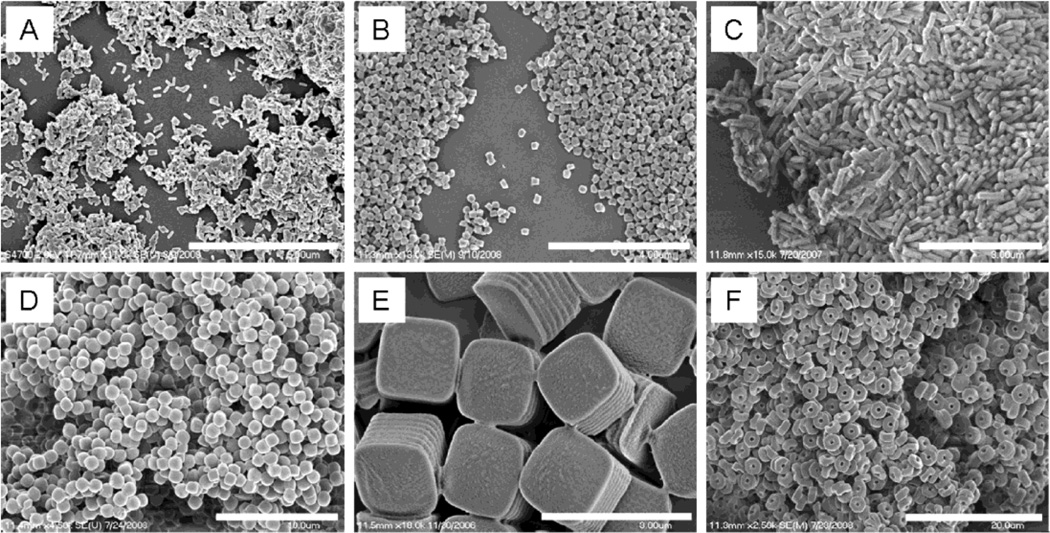
PRINT PLGA nano- and microparticles. (A) 80 nm × 320 nm cylinders, (B) 200 nm × 200 nm cylinders, (C) 200 nm × 600 nm cylinders, (D) 1 µm sphere approximates, (E) 2 µm cubes with ridges, and (F) 3 µm particles with center fenestrations. Scale bars: (A) 5 µm, (B) 4 µm, (C) 3 µm, (D) 10 µm, (E) 3 µm, and (F) 20 µm. Reproduced from Ref. with permission of American Chemical Society.
Fig. 6
Fig. 6
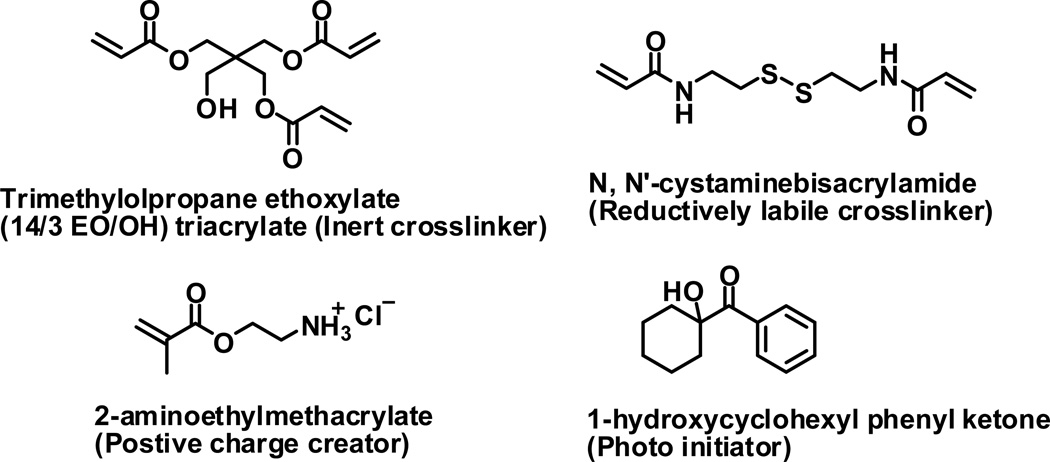
Building blocks for the reductively labile PRINT particles.
Fig. 7
Fig. 7
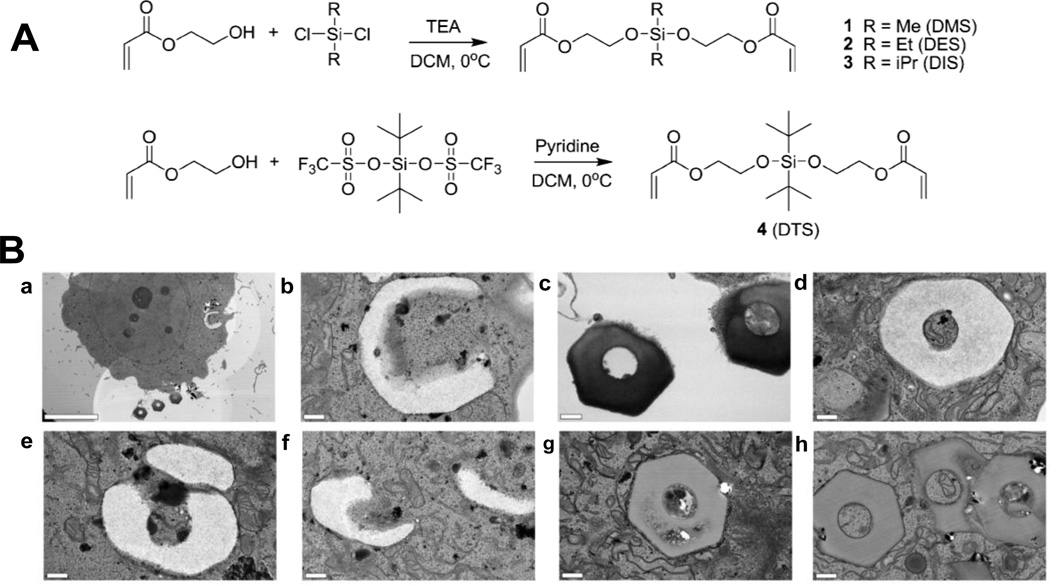
(A) Synthesis of photo-curable silyl ether cross-linkers. (B) TEM micrographs of PRINT hexnut particles incubated in HeLa cells: (a–f) rapidly degrading hexnut particles fabricated from the DMS cross-linker [scale bars: (a) 10 µm; (b–f) 0.5 µm; (g, h) nondegrading hexnut particles fabricated from the DTS cross-linker (scale bars: 0.5 µm). Reproduced from Ref. with permission of American Chemical Society.
Fig.8
Fig.8
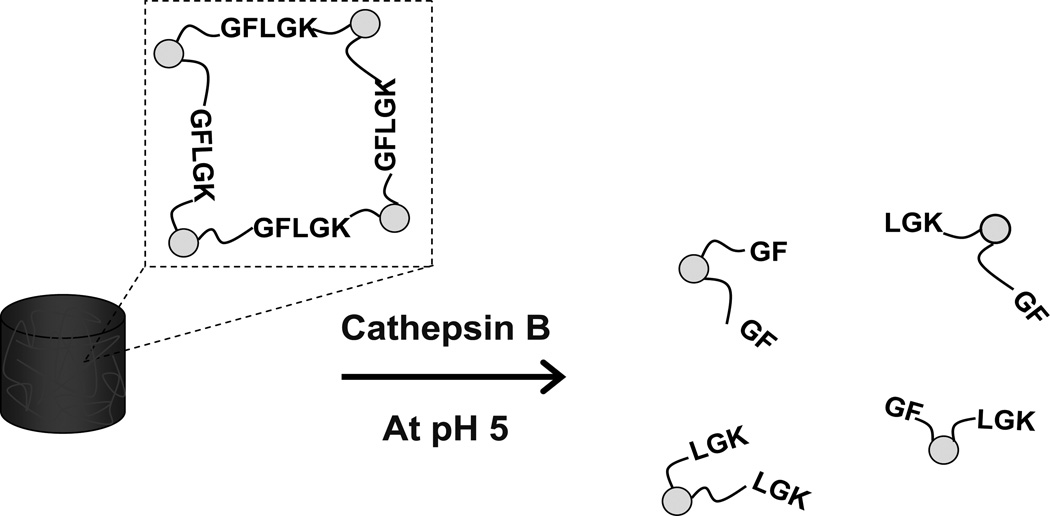
The enzymatically-triggered biodegradation of micromolding GFLGK particles.

References

    1. Petros RA, DeSimone JM. Strategies in the design of nanoparticles for therapeutic application. Nature Rev. 2010;9:615–627. - PubMed
    1. Li S-D, Huang L. Pharmacokinetics and biodistribution of nanoparticles. Mol. Pharmaceutics. 2008;5:496–504. - PubMed
    1. del Valle EMM, Galan MA, Carbonell RG. Drug delivery technologies: the way forward in the new decade. Ind. Eng. Chem. Res. 2009;48:2475–2486.
    1. Barenholz Y. Liposome application: problems and prospects. Curr. Opin. Colloid Interface Sci. 2001;6:66–77.
    1. Torchilin VP. Targeted polymeric micelles for delivery of poorly soluble drugs. Cell. Mol. Life Sci. 2004;61:2549–2559. - PMC - PubMed

Publication types

MeSH terms

Substances