


Malaria evolution in South Asia: knowledge for control and elimination
- PMID: 22266213
- PMCID: PMC3894252
- DOI: 10.1016/j.actatropica.2012.01.008
Malaria evolution in South Asia: knowledge for control and elimination
Abstract
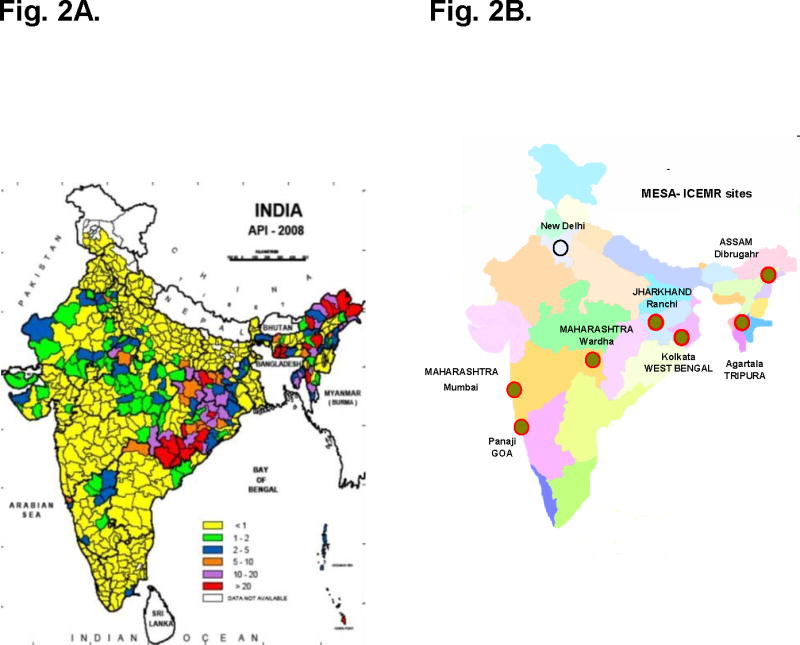
The study of malaria parasites on the Indian subcontinent should help us understand unexpected disease outbreaks and unpredictable disease presentations from Plasmodium falciparum and Plasmodium vivax infections. The Malaria Evolution in South Asia (MESA) research program is one of ten International Centers of Excellence for Malaria Research (ICEMR) sponsored by the US National Institutes of Health. In this second of two reviews, we describe why population structures of Plasmodia in India will be characterized and how we will determine their consequences on disease presentation, outcome and patterns. Specific projects will determine if genetic diversity, possibly driven by parasites with higher genetic plasticity, plays a role in changing epidemiology, pathogenesis, vector competence of parasite populations and whether innate human genetic traits protect Indians from malaria today. Deep local clinical knowledge of malaria in India will be supplemented by basic scientists who bring new research tools. Such tools will include whole genome sequencing and analysis methods; in vitro assays to measure genome plasticity, RBC cytoadhesion, invasion, and deformability; mosquito infectivity assays to evaluate changing parasite-vector compatibilities; and host genetics to understand protective traits in Indian populations. The MESA-ICEMR study sites span diagonally across India and include a mixture of very urban and rural hospitals, each with very different disease patterns and patient populations. Research partnerships include government-associated research institutes, private medical schools, city and state government hospitals, and hospitals with industry ties. Between 2012 and 2017, in addition to developing clinical research and basic science infrastructure at new clinical sites, our training workshops will engage new scientists and clinicians throughout South Asia in the malaria research field.
Copyright © 2012 Elsevier B.V. All rights reserved.
Figures
References
-
- Abu-Zeid YA, Abdulhadi NH, Theander TG, Hviid L, Saeed BO, Jepsen S, Jensen JB, Bayoumi RA. Seasonal changes in cell mediated immune responses to soluble Plasmodium falciparum antigens in children with haemoglobin AA and haemoglobin AS. Trans R Soc Trop Med Hyg. 1992;86:20–22. - PubMed
-
- Acharya P, Pallavi R, Chandran S, Chakravarti H, Middha S, Acharya J, Kochar S, Kochar D, Subudhi A, Boopathi AP, Garg S, Das A, Tatu U. A glimpse into the clinical proteome of human malaria parasites Plasmodium falciparum and Plasmodium vivax. Proteomics Clin Appl. 2009;3:1314–1325. - PubMed
Publication types
MeSH terms
Grants and funding
LinkOut - more resources
Full Text Sources
Medical
