. 2012 Jan 22;19(2):253-9.
doi: 10.1038/nsmb.2223.

HIV-1 reverse transcriptase complex with DNA and nevirapine reveals non-nucleoside inhibition mechanism

Affiliations

HIV-1 reverse transcriptase complex with DNA and nevirapine reveals non-nucleoside inhibition mechanism

Kalyan Das et al. Nat Struct Mol Biol. .

Abstract

Combinations of nucleoside and non-nucleoside inhibitors (NNRTIs) of HIV-1 reverse transcriptase (RT) are widely used in anti-AIDS therapies. Five NNRTIs, including nevirapine, are clinical drugs; however, the molecular mechanism of inhibition by NNRTIs is not clear. We determined the crystal structures of RT-DNA-nevirapine, RT-DNA, and RT-DNA-AZT-triphosphate complexes at 2.85-, 2.70- and 2.80-Å resolution, respectively. The RT-DNA complex in the crystal could bind nevirapine or AZT-triphosphate but not both. Binding of nevirapine led to opening of the NNRTI-binding pocket. The pocket formation caused shifting of the 3' end of the DNA primer by ~5.5 Å away from its polymerase active site position. Nucleic acid interactions with fingers and palm subdomains were reduced, the dNTP-binding pocket was distorted and the thumb opened up. The structures elucidate complementary roles of nucleoside and non-nucleoside inhibitors in inhibiting RT.


Conflict of interest statement

Author Information: The authors declare no competing financial interests.

Figures

Figure 1
Figure 1. Polymerase domain of HIV-1 RT in complex with DNA
Nevirapine and AZTTP are placed based on superposition of the palm subdomain of nevirapine- and AZTTP-ternary structures, respectively, on the RT–DNA structure. The 3’-azido group of AZT-terminated primer in the current RT–DNA and AZTTP-ternary structures occupies the metal A position, whereas metal B is present in the AZTTP-ternary structure; metal ion A is positioned based on its location in the dTTP-ternary structure. RT binds dNTP and catalytically incorporates nucleotides by a cation-dependent nucleotidyltransferase reaction. Incorporation of an NRTI, like AZT, or binding of a nonnucleoside, like nevirapine, inhibits DNA polymerization by RT.
Figure 2
Figure 2. Effects of nevirapine on polymerase active site conformation and dNTP-binding
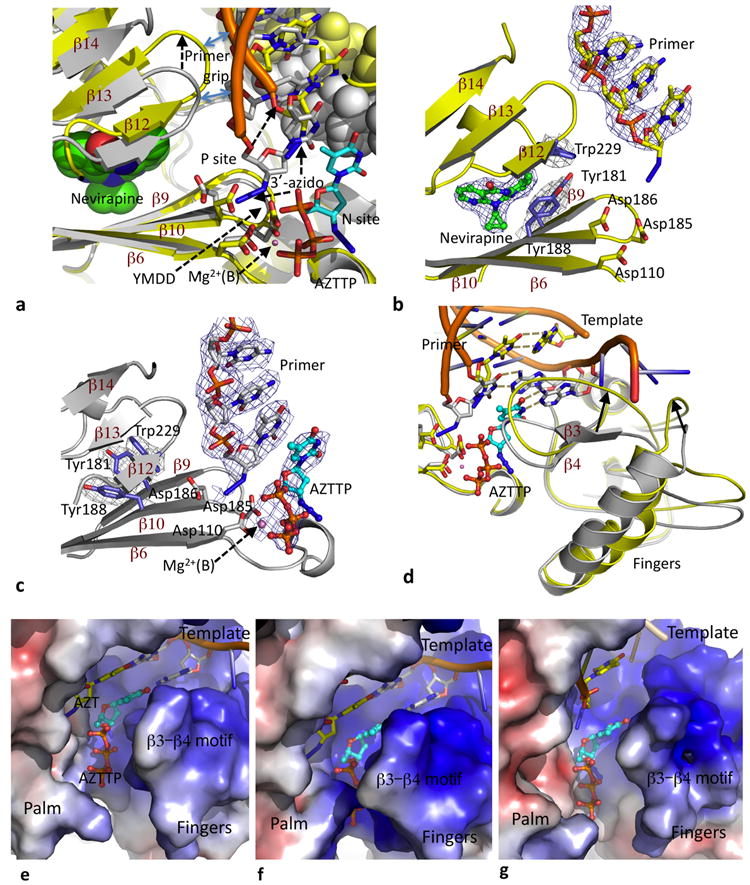
a. Palm superposition of nevirapine-ternary (yellow protein and DNA) on AZTTP-ternary (gray protein and DNA; cyan AZTTP) structures; the template strands are shown as space-filled models. Binding of nevirapine (green space filling) shifts the “primer grip” by ~4 Å which pulls the AZT at the primer end away from the P site and repositions the template strand. b & c. Electron density maps calculated using six-fold symmetry averaged phases (see online methods) show the binding of nevirapine and AZTTP in respective ternary structures; comparison of the two structures show rotamer switching for Y181 and Y188, shearing of the β12–β13–β14 sheet, and the shift of DNA primer. d. Repositioning of fingers subdomain based on the superposition and color code described in panel a. In nevirapine-ternary structure, the template (yellow) overhang is disordered because portions of the repositioned fingers subdomain in the structure would interfere with the template-binding track in AZTTP-ternary structure (gray). Electrostatic potential surfaces of (e) RT–DNA, (f) AZTTP-ternary, and (g) nevirapine-ternary complexes show the conformational variations of the dNTP-binding region upon binding of AZTTP or nevirapine. AZTTP is present only in AZTTP-ternary (f) structure and is placed in RT–DNA (e) and nevirapine-ternary (g) structures based on superposition of palm subdomains.
Figure 3
Figure 3. Impact of nevirapine binding on thumb, fingers and DNA
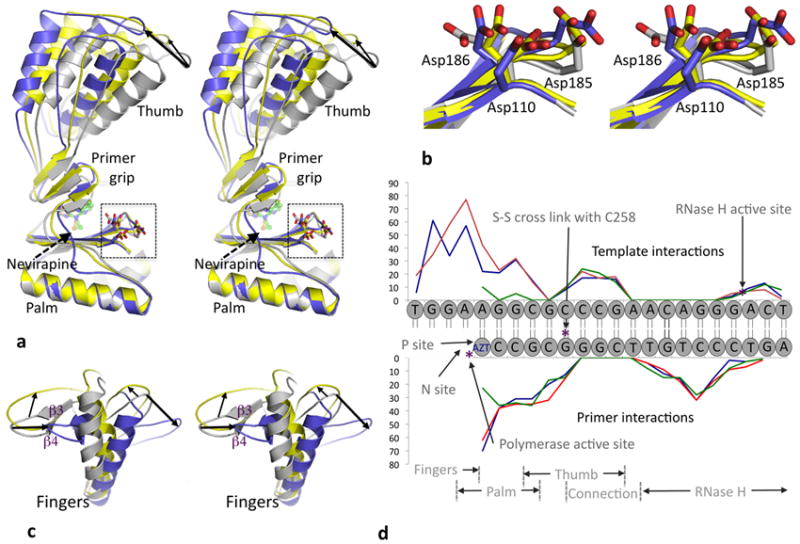
a. Stereo view of a palm superposition of nevirapine-ternary (yellow), AZTTP-ternary (gray), and nevirapine-binary (blue) structures shows that the thumb subdomain is hyper extended upon nevirapine binding; the tip of the thumb is ~7.5 and 11 Å away in nevirapine-ternary and nevirapine-binary structures, respectively, from the tip in AZTTP-ternary structure based on described superposition. The thumb of nevirapine-ternary and the first nevirapine-binary structures however are in close proximity based on palm superposition (Supplementary Fig. 3). In the higher resolution nevirapine-binary structure, the thumb was further extended as a result of crystal contacts. b. Zoomed stereo view of the polymerase active site region of superimposed structures in a. The YMDD loop in nevirapine-ternary (yellow) has an intermediate state between AZTTP-ternary (gray) and nevirapine-binary (blue) structures indicating active site flexibility even when nevirapine is bound; the Cα atom of D185 in the nevirapine-ternary structure is displaced ~1 Å from its counterpart in the other two structures. c. Repositioning of fingers subdomain based on described superposition and color scheme in panel a. The thick arrows represent fingers repositioning to nevirapine-binary and thin arrow represents repositioning to nevirapine-ternary from AZTTP-ternary structure. d. Comparison of interactions of DNA template-primer with RT in RT–DNA (blue), AZTTP-ternary (red) and nevirapine-ternary (green) structures; the extent of interactions (y-axis) are represented by the number of interatomic distances (<4.5 Å) between a nucleotide and RT. The interactions of DNA with fingers and palm are decreased upon nevirapine binding; the interactions with thumb, connection, and RNase H are not altered.
Figure 4
Figure 4. A molecular mechanism of nonnucleoside inhibition and impact of DNA binding on resistance to nonnucleoside drugs
a. Scheme representing effect of nonnucleoside inhibitor binding on DNA polymerization by RT. For incorporating a nucleotide, RT completes three structurally distinct steps in a clockwise cycle. Incorporation of an NRTI drug blocks the cyclic process, leading to a P-complex structure lacking 3’-OH, like the structure of RT–DNA–AZT-terminated complex. RT removes AZT by following the three steps in a reverse cycle and using a pyrophosphate donor (ATP or PPi). Binding of a nonnucleoside inhibitor shifts the primer end from P site to P’ site. This P’-complex is catalytically incompetent because the 3’-end is positioned away from the polymerase active site. Release of nonnucleoside inhibitor would shift the P’-complex to P-complex and restore DNA polymerization by RT. b. Positions of three structural elements: β6–β10–β9 sheet (yellow), β12–β13–β14 sheet (gray), and loop 95-103 (cyan) + Glu138 loop (blue) of p51 in nevirapine-ternary structure. These elements are responsible for and rearranged upon the binding of nevirapine (green). Nonnucleoside inhibitor binding locks the primer grip away from the active site, whereas binding of dsDNA requires the primer grip to be positioned near the active site as in RT–DNA and AZTTP-ternary structures. Red arrows indicate the structural movements (Supplementary Movie 1) between the polymerase-competent and nonnucleoside-bound states.

References

    1. U. S. F. & D. Administrtion. http://www.fda.gov/ForConsumers/byAudience/ForPatientAdvocates/HIVandAID....
    1. Kohlstaedt LA, Wang J, Friedman JM, Rice PA, Steitz TA. Crystal structure at 3.5 Å resolution of HIV-1 reverse transcriptase complexed with an inhibitor. Science. 1992;256:1783–1790. - PubMed
    1. Jacobo-Molina A, et al. Crystal structure of human immunodeficiency virus type 1 reverse transcriptase complexed with double-stranded DNA at 3.0 Å resolution shows bent DNA. Proc Natl Acad Sci U S A. 1993;90:6320–6324. - PMC - PubMed
    1. Huang H, Chopra R, Verdine GL, Harrison SC. Structure of a covalently trapped catalytic complex of HIV-1 reverse transcriptase: implications for drug resistance. Science. 1998;282:1669–1675. - PubMed
    1. Ren J, Stammers DK. Structural basis for drug resistance mechanisms for non-nucleoside inhibitors of HIV reverse transcriptase. Virus Res. 2008;134:157–170. - PubMed

Publication types

MeSH terms