


doi: 10.1038/nchembio.767.
Metabolomics implicates altered sphingolipids in chronic pain of neuropathic origin
Affiliations
- PMID: 22267119
- PMCID: PMC3567618
- DOI: 10.1038/nchembio.767
Item in Clipboard
Metabolomics implicates altered sphingolipids in chronic pain of neuropathic origin
Nat Chem Biol.
.
Abstract
Neuropathic pain is a debilitating condition for which the development of effective treatments has been limited by an incomplete understanding of its chemical basis. We show by using untargeted metabolomics that sphingomyelin-ceramide metabolism is altered in the dorsal horn of rats with neuropathic pain and that the upregulated, endogenous metabolite N,N-dimethylsphingosine induces mechanical hypersensitivity in vivo. These results demonstrate the utility of metabolomics to implicate unexplored biochemical pathways in disease.
Conflict of interest statement
Figures
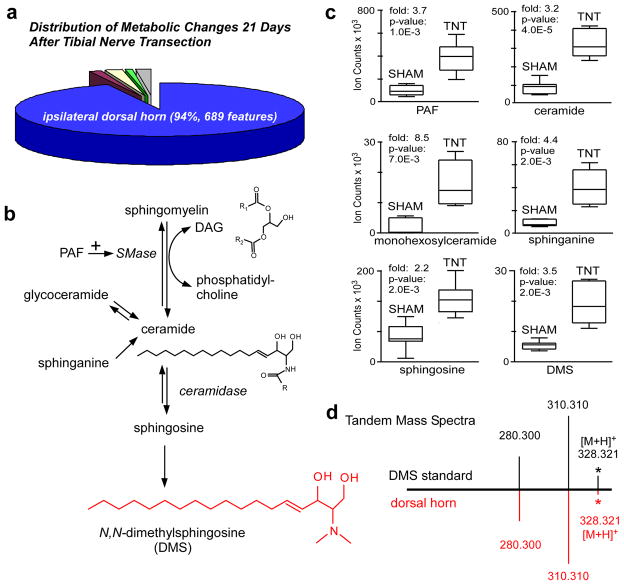
Untargeted metabolomics identifies the dysregulation of sphingomyelin-ceramide metabolism in the ipsilateral dorsal horn during chronic neuropathic pain. (a) Distribution of the 733 statistically significant molecular features (p<0.01) with changes greater than 2 fold that are altered in TNT relative to sham animals 21 days after injury (n=7 animals per group). The distribution of changes is: 94% ipsilateral dorsal horn (blue), 1% contralateral dorsal horn (purple), 2% ipsilateral dorsal root ganglia (yellow), 1% ipsilateral tibial nerve (green), and 2% plasma (grey). (b) The sphingomyelin-ceramide pathway, highlighting metabolites determined to be dysregulated. (c) Box-and-Whisker plots of altered sphingomyelin-ceramide metabolites in the ipsilateral dorsal horn after TNT. The intensities represent ion counts from extracted ion chromatograms. (d) Tandem mass spectra from DMS standard and m/z 328.321 from the dorsal horn show the same fragments and relative intensities.
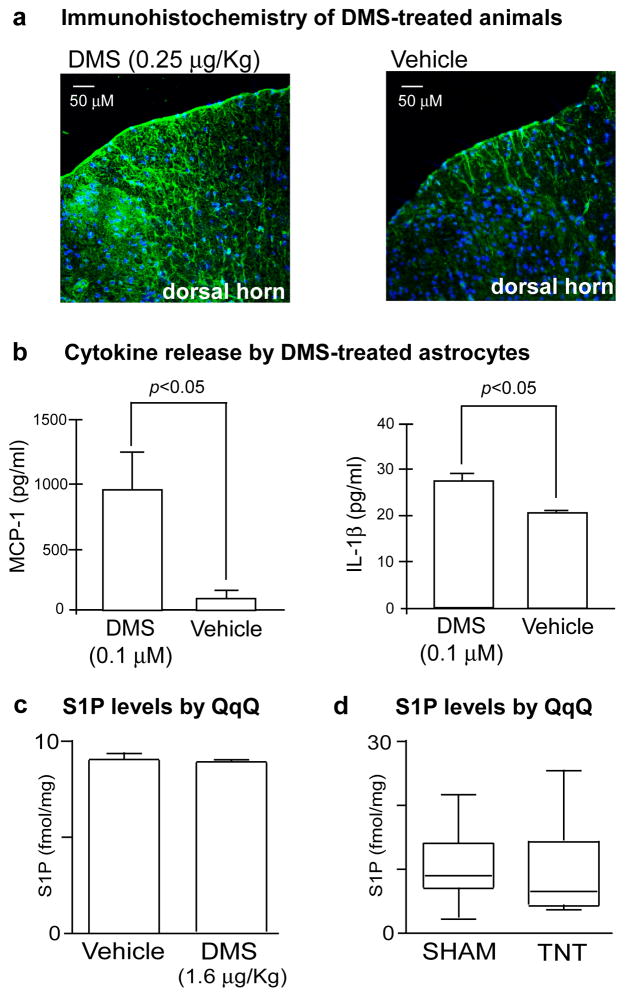
N,N-dimethylsphingosine (DMS) elicits neuropathic pain behavior and cytokine release. (a) Immunohistochemistry of the dorsal horn of rats intrathecally administered DMS at 0.25 μg/Kg (left) and vehicle (right) and stained with anti-glial fibrillary acidic protein (anti-GFAP) and a Alexa fluor 488 anti-rabbit IgG secondary antibody (green). Increased GFAP staining, a marker of astrocyte activation, is seen in the dorsal horn of DMS-treated rats relative to vehicle controls. (b) ELISAs of IL-1β and MCP-1 released into the supernatant of astrocyte cultures treated with DMS or vehicle. Cultures treated with 0.1 μM of DMS show a significant increase in IL-1β and MCP-1 release relative to vehicle controls. Data are expressed as mean ± SEM, with n=3 cultures per group. (c) Comparison of S1P levels in the dorsal horn of rats intrathecally administered DMS at 1.6 μg/Kg and vehicle control. S1P was measured by selective reaction monitoring triple quadrupole mass spectrometry (QqQ). S1P levels between the groups are not statistically different (n=4 animals per group). S1P levels are represented as fmol per mg of spinal cord tissue. (d) Comparison of S1P levels in the ipsilateral dorsal horn of sham control animals relative to animals suffering from TNT 21 days after injury. S1P levels between the groups are not statistically different (n=7 animals per group). S1P levels are represented as fmol per mg of spinal cord tissue.
Comment in
-
Metabolomics: Gaining insight into pain.Nat Rev Drug Discov. 2012 Mar 1;11(3):188-9. doi: 10.1038/nrd3685. Nat Rev Drug Discov. 2012. PMID: 22378263 No abstract available.
References
-
- Torrance N, Smith BH, Bennett MI, Lee AJ. The epidemiology of chronic pain of predominantly neuropathic origin. Results from a general population survey. J Pain. 2006;7:281–9. - PubMed
-
- Warfield CA, Fausett HJ. Manual of Pain Management. In: Warfield CA, Fausett HJ, editors. Manual of Pain Management. Lippincott Williams & Wilkins; Philadelphia: 2002.
-
- Woolf CJ, Mannion RJ. Neuropathic pain: aetiology, symptoms, mechanisms, and management. Lancet. 1999;353:1959–64. - PubMed
-
- Sung YJ, Ambron RT. Pathways that elicit long-term changes in gene expression in nociceptive neurons following nerve injury: contributions to neuropathic pain. Neurol Res. 2004;26:195–203. - PubMed
Publication types
MeSH terms
Substances
Grants and funding
- R24 EY017540-04/EY/NEI NIH HHS/United States
- P30 MH062261/MH/NIMH NIH HHS/United States
- UL1 RR025774/RR/NCRR NIH HHS/United States
- P01 DA026146/DA/NIDA NIH HHS/United States
- R01 CA112075/CA/NCI NIH HHS/United States
- L30 AG038036/AG/NIA NIH HHS/United States
- P01 DA026146-02/DA/NIDA NIH HHS/United States
- F32 NS068015/NS/NINDS NIH HHS/United States
- F32NS068015/NS/NINDS NIH HHS/United States
- L30 AG0 038036/AG/NIA NIH HHS/United States
- RR025774/RR/NCRR NIH HHS/United States
- T32 NS041219/NS/NINDS NIH HHS/United States
- R24 EY017540/EY/NEI NIH HHS/United States
LinkOut - more resources
Full Text Sources
Other Literature Sources
Medical
