. 2012 Apr;32(4):979-87.
doi: 10.1161/ATVBAHA.111.244053. Epub 2012 Jan 19.

Site-specific microRNA-92a regulation of Kruppel-like factors 4 and 2 in atherosusceptible endothelium

Affiliations

Site-specific microRNA-92a regulation of Kruppel-like factors 4 and 2 in atherosusceptible endothelium

Yun Fang et al. Arterioscler Thromb Vasc Biol. 2012 Apr.

Abstract

Objective: Endothelial transcription factors Krüppel-like factor 4 (KLF4) and KLF2 are implicated in protection against atherogenesis. Steady-state microRNA (miR) regulation of KLFs in vivo is accessible by screening region-specific endothelial miRs and their targets.

Methods and results: A subset of differentially expressed endothelial miRs was identified in atherosusceptible versus protected regions of normal swine aorta. In silico analyses predicted highly conserved binding sites in the 3'-untranslated region (3'UTR) of KLF4 for 5 miRs of the subset (miR-26a, -26b, -29a, -92a, and -103) and a single binding site for a miR-92a complex in the 3'UTR of KLF2. Of these, only miR-92a knockdown and knock-in resulted in responses of KLF4 and KLF2 expression in human arterial endothelial cells. Dual luciferase reporter assays demonstrated functional interactions of miR-92a with full-length 3'UTR sequences of both KLFs and with the specific binding elements therein. Two evolutionarily conserved miR-92a sites in KLF4 3'UTR and 1 site in KLF2 3'UTR were functionally validated. Knockdown of miR-92a in vitro resulted in partial rescue from cytokine-induced proinflammatory marker expression (monocyte chemotactic protein 1, vascular cell adhesion molecule-1, E-selectin, and endothelial nitric oxide synthase) that was attributable to enhanced KLF4 expression. Leukocyte-human arterial endothelial cell adhesion experiments supported this conclusion. In swine aortic arch endothelium, a site of atherosusceptibility where miR-92a expression was elevated, both KLFs were expressed at low levels relative to protected thoracic aorta.

Conclusions: miR-92a coregulates KLF4 and KLF2 expression in arterial endothelium and contributes to phenotype heterogeneity associated with regional atherosusceptibility and protection in vivo.


Conflict of interest statement

(c) The authors have no conflicts to disclose.

Figures
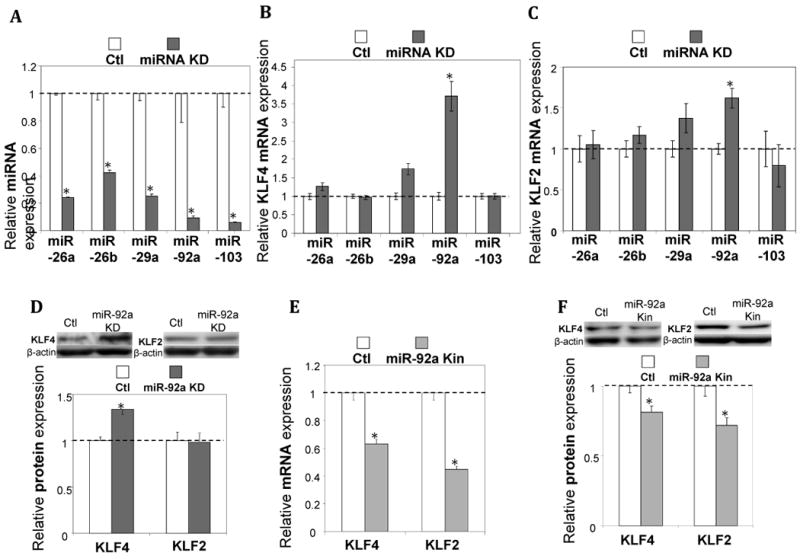
Figure 1
Figure 1
miR-92a regulation of endothelial KLF4 and KLF2. A-D: Knock-down of miRs (A) selectively influenced expression of KLF4/KLF2 mRNA (B, C) and protein (D) in HAECs (n=4-6). E, F: miR-92a knock-in suppressed expression of KLF4 and KLF2 in HAECs (n=4). Data represent mean ± SEM. *p < 0.05. KD: knock-down; Kin: knock-in.
Figure 2
Figure 2
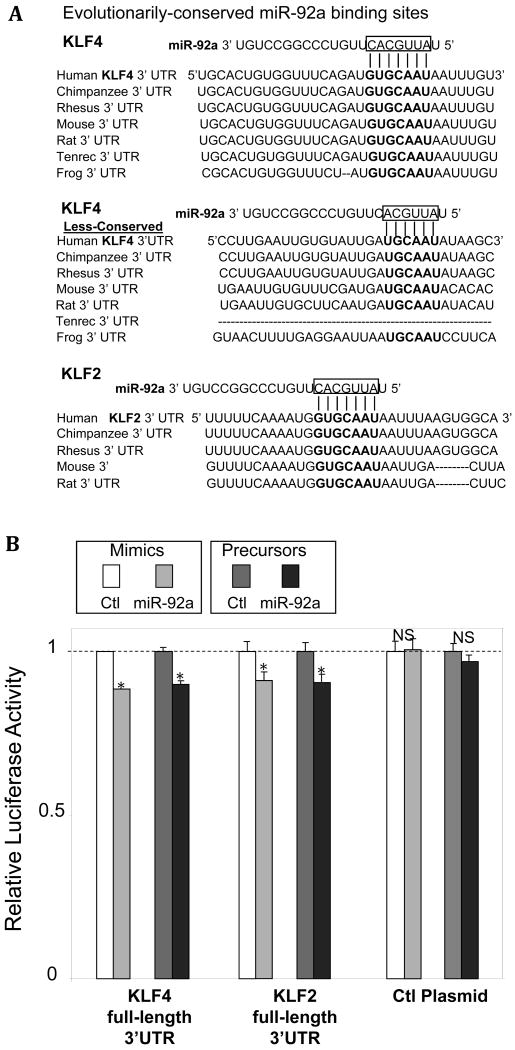
miR-92a targeting of the 3′ UTRs of KLF4 and KLF2. A: Evolutionarily-conserved putative miR-92a binding sites in 3′ UTRs of KLF4 and KLF2. B: Reduced luciferase activity in HEK293 cells overexpressing miR-92a mimetics or miR-92a precursors following insertion of the full-length 3′UTRs cloned from human KLF4 and KLF2 (n=4-5). Ctl plasmids express wild-type firefly luciferase without 3′ UTR insertions. Data represent mean ± SEM. *p < 0.05.
Figure 3
Figure 3
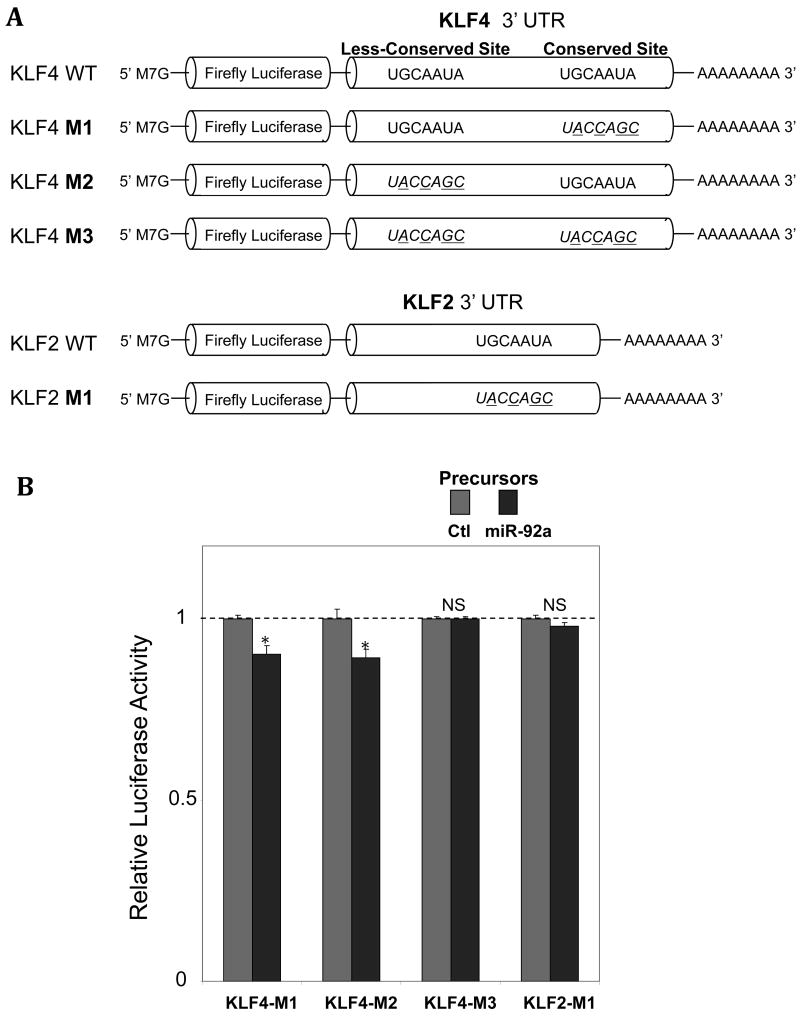
miR-92a negatively regulates KLF4 and KLF2 through the seed-pairing sequence(s) in the 3′UTR binding site(s). A: Schematic representation of the luciferase vectors containing the full-length 3′ UTR(s) of KLF4 and KLF2 and mutation(s) in the miR-92a seed-pairing site(s). B: Reduced luciferase activity in HEK293 cells overexpressing miR-92a precursors following insertion of the mutant clones (n=3-5). Data represent mean ± SEM. *p < 0.05.
Figure 4
Figure 4
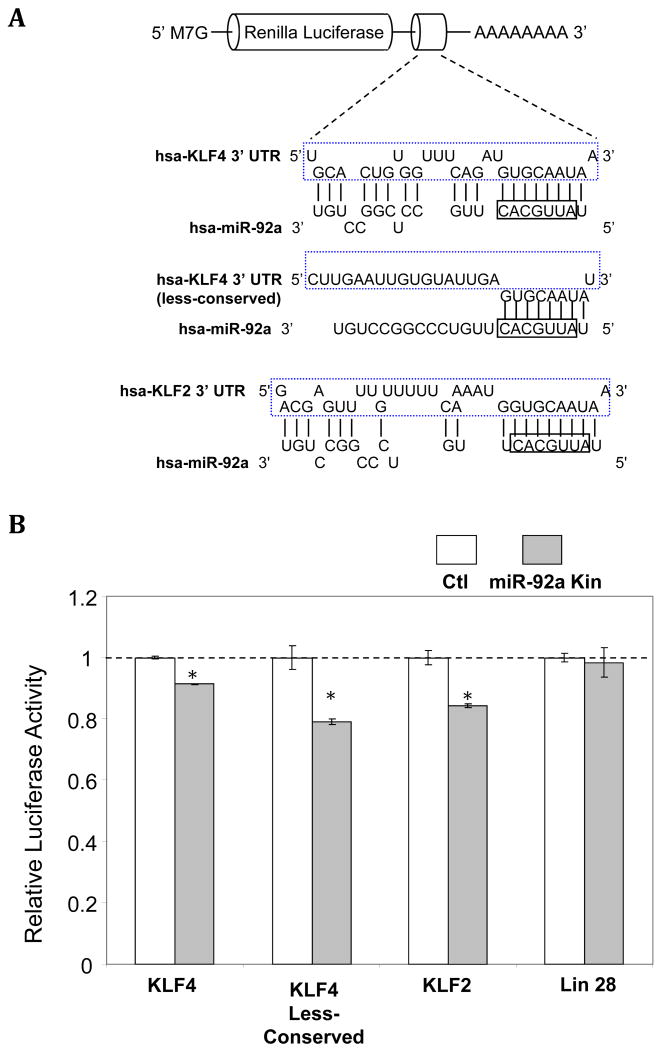
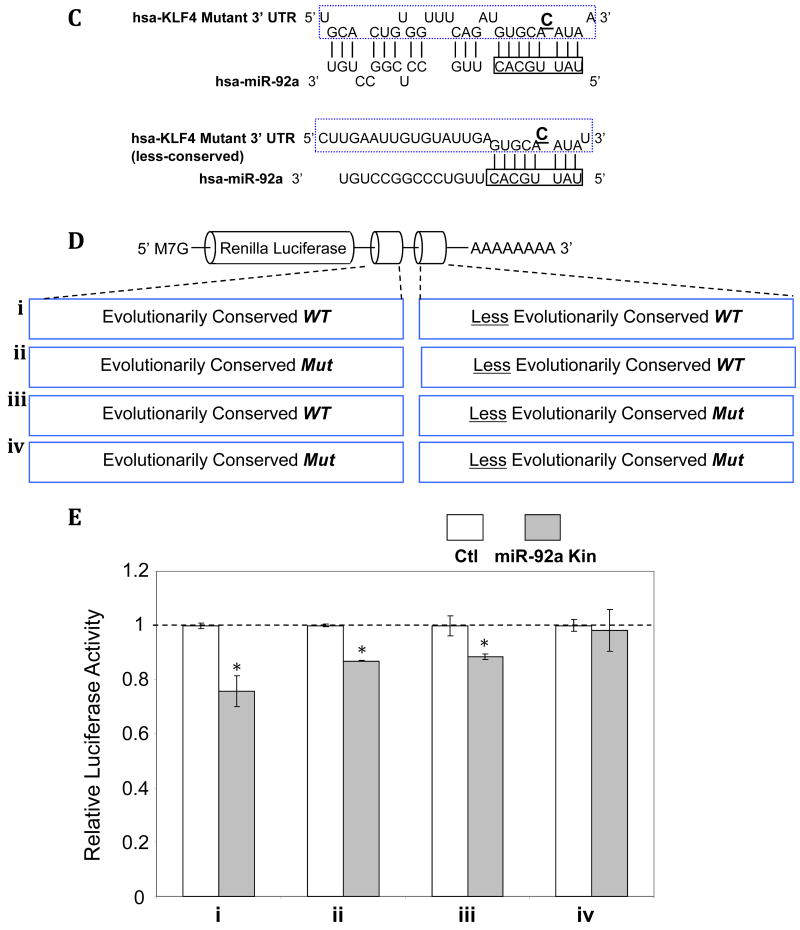
miR-92a negatively regulates KLF4 and KLF2 through the miR-92a recognition elements in the 3′UTR binding site(s). A: Schematic representation of the luciferase vectors containing the corresponding miR-92a binding sites. B: Reduced luciferase activity in HEK293 cells overexpressing miR-92a mimetics following insertion of miR-92a putative binding elements cloned from KLF4 and KLF2 3′ UTRs. Renilla luciferase inserted with putative let-7b binding sites, cloned from LIN-28 3′ UTR, served as negative control (n=3-5). *p < 0.05. C-E: Seed sequence-mediated regulation of KLF4 by miR-92a. C: Point mutations in the miR-92a binding elements that disrupt the interaction between miR-92a seed region and the 3′ UTR of KLF4. D: Schematic representation of the luciferase vectors containing the combinations of wild-type/mutated conserved and less-conserved miR-92a binding sites cloned from 3′ UTR of KLF4. E: Reduced luciferase activity in HEK293 cells overexpressing miR-92a following insertion of miR-92a binding elements cloned from wild-type conserved and less-conserved miR-92a binding sites (n=3-5). Data represent mean ± SEM. *p < 0.05.
Figure 4
Figure 4
miR-92a negatively regulates KLF4 and KLF2 through the miR-92a recognition elements in the 3′UTR binding site(s). A: Schematic representation of the luciferase vectors containing the corresponding miR-92a binding sites. B: Reduced luciferase activity in HEK293 cells overexpressing miR-92a mimetics following insertion of miR-92a putative binding elements cloned from KLF4 and KLF2 3′ UTRs. Renilla luciferase inserted with putative let-7b binding sites, cloned from LIN-28 3′ UTR, served as negative control (n=3-5). *p < 0.05. C-E: Seed sequence-mediated regulation of KLF4 by miR-92a. C: Point mutations in the miR-92a binding elements that disrupt the interaction between miR-92a seed region and the 3′ UTR of KLF4. D: Schematic representation of the luciferase vectors containing the combinations of wild-type/mutated conserved and less-conserved miR-92a binding sites cloned from 3′ UTR of KLF4. E: Reduced luciferase activity in HEK293 cells overexpressing miR-92a following insertion of miR-92a binding elements cloned from wild-type conserved and less-conserved miR-92a binding sites (n=3-5). Data represent mean ± SEM. *p < 0.05.
Figure 5
Figure 5
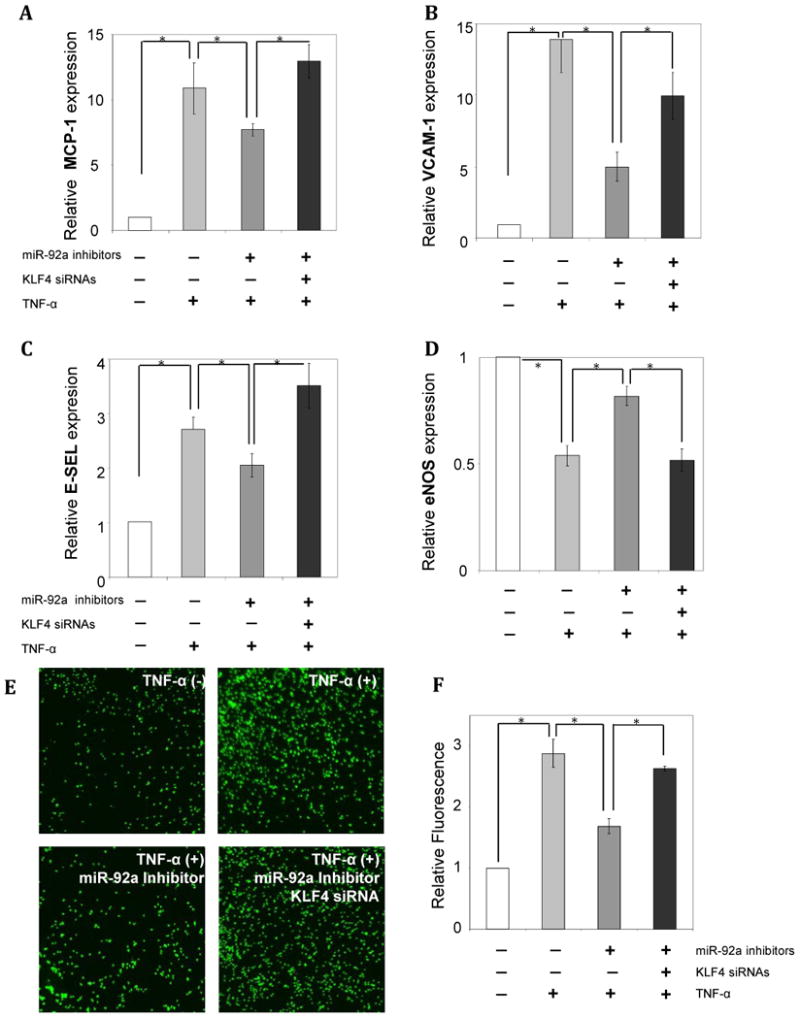
miR-92a primes endothelial inflammation by inhibiting athero-protective KLF4. A, B, C: Knockdown of endogenous miR-92a desensitizes the TNFα-induced inflammatory markers MCP-1 (A), VCAM-1 (B) and E-SEL (C). The rescue effect was reversed in cells in which both miR-92a and KLF4 (siRNA) were knocked-down (n=4). D: Rescue of TNFα-induced inhibition of eNOS in endothelial cells knockdown of endogenous miR-92a and reversal following knockdown of both miR-92a and KLF4 (n=4). E, F: Knockdown of endogenous miR-92a in HAECs decreases THP-1 cell adhesion to HAEC while simultaneous siRNA inhibition of KLF4 restores the level of leukocyte-endothelial interaction. Representative images of fluorescence-labeled THP-1 cells (E), and quantitative fluorescence measurements (F). n=4. Data represent mean ± SEM. *p < 0.05.
Figure 6
Figure 6
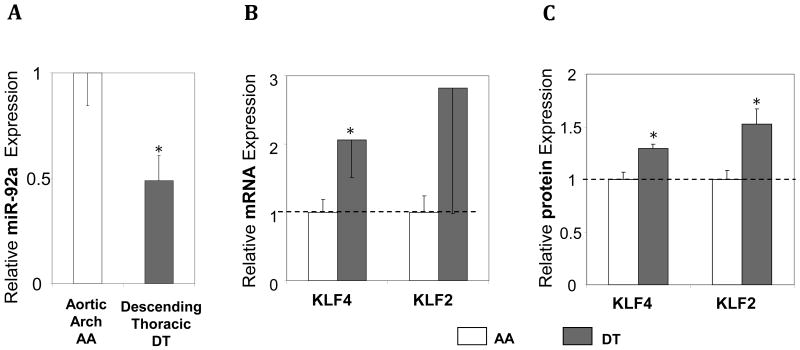
Endothelial expression of miR-92a, KLF4, and KLF2 in swine athero-susceptible aortic arch (AA) and athero-resistant descending thoracic aorta (DT). A: Low expression of endothelial miR-92a in DT referenced to AA (n=7-9). B, C: Increased expression of endothelial KLF4 and KLF2 mRNA (B) and protein (C) in DT aorta referenced to AA (n=7). Data represent mean ± SEM. *p < 0.05

Comment in

  • MiRrored regulation of KLF2 and KLF4.
    Hamik A, Jain MK. Hamik A, et al. Arterioscler Thromb Vasc Biol. 2012 Apr;32(4):839-40. doi: 10.1161/ATVBAHA.112.245563. Arterioscler Thromb Vasc Biol. 2012. PMID: 22423032 Free PMC article. No abstract available.

References

    1. Passerini AG, Polacek DC, Shi C, Francesco NM, Manduchi E, Grant GR, Pritchard WF, Powell S, Chang GY, Stoeckert CJ, Jr, Davies PF. Coexisting proinflammatory and antioxidative endothelial transcription profiles in a disturbed flow region of the adult porcine aorta. Proc Natl Acad Sci U S A. 2004;101:2482–2487. - PMC - PubMed
    1. Hajra L, Evans AI, Chen M, Hyduk SJ, Collins T, Cybulsky MI. The NF-kappa B signal transduction pathway in aortic endothelial cells is primed for activation in regions predisposed to atherosclerotic lesion formation. Proc Natl Acad Sci U S A. 2000;97:9052–9057. - PMC - PubMed
    1. Civelek M, Manduchi E, Riley RJ, Stoeckert CJ, Jr, Davies PF. Chronic endoplasmic reticulum stress activates unfolded protein response in arterial endothelium in regions of susceptibility to atherosclerosis. Circ Res. 2009;105:453–461. - PMC - PubMed
    1. Jongstra-Bilen J, Haidari M, Zhu SN, Chen M, Guha D, Cybulsky MI. Low-grade chronic inflammation in regions of the normal mouse arterial intima predisposed to atherosclerosis. J Exp Med. 2006;203:2073–2083. - PMC - PubMed
    1. Civelek M, Manduchi E, Riley RJ, Stoeckert CJ, Jr, Davies PF. Coronary artery endothelial transcriptome in vivo: identification of endoplasmic reticulum stress and enhanced reactive oxygen species by gene connectivity network analysis. Circ Cardiovasc Genet. 2011;4:243–252. - PMC - PubMed

Publication types

MeSH terms