. 2012 Apr;78(7):2200-12.
doi: 10.1128/AEM.07694-11. Epub 2012 Jan 20.

Cloning, Baeyer-Villiger biooxidations, and structures of the camphor pathway 2-oxo-Δ(3)-4,5,5-trimethylcyclopentenylacetyl-coenzyme A monooxygenase of Pseudomonas putida ATCC 17453

Affiliations

Cloning, Baeyer-Villiger biooxidations, and structures of the camphor pathway 2-oxo-Δ(3)-4,5,5-trimethylcyclopentenylacetyl-coenzyme A monooxygenase of Pseudomonas putida ATCC 17453

Hannes Leisch et al. Appl Environ Microbiol. 2012 Apr.

Abstract

A dimeric Baeyer-Villiger monooxygenase (BVMO) catalyzing the lactonization of 2-oxo-Δ(3)-4,5,5-trimethylcyclopentenylacetyl-coenzyme A (CoA), a key intermediate in the metabolism of camphor by Pseudomonas putida ATCC 17453, had been initially characterized in 1983 by Ougham and coworkers (H. J. Ougham, D. G. Taylor, and P. W. Trudgill, J. Bacteriol. 153:140-152, 1983). Here we cloned and overexpressed the 2-oxo-Δ(3)-4,5,5-trimethylcyclopentenylacetyl-CoA monooxygenase (OTEMO) in Escherichia coli and determined its three-dimensional structure with bound flavin adenine dinucleotide (FAD) at a 1.95-Å resolution as well as with bound FAD and NADP(+) at a 2.0-Å resolution. OTEMO represents the first homodimeric type 1 BVMO structure bound to FAD/NADP(+). A comparison of several crystal forms of OTEMO bound to FAD and NADP(+) revealed a conformational plasticity of several loop regions, some of which have been implicated in contributing to the substrate specificity profile of structurally related BVMOs. Substrate specificity studies confirmed that the 2-oxo-Δ(3)-4,5,5-trimethylcyclopentenylacetic acid coenzyme A ester is preferred over the free acid. However, the catalytic efficiency (k(cat)/K(m)) favors 2-n-hexyl cyclopentanone (4.3 × 10(5) M(-1) s(-1)) as a substrate, although its affinity (K(m) = 32 μM) was lower than that of the CoA-activated substrate (K(m) = 18 μM). In whole-cell biotransformation experiments, OTEMO showed a unique enantiocomplementarity to the action of the prototypical cyclohexanone monooxygenase (CHMO) and appeared to be particularly useful for the oxidation of 4-substituted cyclohexanones. Overall, this work extends our understanding of the molecular structure and mechanistic complexity of the type 1 family of BVMOs and expands the catalytic repertoire of one of its original members.


Figures
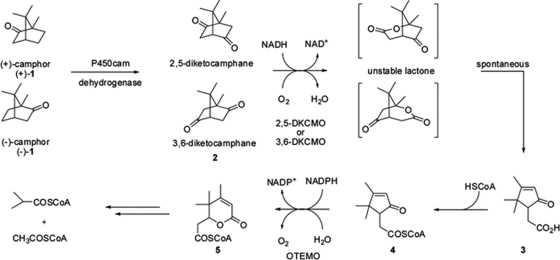
Fig 1
Fig 1
Catabolic steps of conversion of camphor isomers to acetyl-CoA and isobutyryl-CoA in Pseudomonas putida ATCC 17453. A cytochrome P450-containing enzyme complex (CamCAB) hydroxylates (+)- and (−)-camphor at the 5-exo position to produce 5-exo-hydroxycamphor; upon dehydrogenation (5-exo-hydroxycamphor dehydrogenase [CamD]), the respective diketocamphane is formed. Ring oxygen insertion by the FMN- and NADH-dependent 2,5-diketocamphane monooxygenase for (+)-camphor or 3,6-diketocamphane monooxygenase for (−)-camphor (type 2 BVMOs) produces an unstable lactone that presumably undergoes spontaneous hydrolysis to form 2-oxo-Δ3-4,5,5-trimethylcyclopentenylacetic acid (compound 3). The activation of compound 3 by a putative CoA synthetase produces 2-oxo-Δ3-4,5,5-trimethylcyclopentenylacetyl-CoA, a substrate for OTEMO (type 1 BVMO), the subject of this study. Cumulative data are from references , , and . COSCoA, carbonyl-CoA; HSCoA, acetyl-CoA.
Fig 2
Fig 2
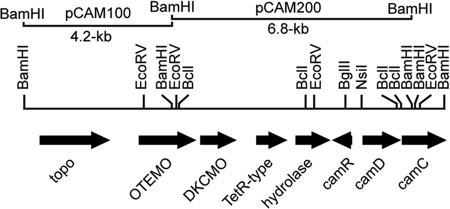
Localizations of the OTEMO-encoding gene and BamHI fragment subclones in an 11-kb region of P. putida ATCC 17453. The identified open reading frames are as follows, from left to right: putative DNA topoisomerase III (topo), OTEMO, 2,5-diketocamphane monooxygenase (DKCMO), a TetR-type regulator, lactone hydrolase, and a camR repressor that regulates the downstream camDCAB operon (camAB) (not shown) (5, 30).
Fig 3
Fig 3
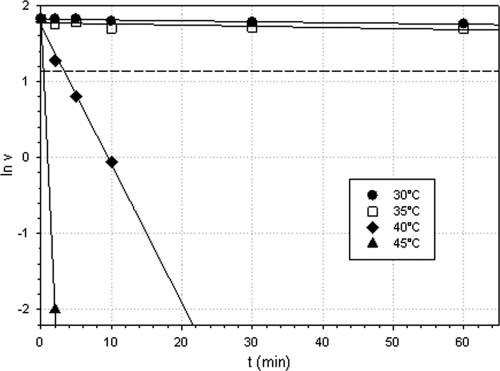
Thermostability of OTEMO. Denaturation constants (Kd) were used to calculate the enzyme's half-lives at the respective temperatures.
Fig 4
Fig 4
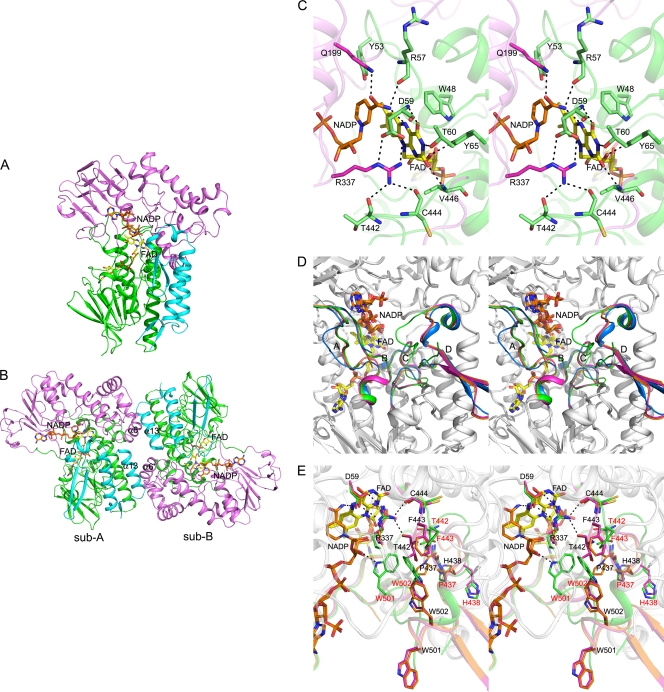
Crystal structure of OTEMO. (A) Overall structure of the OTEMO monomer, colored by domain, with the FAD-binding domain (residues 6 to 152 and 391 to 470) (green), NADP-binding domain (residues 153 to 390) (magenta), and flap domain (residues 471 to 545) (cyan) indicated. FAD (yellow carbon) and NADP (orange carbon) are shown in a stick representation. This and subsequent depictions of the OTEMO structure were prepared by using the program PyMol (http://www.pymol.org/). (B) Organization of the OTEMO dimer, with the same color scheme as that described above for panel A. The two α-helices, α6 and α13, involved in dimerization are labeled. (C) Stereo view of the FAD- and NADP-binding region within the OTEMO active site (type 1, as summarized in Table 5) (PDB accession number 3UOY). Key active-site residues are labeled. Domains of the OTEMO monomer are colored as described above for panel A. H bonds are shown as black dashed lines. (D) Stereo view of the superposition of different monomers obtained from different crystal forms/crystallization conditions, showing conformational flexibility in the structure. The four regions displaying variations are shown in different colors (types 1, 2, 3, and 4 are shown in blue, orange, magenta, and green, respectively; all other parts having the same conformations are shown in gray) and are indicated by the letters A (residues 145 to 152), B (residues 390 to 394), C (residues 435 to 444), and D (residues 497 to 518). (E) Stereo close-up view of the conformational flexibility of the active-site region shown in panel D. Residues that undergo significant movements are labeled in different colors.

References

    1. Adger B, et al. 1995. Application of enzymic Baeyer-Villiger oxidations of 2-substituted cycloalkanones to the total synthesis of R-(+)-lipoic acid. J. Chem. Soc. Chem. Commun. (Camb.) 1995:1563–1564
    1. Adger B, et al. 1997. The synthesis of R-(+)-lipoic acid using a monooxygenase-catalysed biotransformation as the key step. Bioorg. Med. Chem. 5:253–261 - PubMed
    1. Alphand V, Furstoss R, Pedragosa-Moreau S, Roberts SM, Willetts AJ. 1996. Comparison of microbiologically and enzymatically mediated Baeyer-Villiger oxidations: synthesis of optically active caprolactones. J. Chem. Soc. Perkin Trans. 1996:1867–1872
    1. Alphand V, Wohlgemuth R. 2010. Applications of Baeyer-Villiger monooxygenases in organic synthesis. Curr. Org. Chem. 14:1928–1965
    1. Aramaki H, Sagara Y, Hosoi M, Horiuchi T. 1993. Evidence for autoregulation of camR, which encodes a repressor for the cytochrome P-450cam hydroxylase operon on the Pseudomonas putida CAM plasmid. J. Bacteriol. 175:7828–7833 - PMC - PubMed

Publication types

MeSH terms

Substances

LinkOut - more resources