Practice patterns and opening pressure measurements using fluoroscopically guided lumbar puncture
- PMID: 22268077
- PMCID: PMC7968814
- DOI: 10.3174/ajnr.A2876
Practice patterns and opening pressure measurements using fluoroscopically guided lumbar puncture
Abstract
Background and purpose: Evidenced-based protocols for fluoroscopically guided LP do not exist. This study analyzed the fluoroscopically guided LP techniques currently used by practicing neuroradiologists.
Materials and methods: An anonymous Web-based survey was e-mailed to members of ASNR. The results were compiled and tabulated on a spreadsheet.
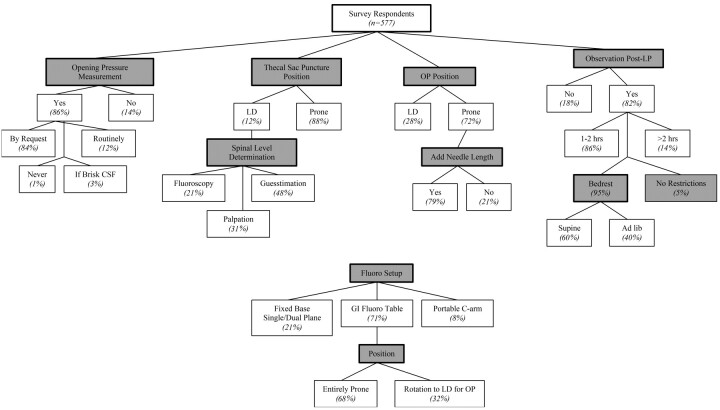
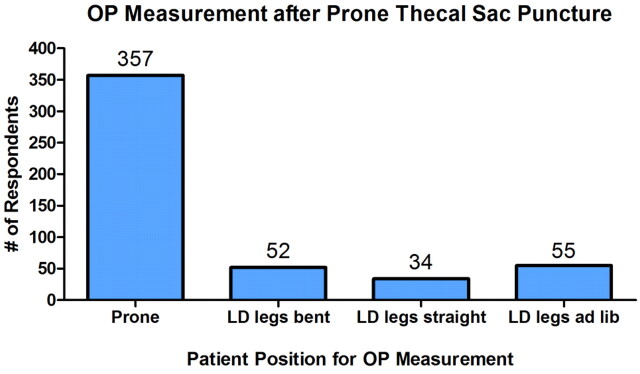
Results: A total of 577 neuroradiologists completed the survey. Most neuroradiologists perform fluoroscopically guided LPs with the patient in the prone position by using a 22-ga needle at the L2-L3 or L3-L4 intervertebral space. The OP measurement technique is quite variable. Only a minority of patients are rotated to the left LD position for OP measurement. Most neuroradiologists observe patients for 1-2 hours after the procedure and require strict bed rest.
Conclusions: Most neuroradiologists have similar protocols for thecal sac puncture. Normative adult OP data exist only for the LD position, and the accuracy of prone OP measurements is not known. We found that the OP measurement technique is not consistent and a standard protocol is warranted.
Figures
References
-
- ACR-ASNR Practice Guidelines for the Performance of Myelography and Cisternography. 2008. http://www.acr.org/SecondaryMainMenuCategories/quality_safety/guidelines.... Accessed May 1, 2011.
-
- Euerle BD. Spinal puncture and cerebrospinal fluid examination. In: Roberts JR, Hedges JR. eds. Clinical Procedures in Emergency Medicine. 5th ed. Philadelphia: Saunders/Elsevier; 2010:1107–27
-
- Abbrescia KL, Brabson TA, Dalsey WC, et al. , for the Lumbar Puncture Study Group The effect of lower-extremity position on cerebrospinal fluid pressures. Acad Emerg Med 2001;8:8–12 - PubMed
-
- Ellis R. Lumbar cerebrospinal fluid opening pressure measured in a flexed lateral decubitus position in children. Pediatrics 1994;93:622–23 - PubMed
Publication types
MeSH terms
LinkOut - more resources
Full Text Sources
Research Materials
Miscellaneous