. 2012 May 1;302(9):G979-96.
doi: 10.1152/ajpgi.00370.2011. Epub 2012 Jan 19.

Bile acids via FXR initiate the expression of major transporters involved in the enterohepatic circulation of bile acids in newborn mice

Affiliations

Bile acids via FXR initiate the expression of major transporters involved in the enterohepatic circulation of bile acids in newborn mice

Julia Yue Cui et al. Am J Physiol Gastrointest Liver Physiol. .

Abstract

The enterohepatic circulation (EHC) of bile acids (BAs) plays a pivotal role in facilitating lipid absorption. Therefore, initiation of the EHC in newborns is of crucial importance for lipid absorption from milk. The purpose of this study was to determine at what age BA transporters in liver are expressed, and the mechanism for their initiation. Serum and liver samples were collected from C57BL/6 mice at 2 days before birth and various postnatal ages. Messenger RNA assays revealed a dramatic increase at birth in the expression of the BA transporters (Ntcp, Bsep, Mrp4, Ostβ), as well as the phospholipid floppase Mdr2 in mouse liver, with the highest expression at 1 day of age. The mRNA expression of the ileal BA transporters (Ostα and Ostβ) also markedly increased at birth. Meanwhile, taurine-conjugated cholic acid markedly increased in both serum and liver of newborns, correlated with upregulation of the classic pathway of BA biosynthesis in newborn liver. The mRNA levels of the major BA sensors, FXR and PXR, were increased at 1 day of age, and their prototypical target genes were upregulated in liver. The mRNA expression of transporters involved in the EHC of BAs was similar in wild-type and PXR-null mice. In contrast, in FXR-null mice, the "day 1 surge" pattern of Ntcp, Bsep, Ostβ, and Mdr2 was blocked in newborn mouse liver, and the induction of Ostα and Ostβ was also abolished in ileums of FXR-null mice. In conclusion, at birth, BAs from the classic pathway of synthesis trigger the induction of transporters involved in EHC of BAs in mice, through activation of the nuclear receptor FXR.


Figures
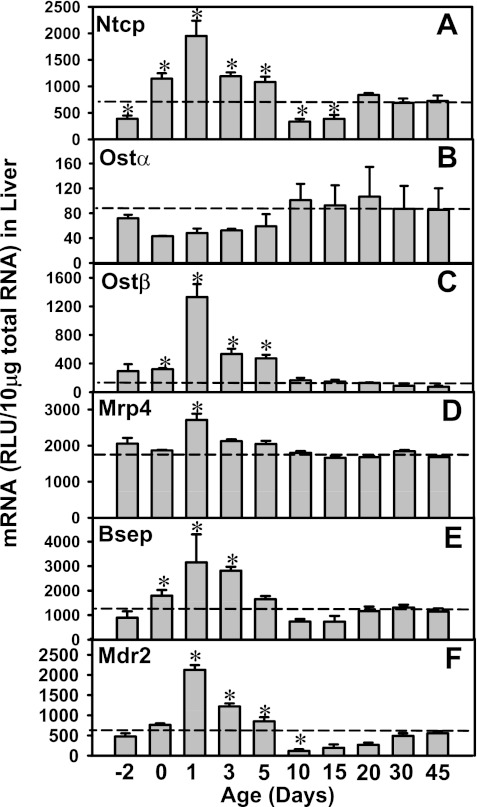
Fig. 1.
Fig. 1.
Ontogeny of liver transporters: sodium taurocholate cotransporting polypeptide (Ntcp; basolateral uptake), organic solute transporter (Ost)α, Ostβ, multidrug resistance-associated protein 4 (Mrp4; basolateral efflux), bile salt export pump (Bsep), and multidrug resistance protein 2 (Mdr2; canalicular efflux) in wild-type mice from 2 days before birth to 45 days of age. Total RNA was isolated from liver at each age and analyzed by the bDNA assay as described in materials and methods. Data are presented as mean relative light units (RLU) ± SE (n = 5 animals). *Significant differences (P < 0.05) compared with values at 45 days of age.
Fig. 2.
Fig. 2.
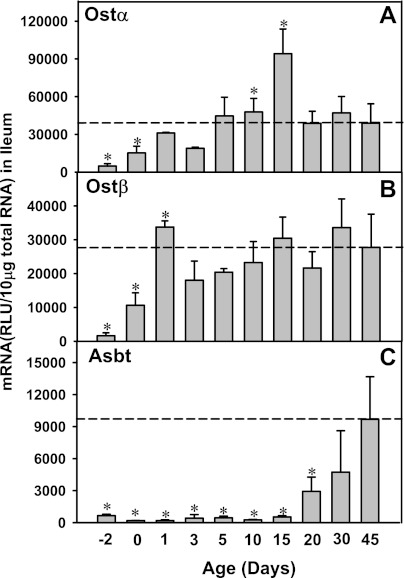
Ontogeny of ileal transporters: Ostα and Ostβ (basolateral efflux) and Asbt (apical uptake) in wild-type mice from 2 days before birth to 45 days of age. Total RNA was isolated from ileum at each age and analyzed by the bDNA assay as described in materials and methods. Data are presented as mean RLU ± SE (n = 5 animals). *Significant differences (P < 0.05) compared with values at 45 days of age.
Fig. 3.
Fig. 3.
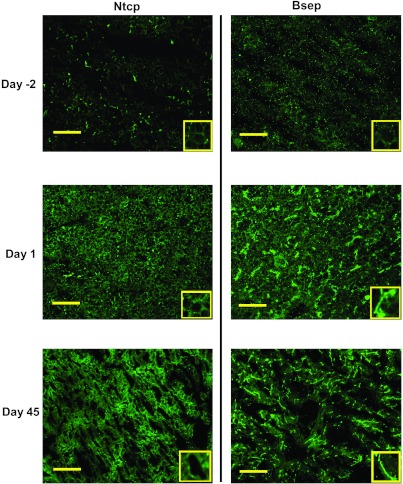
Immunofluorescence of Ntcp and Bsep protein in livers from 2 days before birth, 1 day, and 45 days of age. Immunofluorescence against basolateral Ntcp as well as canalicular Bsep (green) was conducted on liver cryosections as described in materials and methods. Portions of images were enlarged and provided as insets. Representative images are shown. Bar = 50 μm.
Fig. 4.
Fig. 4.
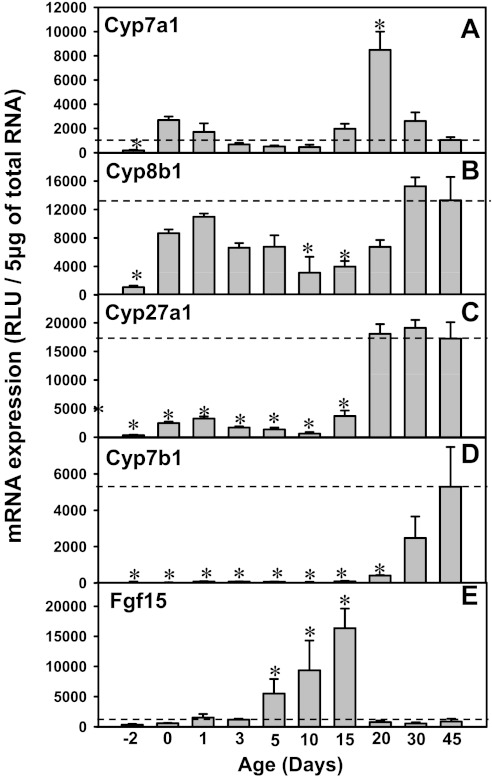
A–D: messenger RNA of bile acid (BA) synthesizing enzymes (Cyp7a1, 8b1, 27a1, and 7b1) in livers of wild-type mice during development. E: ontogeny of the mRNA expression of ileal fibroblast growth factor 15 (Fgf15) and in wild-type mice. Total RNA was isolated from liver at each age and analyzed as described in materials and methods. Individual samples (n = 5) were analyzed by bDNA assay. Data are presented as mean RLU normalized to 5 μg total RNA.
Fig. 5.
Fig. 5.
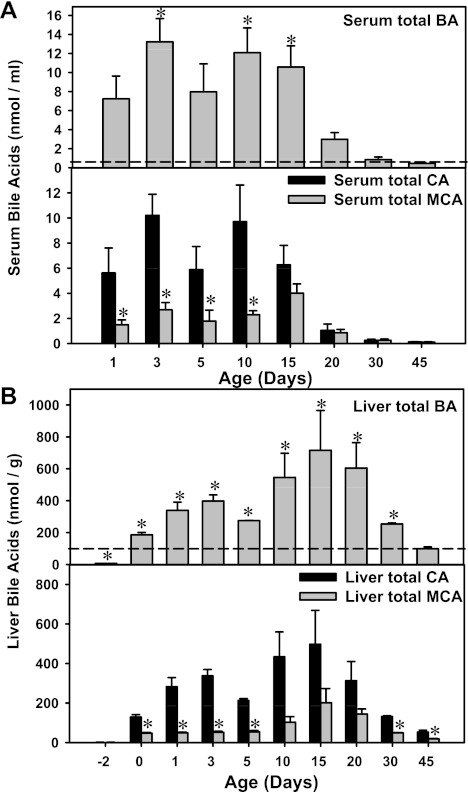
A: serum total BA concentrations (top) as well as concentrations of total cholic acid (CA; taurine-conjugated CA and unconjugated CA) and total muricholic acid (TαMCA, TβMCA, αMCA, and βMCA; bottom) during development (n = 3 per age). The ωMCA was excluded because it is a secondary BA. B: liver total BA concentrations (top) as well as concentrations of total CA (taurine-conjugated CA and unconjugated CA) and total primary muricholic acid (TαMCA, TβMCA, αMCA, and βMCA) during development (n = 3 per age). BAs from serum and liver were quantified by LC-MS/MS as described in materials and methods. For serum, data are expressed as nmol of BAs per ml. For liver, data are expressed as nmol/g. A and B, top: *signfificant differernces (P < 0.05) compared with levels at 45 days of age. A and B, bottom: *significant differences (P < 0.05) between total CA and MCA concentrations at the same age.
Fig. 6.
Fig. 6.
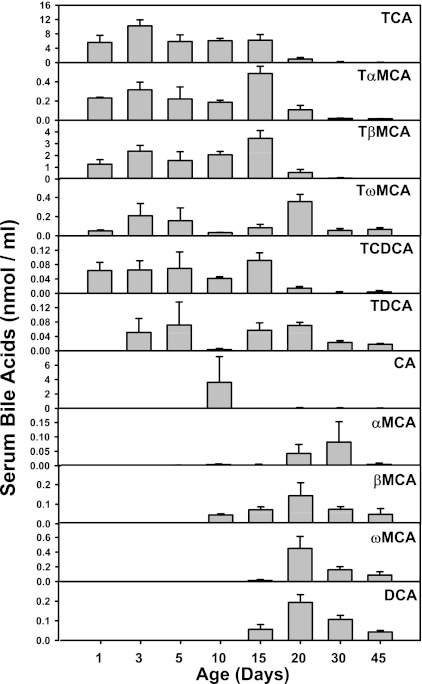
Serum unconjugated BA concentrations during development (n = 3 per age). BAs from serum were quantified by LC-MS/MS as described in materials and methods. Data are expressed as nmol of BAs per ml.
Fig. 7.
Fig. 7.
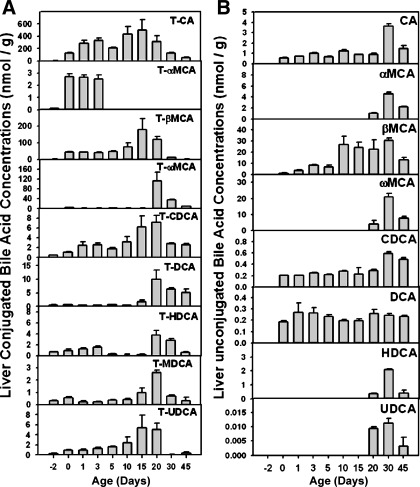
Liver conjugated (A) and unconjugated (B) BA concentrations during development (n = 3 per age). BAs from liver were quantified by LC-MS/MS as described in materials and methods. Data are expressed as nmol/g.
Fig. 8.
Fig. 8.
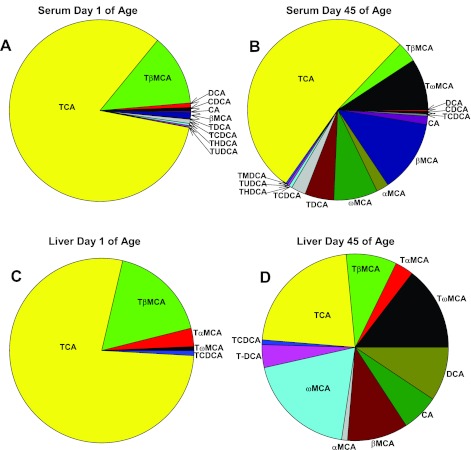
Percentage of various components of BAs in serum (A and B) and liver (C and D) at day 1 (A and C) and 45 days of age (B and D). BAs were quantified by LC-MS/MS as described in materials and methods.
Fig. 9.
Fig. 9.
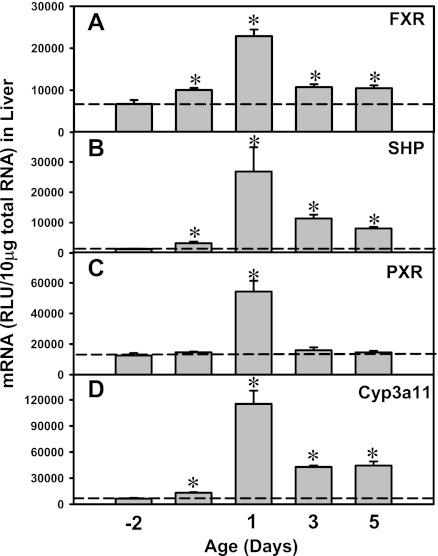
Upregulation of the mRNA expression of Farnesoid X Receptor (FXR), SHP (prototypical target gene of FXR), Pregnane X Receptor (PXR), and Cyp3a11 (prototypical target gene of PXR) in neonatal wild-type mouse livers. Total RNA was isolated from liver at each age and analyzed by the bDNA assay as described in materials and methods. Data are presented as mean RLU ± SE (n = 5 animals). *Significant differences (P < 0.05) compared with values at day −2 of age.
Fig. 10.
Fig. 10.
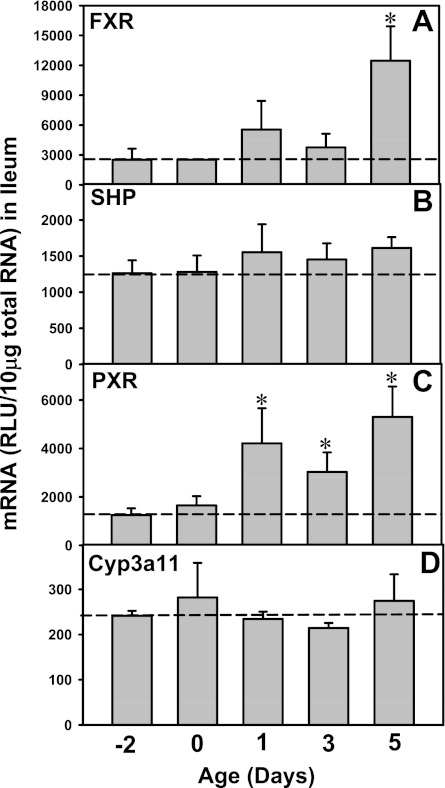
Messenger RNA expression of FXR, SHP (prototypical target gene of FXR), PXR, and Cyp3a11 (prototypical target gene of PXR) in neonatal wild-type mouse ileum. Total RNA was isolated from ileum at each age and analyzed by the bDNA assay as described in materials and methods. Data are presented as mean RLU ± SE (n = 5 animals). *Significant differences (P < 0.05) compared with values at day −2 of age.
Fig. 11.
Fig. 11.
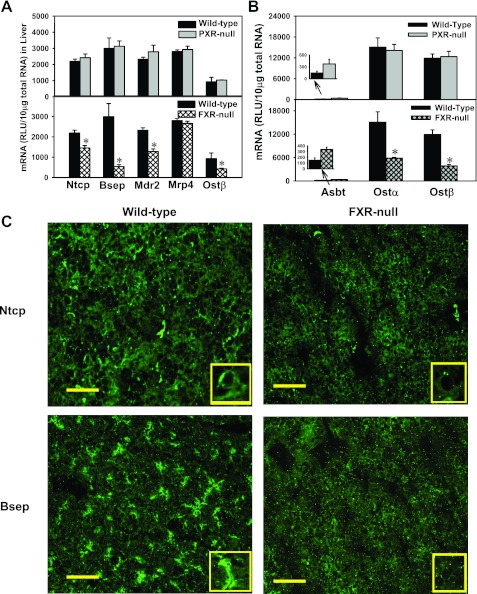
A: mRNA expression of liver transporters Ntcp, Bsep, Mdr2, Mrp4, and Ostβ in wild-type, PXR-null (top), and FXR-null mice (bottom) at 1 day of age. B: mRNA expression of ileal transporters Asbt, Ostα, and Ostβ in wild-type, PXR-null (top), and FXR-null mice (bottom) at 1 day of age. C: immunofluorescence of Ntcp and Bsep protein in livers from wild-type and FXR-null mice at 1 day of age. Immunofluorescence against basolateral Ntcp protein as well as canalicular Bsep (green) was conducted on liver cryosections as described in materials and methods. Portions of images were enlarged and provided as insets. Representative images are shown. Bar = 50 μm.
Fig. 12.
Fig. 12.
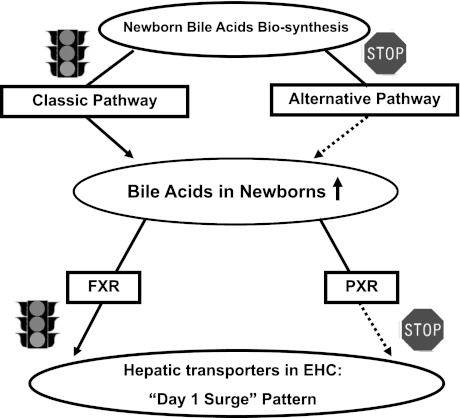
Schematic of the working hypothesis for the molecular mechanisms underlying the neonatal induction of hepatic transporters involved in enterohepatic circulation (EHC).
Fig. 13.
Fig. 13.
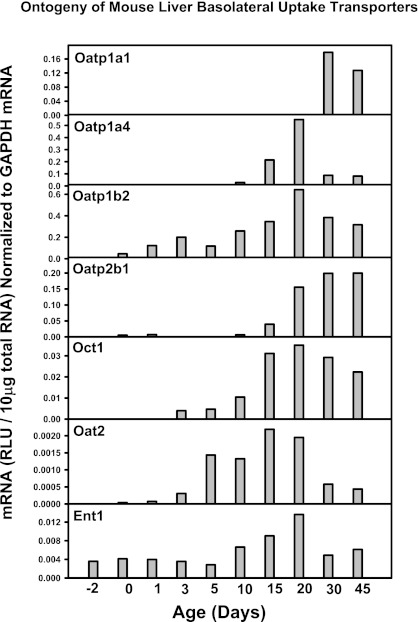
mRNA ontogeny of mouse liver basolateral uptake transporters.
Fig. 14.
Fig. 14.
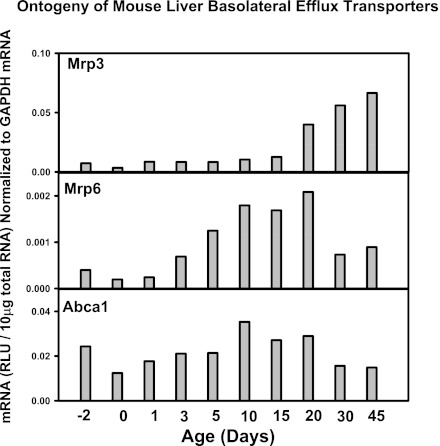
mRNA ontogeny of mouse liver basolateral efflux transporters.
Fig. 15.
Fig. 15.
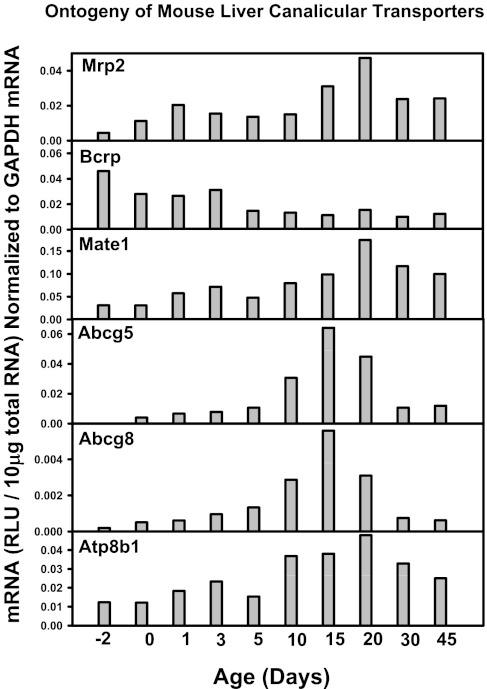
mRNA ontogeny of mouse liver canalicular transporters.
Fig. 16.
Fig. 16.
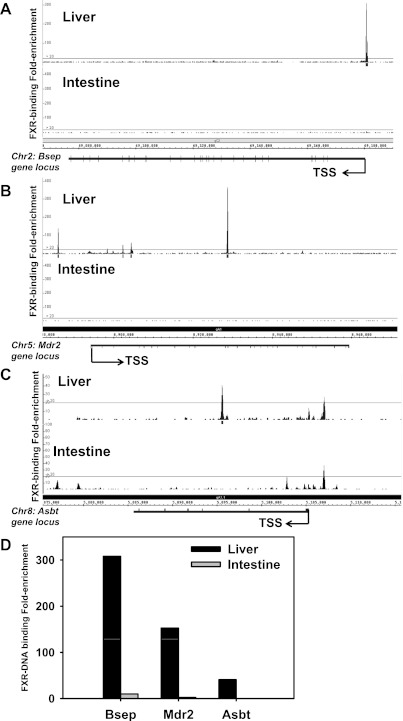
Location and fold enrichment of FXR binding to the gene loci of Bsep (A), Mdr2 (B), and Asbt (C) in adult mouse liver and intestine. Threshold for positive FXR enrichment: average peak value >20-fold based on calculation of false discovery rate (FDR). Images were generated by integrated genome browser. D: overall FXR DNA binding fold enrichment in livers and intestines of adult mice for these 3 genes.
Fig. 17.
Fig. 17.
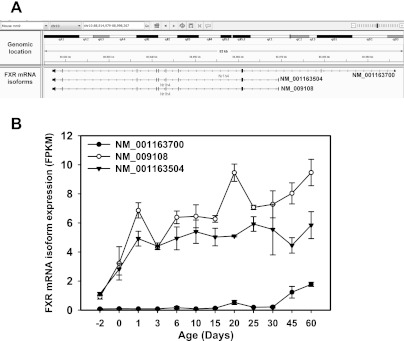
A: genomic location of the 3 known FXR transcript variants in mice. B: ontogeny of the 3 known FXR transcript variants during liver development in mice.
Fig. 18.
Fig. 18.
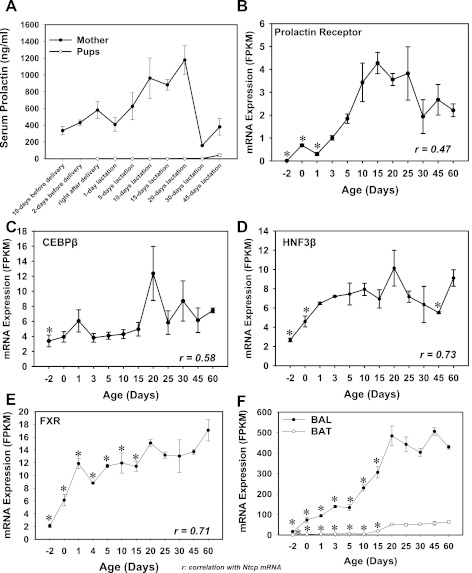
A: serum prolactin concentrations in mother and the male pups (n = 5) at various time points from before birth to postweaning. Prolactin was quantified using a radioimmunoassay (RIA; I125). B–F: mRNA ontogeny of prolactin receptor (B), CEBPβ (C), HNF3β (D), FXR (E), as well as BAL and BAT (F) during liver development in mice (n = 5 per age, male only). Data are represented as means ± SE. *Statistically significant differences compared with 60 days of age.
Fig. 19.
Fig. 19.
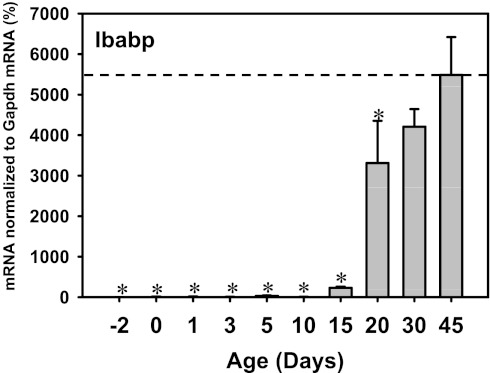
Ontogeny of Ibabp mRNA in ilea of mice (n = 3 per age, male only). Data are represented as means ± SE. *Statistically significant differences compared with 45 days of age.

References

    1. Aleksunes LM, Slitt AM, Cherrington NJ, Thibodeau MS, Klaassen CD, Manautou JE. Differential expression of mouse hepatic transporter genes in response to acetaminophen and carbon tetrachloride. Toxicol Sci 83: 44–52, 2005 - PubMed
    1. Alnouti Y, Csanaky IL, Klaassen CD. Quantitative-profiling of bile acids and their conjugates in mouse liver, bile, plasma, and urine using LC-MS/MS. J Chromatogr B Analyt Technol Biomed Life Sci 873: 209–217, 2008 - PMC - PubMed
    1. Arrese M, Trauner M, Ananthanarayanan M, Boyer JL, Suchy FJ. Maternal cholestasis does not affect the ontogenic pattern of expression of the Na+/taurocholate cotransporting polypeptide (ntcp) in the fetal and neonatal rat liver. Hepatology 28: 789–795, 1998 - PubMed
    1. Assem M, Schuetz EG, Leggas M, Sun D, Yasuda K, Reid G, Zelcer N, Adachi M, Strom S, Evans RM, Moore DD, Borst P, Schuetz JD. Interactions between hepatic Mrp4 and Sult2a as revealed by the constitutive androstane receptor and Mrp4 knockout mice. J Biol Chem 279: 22250–22257, 2004 - PubMed
    1. Ballatori N, Christian WV, Lee JY, Dawson PA, Soroka CJ, Boyer JL, Madejczyk MS, Li N. OSTalpha-OSTbeta: a major basolateral bile acid and steroid transporter in human intestinal, renal, and biliary epithelia. Hepatology 42: 1270–1279, 2005 - PubMed

Publication types

Substances

LinkOut - more resources