A randomized controlled trial of positive-affect intervention and medication adherence in hypertensive African Americans
- PMID: 22269592
- PMCID: PMC4669680
- DOI: 10.1001/archinternmed.2011.1307
A randomized controlled trial of positive-affect intervention and medication adherence in hypertensive African Americans
Abstract
Background: Poor adherence explains poor blood pressure (BP) control; however African Americans suffer worse hypertension-related outcomes.
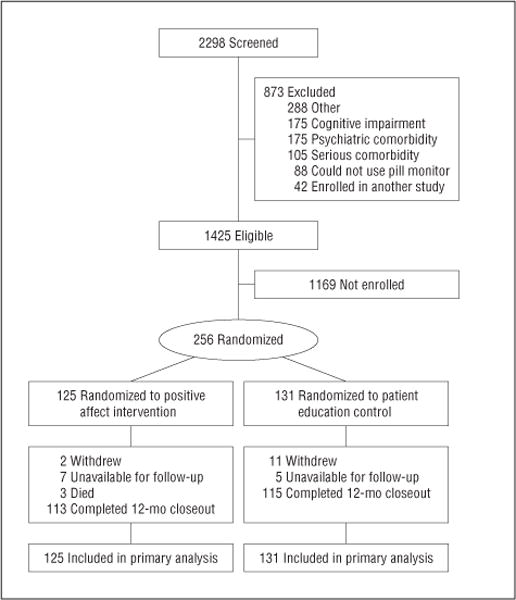
Methods: This randomized controlled trial evaluated whether a patient education intervention enhanced with positive-affect induction and self-affirmation (PA) was more effective than patient education (PE) alone in improving medication adherence and BP reduction among 256 hypertensive African Americans followed up in 2 primary care practices. Patients in both groups received a culturally tailored hypertension self-management workbook, a behavioral contract, and bimonthly telephone calls designed to help them overcome barriers to medication adherence. Also, patients in the PA group received small gifts and bimonthly telephone calls to help them incorporate positive thoughts into their daily routine and foster self-affirmation. The main outcome measures were medication adherence (assessed with electronic pill monitors) and within-patient change in BP from baseline to 12 months.
Results: The baseline characteristics were similar in both groups: the mean BP was 137/82 mm Hg; 36% of the patients had diabetes; 11% had stroke; and 3% had chronic kidney disease. Based on the intention-to-treat principle, medication adherence at 12 months was higher in the PA group than in the PE group (42% vs 36%, respectively; P =.049). The within-group reduction in systolic BP (2.14 mm Hg vs 2.18 mm Hg; P = .98) and diastolic BP (-1.59 mm Hg vs -0.78 mm Hg; P = .45) for the PA group and PE group, respectively, was not significant.
Conclusions: A PE intervention enhanced with PA led to significantly higher medication adherence compared with PE alone in hypertensive African Americans. Future studies should assess the cost-effectiveness of integrating such interventions into primary care. Trial Registration clinicaltrials.gov Identifier: NCT00227175.
Figures
Comment in
-
On motivating patients: a picture, even if worth a thousand words, is not enough.Arch Intern Med. 2012 Feb 27;172(4):309-10. doi: 10.1001/archinternmed.2011.1948. Epub 2012 Jan 23. Arch Intern Med. 2012. PMID: 22269591 No abstract available.
-
Positive affect and self-affirmation are beneficial, but do they facilitate maintenance of health-behavior change? A self-determination theory perspective: comment on "a randomized controlled trial of positive-affect intervention and medication adherence in hypertensive African Americans".Arch Intern Med. 2012 Feb 27;172(4):327-8. doi: 10.1001/archinternmed.2011.1830. Epub 2012 Jan 23. Arch Intern Med. 2012. PMID: 22269594 No abstract available.
References
-
- Mensah GA, Mokdad AH, Ford ES, Greenlund KJ, Croft JB. State of disparities in cardiovascular health in the United States. Circulation. 2005;111(10):1233–1241. - PubMed
-
- Wong MD, Shapiro MF, Boscardin WJ, Ettner SL. Contribution of major diseases to disparities in mortality. N Engl J Med. 2002;347(20):1585–1592. - PubMed
-
- Bosworth HB, Dudley T, Olsen MK, et al. Racial differences in blood pressure control: potential explanatory factors. Am J Med. 2006;119(1):70, e9–e15. - PubMed
-
- Ho PM, Rumsfeld JS, Masoudi FA, et al. Effect of medication nonadherence on hospitalization and mortality among patients with diabetes mellitus. Arch Intern Med. 2006;166(17):1836–1841. - PubMed