


Spine stabilisation exercises in the treatment of chronic low back pain: a good clinical outcome is not associated with improved abdominal muscle function
- PMID: 22270245
- PMCID: PMC3389103
- DOI: 10.1007/s00586-012-2155-9
Spine stabilisation exercises in the treatment of chronic low back pain: a good clinical outcome is not associated with improved abdominal muscle function
Abstract
Introduction: Various studies have shown that spine stabilisation exercise therapy elicits improvements in symptoms/disability in patients with chronic non-specific low back pain (cLBP). However, few have corroborated the intended mechanism of action by examining whether clinical improvements (1) are greater in patients with functional deficits of the targeted muscles and (2) correlate with post-treatment improvements in abdominal muscle function.
Methods: Pre and directly after 9 weeks' therapy, 32 cLBP patients (44.0 ± 12.3 years) rated their LBP intensity (0-10) and disability (0-24, Roland-Morris; RM) and completed psychological questionnaires. At the same timepoints, the voluntary activation of transversus abdominis (TrA), obliquus internus and obliquus externus during "abdominal-hollowing" and the anticipatory ("feedforward") activation of these muscles during rapid arm movements were measured using M-mode ultrasound with tissue Doppler imaging.
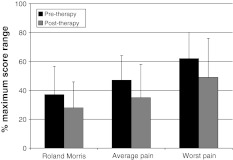
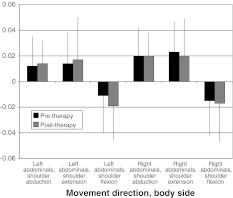
Results: Pre-therapy to post-therapy, RM decreased from 8.9 ± 4.7 to 6.7 ± 4.3, and average pain, from 4.7 ± 1.7 to 3.5 ± 2.3 (each P < 0.01). The ability to voluntarily activate TrA increased by 4.5% (P = 0.045) whilst the anticipatory activation of the lateral abdominal muscles showed no significant change (P > 0.05). There was no significant correlation between the change in RM scores after therapy and either baseline values for voluntary (r = 0.24, P = 0.20) or anticipatory activation (r = 0.04, P = 0.84), or their changes after therapy (voluntary, r = 0.08, P = 0.66; anticipatory, r = 0.16, P = 0.40). In multiple regression, only a reduction in catastrophising (P = 0.0003) and in fingertip-floor distance (P = 0.0006) made unique contributions to explaining the variance in the reduction in RM scores.
Conclusion: Neither baseline lateral abdominal muscle function nor its improvement after a programme of stabilisation exercises was a statistical predictor of a good clinical outcome. It is hence difficult to attribute the therapeutic result to any specific effects of the exercises on these trunk muscles. The association between changes in catastrophising and outcome serves to encourage further investigation on larger groups of patients to clarify whether stabilisation exercises have some sort of "central" effect, unrelated to abdominal muscle function per se.
Figures
References
-
- Airaksinen O, Brox JI, Cedraschi C, Hildebrandt J, Klaber-Moffett J, Kovacs F, Mannion AF, Reis S, Staal JB, Ursin H, Zanoli G, et al. Chapter 4. European guidelines for the management of chronic nonspecific low back pain. Eur Spine J. 2006;15(Suppl 2):S192–S300. doi: 10.1007/s00586-006-1072-1. - DOI - PMC - PubMed
-
- Allison GT, Morris SL, Lay B. Feedforward responses of transversus abdominis are directionally specific and act asymmetrically: implications for core stability theories. J Orthop Sports Phys Ther. 2008;38:228–237. - PubMed
Publication types
MeSH terms
LinkOut - more resources
Full Text Sources
Miscellaneous
