


Review physical and chemical aspects of stabilization of compounds in silk
- PMID: 22270942
- PMCID: PMC4527307
- DOI: 10.1002/bip.22026
Review physical and chemical aspects of stabilization of compounds in silk
Abstract
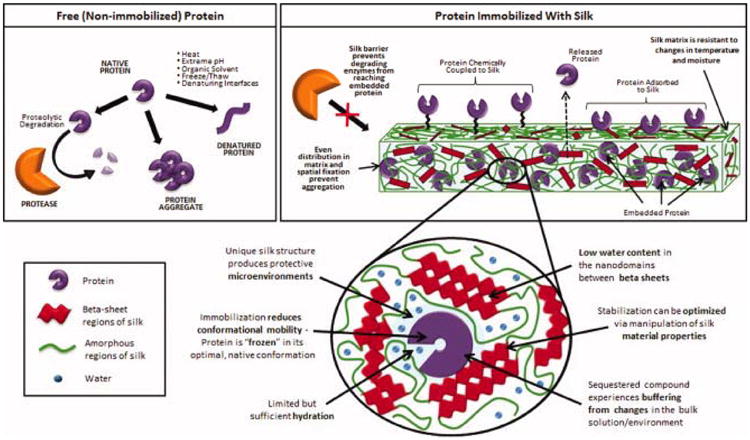
The challenge of stabilization of small molecules and proteins has received considerable interest. The biological activity of small molecules can be lost as a consequence of chemical modifications, while protein activity may be lost due to chemical or structural degradation, such as a change in macromolecular conformation or aggregation. In these cases, stabilization is required to preserve therapeutic and bioactivity efficacy and safety. In addition to use in therapeutic applications, strategies to stabilize small molecules and proteins also have applications in industrial processes, diagnostics, and consumer products like food and cosmetics. Traditionally, therapeutic drug formulation efforts have focused on maintaining stability during product preparation and storage. However, with growing interest in the fields of encapsulation, tissue engineering, and controlled release drug delivery systems, new stabilization challenges are being addressed; the compounds or protein of interest must be stabilized during: (1) fabrication of the protein or small molecule-loaded carrier, (2) device storage, and (3) for the duration of intended release needs in vitro or in vivo. We review common mechanisms of compound degradation for small molecules and proteins during biomaterial preparation (including tissue engineering scaffolds and drug delivery systems), storage, and in vivo implantation. We also review the physical and chemical aspects of polymer-based stabilization approaches, with a particular focus on the stabilizing properties of silk fibroin biomaterials.
Copyright © 2012 Wiley Periodicals, Inc.
Figures
References
-
- Acharya C, Kumar V, Sen R, Kundu SC. Biotechnol J. 2008;3:226–233. - PubMed
-
- Altman GH, Diaz F, Jakuba C, Calabro T, Horan RL, Chen J, Lu H, Richmond J, Kaplan DL. Biomaterials. 2003;24:401–416. - PubMed
-
- Bayçin D, Altiok E, Ülkü S, Bayraktar O. J Agric Food Chem. 2007;55:1227–1236. - PubMed
-
- Benoit DSW, Anseth KS. Acta Biomaterialia. 2005;1:461–470. - PubMed
-
- Bessa PC, Balmayor ER, Hartinger J, Zanoni G, Dopler D, Meinl A, Banerjee A, Casal M, Redl H, Reis RL, vanGriensven M. Tissue Eng C Methods. 2010;16:937–945. - PubMed
Publication types
MeSH terms
Substances
Grants and funding
LinkOut - more resources
Full Text Sources
Other Literature Sources
