


The puzzle of monogamous marriage
- PMID: 22271782
- PMCID: PMC3260845
- DOI: 10.1098/rstb.2011.0290
The puzzle of monogamous marriage
Abstract
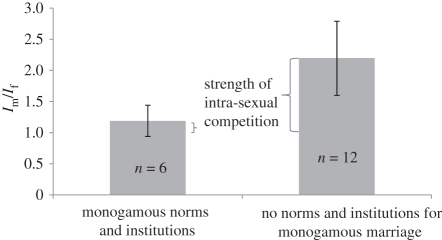
The anthropological record indicates that approximately 85 per cent of human societies have permitted men to have more than one wife (polygynous marriage), and both empirical and evolutionary considerations suggest that large absolute differences in wealth should favour more polygynous marriages. Yet, monogamous marriage has spread across Europe, and more recently across the globe, even as absolute wealth differences have expanded. Here, we develop and explore the hypothesis that the norms and institutions that compose the modern package of monogamous marriage have been favoured by cultural evolution because of their group-beneficial effects-promoting success in inter-group competition. In suppressing intrasexual competition and reducing the size of the pool of unmarried men, normative monogamy reduces crime rates, including rape, murder, assault, robbery and fraud, as well as decreasing personal abuses. By assuaging the competition for younger brides, normative monogamy decreases (i) the spousal age gap, (ii) fertility, and (iii) gender inequality. By shifting male efforts from seeking wives to paternal investment, normative monogamy increases savings, child investment and economic productivity. By increasing the relatedness within households, normative monogamy reduces intra-household conflict, leading to lower rates of child neglect, abuse, accidental death and homicide. These predictions are tested using converging lines of evidence from across the human sciences.
Figures
References
-
- White D. R., Betzig L., Borgerhoff Mulder M., Chick G., Hartung J., Irons W., Low B. S., Otterbein K. F. 1988. Rethinking polygyny: co-wives, codes, and cultural systems (includes comments and author's reply). Curr. Anthropol. 29, 529(44).10.1086/203674 (doi:10.1086/203674) - DOI - DOI
-
- Cashdan E. 1996. Women's mating strategies. Evol. Anthropol.: Issues, News, Rev. 5, 134–14310.1002/(SICI)1520-6505(1996)5:4<134::AID-EVAN3>3.0.CO;2-G (doi:10.1002/(SICI)1520-6505(1996)5:4<134::AID-EVAN3>3.0.CO;2-G) - DOI - DOI
-
- Marlowe F. W. 2003. The mating system of foragers in the standard cross-cultural sample. Cross-Cult. Res. 37, 282–30610.1177/1069397103254008 (doi:10.1177/1069397103254008) - DOI - DOI
-
- Betzig L. L. 1982. Despotism and differential reproduction: a cross-cultural correlation of conflict asymmetry, hierarchy, and degree of polygyny. Ethol. Sociobiol. 3, 209–22110.1016/0162-3095(82)90050-4 (doi:10.1016/0162-3095(82)90050-4) - DOI - DOI
-
- Scheidel W. 2009. Sex and empire: a Darwinian perspective. In The dynamics of ancient empires: state power from Assyria to Byzantium (eds Morris I., Scheidel W.), pp. 255–324 Oxford, UK: Oxford University Press
Publication types
MeSH terms
LinkOut - more resources
Full Text Sources
Miscellaneous
