


Iron availability increases the pathogenic potential of Salmonella typhimurium and other enteric pathogens at the intestinal epithelial interface
- PMID: 22272265
- PMCID: PMC3260200
- DOI: 10.1371/journal.pone.0029968
Iron availability increases the pathogenic potential of Salmonella typhimurium and other enteric pathogens at the intestinal epithelial interface
Abstract
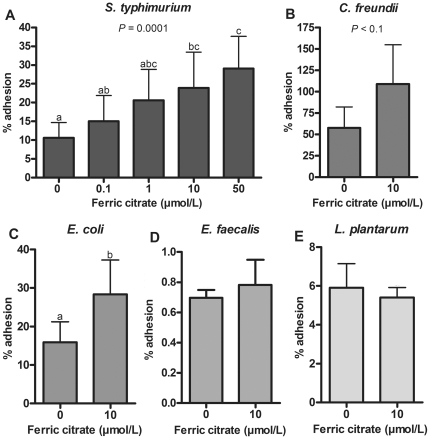
Recent trials have questioned the safety of untargeted oral iron supplementation in developing regions. Excess of luminal iron could select for enteric pathogens at the expense of beneficial commensals in the human gut microflora, thereby increasing the incidence of infectious diseases. The objective of the current study was to determine the effect of high iron availability on virulence traits of prevalent enteric pathogens at the host-microbe interface. A panel of enteric bacteria was cultured under iron-limiting conditions and in the presence of increasing concentrations of ferric citrate to assess the effect on bacterial growth, epithelial adhesion, invasion, translocation and epithelial damage in vitro. Translocation and epithelial integrity experiments were performed using a transwell system in which Caco-2 cells were allowed to differentiate to a tight epithelial monolayer mimicking the intestinal epithelial barrier. Growth of Salmonella typhimurium and other enteric pathogens was increased in response to iron. Adhesion of S. typhimurium to epithelial cells markedly increased when these bacteria were pre-incubated with increasing iron concentration (P = 0.0001), whereas this was not the case for the non-pathogenic Lactobacillus plantarum (P = 0.42). Cellular invasion and epithelial translocation of S. typhimurium followed the trend of increased adhesion. Epithelial damage was increased upon incubation with S. typhimurium or Citrobacter freundii that were pre-incubated under iron-rich conditions. In conclusion, our data fit with the consensus that oral iron supplementation is not without risk as iron could, in addition to inducing pathogenic overgrowth, also increase the virulence of prevalent enteric pathogens.
Conflict of interest statement
Figures



References
-
- WHOUNICEF. 2004. Focusing on anaemia: Towards an integrated approach for effective anaemia control.
-
- Zimmermann MB, Hurrell RF. Nutritional iron deficiency. Lancet. 2007;370:511–520. - PubMed
-
- Sazawal S, Black RE, Ramsan M, Chwaya HM, Stoltzfus RJ, et al. Effects of routine prophylactic supplementation with iron and folic acid on admission to hospital and mortality in preschool children in a high malaria transmission setting: community-based, randomised, placebo-controlled trial. Lancet. 2006;367:133–143. - PubMed
-
- WHOUNICEF. 2006. WHO Statement: Iron supplementation of young children in regions where malaria transmission is intense and infectious disease highly prevalent.
-
- Oppenheimer SJ. Iron and its relation to immunity and infectious disease. J Nutr. 2001;131:616S–633S. discussion 633S–635S. - PubMed
Publication types
MeSH terms
Substances
LinkOut - more resources
Full Text Sources
Other Literature Sources
Medical
Molecular Biology Databases
