. 2012 Jan 24:13:39.
doi: 10.1186/1471-2164-13-39.

The core and unique proteins of haloarchaea

Affiliations

The core and unique proteins of haloarchaea

Melinda D Capes et al. BMC Genomics. .

Abstract

Background: Since the first genome of a halophilic archaeon was sequenced in 2000, biologists have been advancing the understanding of genomic characteristics that allow for survival in the harsh natural environments of these organisms. An increase in protein acidity and GC-bias in the genome have been implicated as factors in tolerance to extreme salinity, desiccation, and high solar radiation. However, few previous attempts have been made to identify novel genes that would permit survival in such extreme conditions.

Results: With the recent release of several new complete haloarchaeal genome sequences, we have conducted a comprehensive comparative genomic analysis focusing on the identification of unique haloarchaeal conserved proteins that likely play key roles in environmental adaptation. Using bioinformatic methods, we have clustered 31,312 predicted proteins from nine haloarchaeal genomes into 4,455 haloarchaeal orthologous groups (HOGs). We assigned likely functions by association with established COG and KOG databases in NCBI. After identifying homologs in four additional haloarchaeal genomes, we determined that there were 784 core haloarchaeal protein clusters (cHOGs), of which 83 clusters were found primarily in haloarchaea. Further analysis found that 55 clusters were truly unique (tucHOGs) to haloarchaea and qualify as signature proteins while 28 were nearly unique (nucHOGs), the vast majority of which were coded for on the haloarchaeal chromosomes. Of the signature proteins, only one example with any predicted function, Ral, involved in desiccation/radiation tolerance in Halobacterium sp. NRC-1, was identified. Among the core clusters, 33% was predicted to function in metabolism, 25% in information transfer and storage, 10% in cell processes and signaling, and 22% belong to poorly characterized or general function groups.

Conclusion: Our studies have established conserved groups of nearly 800 protein clusters present in all haloarchaea, with a subset of 55 which are predicted to be accessory proteins that may be critical or essential for success in an extreme environment. These studies support core and signature genes and proteins as valuable concepts for understanding phylogenetic and phenotypic characteristics of coherent groups of organisms.


Figures
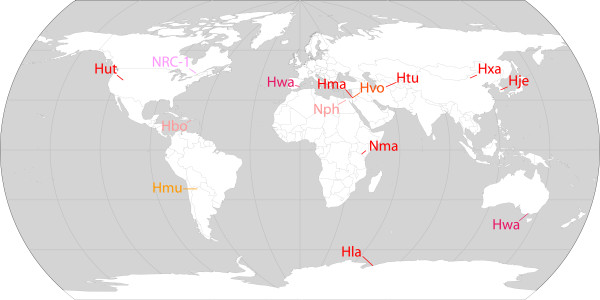
Figure 1
Figure 1
World map showing the locations of isolation for haloarchaeal organisms with sequenced genomes. The organisms represent a significant geographical diversity of haloarchaeal isolates: [Halobacterium sp. NRC-1 (NRC-1), the model haloarchaeal organism isolated from salted food in Canada, Haloarcula marismortui (Hma), a physiologically versatile extreme halophile from the Dead Sea, Natronomonas pharaonis (Nph), an alkaliphilic extreme halophile from an Egyptian soda lake, Haloquadratum walsbyi (Hwa), a square-shaped extreme halophile from solar salterns in Australia and Spain, Halorubrum lacusprofundi (Hla), a cold-adapted halophile from an Antarctic lake, Halogeometricum borinquense (Hbo), a pleomorphic extreme halophile from a solar saltern in Puerto Rico, Halomicrobium mukohataei (Hmu), a rod-shaped halophile from an Argentinean salt flat, Halorhabdus utahensis (Hut), a pleomorphic extreme halophile from sediments of the Great Salt Lake, USA, Haloferax volcanii (Hvo), a moderate halophile from Dead Sea mud, Haloterrigena turkmenica (Htu), a pleomorphic halophile from Turkmenistan, Natrialba magadii (Nma), an alkaliphilic halophile from Lake Magadi, Kenya, Halalkalicoccus jeotgali (Hje), extreme halophile from Korean fermented seafood, and Halopiger xanaduensis (Hxa), extreme halophile from saline Lake Shangmatala, China. Labels are based on the color of haloarchaeal colonies.
Figure 2
Figure 2
Venn diagram showing the distribution and relationship among clusters of orthologous groups for haloarchaea (HOGs), prokaryotes (COGs), and eukaryotes (KOGs). Accessory HOGs (aHOGs) and core HOGs (cHOGs) (black outline) were associated with COGs and KOGs (drawn to scale). cHOGs not associated with COGs or KOGs were termed truly unique cHOGs (tucHOGs) or nearly unique cHOGs (nucHOGs). COGs and associated KOGs with no associated HOG are illustrated for comparison.
Figure 3
Figure 3
Functional classification of haloarchaeal orthologous groups (HOGs) for nine haloarchaea. Predicted functions were assigned to core (9 genomes) and accessory (2 - 8 genomes) HOGs based on association with COGs. Several HOGs were associated with one or more COG and all predicted functions are illustrated. Based on predicted functions, HOGs were classified as likely involved in information transfer and storage (orange), cellular processing and signaling (green), or metabolism (red). Predicted functions could not be assigned to HOGs associated with poorly characterized COGs (purple) or with no associated COG (blue).
Figure 4
Figure 4
Location of uniquely core haloarchaeal orthologous genes, or ucHOGs, coded on the chromosome of Halobacterium sp. NRC-1. Map of Halobacterium sp. NRC-1 chromosome indicating the location of the 55 tucHOG (green), and 28 nucHOG (orange) genes. The nucHOG0027 gene present on the inverted repeat regions of pNRC100 and pNRC200 in Halobacterium sp. NRC-1 is not shown.
Figure 5
Figure 5
Shared synteny of the tucHOG0456 (ral) gene region among the haloarchaeal chromosomes. In Halobacterium sp. NRC-1, ral (purple) is transcriptionally linked to rfa3 (blue) and rfa8 (pink), an additional gene, coding for a predicted helicase (turquoise), near the rfa3-rfa8-ral operon in Halobacterium sp. NRC-1 is also highly conserved. Haloarchaeal chromosomes are designated with the following abbreviations: Halobacterium sp. NRC-1 (NRC-1), H. marismortui (Hma), N. pharaonis (Nph), H. walsbyi (Hwa), H. lacusprofundi (Hla), H. borinquense (Hbo), H. mukohataei (Hmu), H. utahensis (Hut), H. volcanii (Hvo), H. turkmenica (Htu), N. magadii (Nma), H. jeotgali (Hje), and H. xanaduensis (Hxa).

References

    1. Grant WD, Kamekura M, McGenity TJ, Ventosa A. In: Bergey's Manual of Systematic Bacteriology. Boone D, Castenholz R, editor. Vol. 2. New York: Springer; 2001. Class III. Halobacteria class. nov.
    1. DasSarma S, DasSarma P. Encyclopedia of Life Sciences. John Wiley & Sons, Ltd; 2012. Halophiles.
    1. DasSarma P, Coker J, Huse V, DasSarma S. In: Encyclopedia of Industrial Biotechnology, Bioprocess, Bioseparation, and Cell Technology. Flickinger M, editor. Wiley, John & Sons, Incorporated; 2010. Halophiles, Biotechnology; pp. 2769–2777.
    1. Horneck G, Klaus DM, Mancinelli RL. Space microbiology. Microbiol Mol Biol Rev. 2010;74:121–156. doi: 10.1128/MMBR.00016-09. - DOI - PMC - PubMed
    1. Vreeland RH, Jones J, Monson A, Rosenzweig WD, Lowenstein TK, Timofeeff M, Satterfield C, Cho BC, Park JS, Wallace A, Grant WD. Isolation of Live Cretaceous (121-112 Million Years Old) Halophilic Archaea from Primary Salt Crystals. Geomicrobiology Journal. 2007;24:275–282. doi: 10.1080/01490450701456917. - DOI

Publication types

MeSH terms

LinkOut - more resources
