


Analysis of combined data from heterogeneous study designs: an applied example from the patient navigation research program
- PMID: 22273587
- PMCID: PMC3679186
- DOI: 10.1177/1740774511433284
Analysis of combined data from heterogeneous study designs: an applied example from the patient navigation research program
Abstract
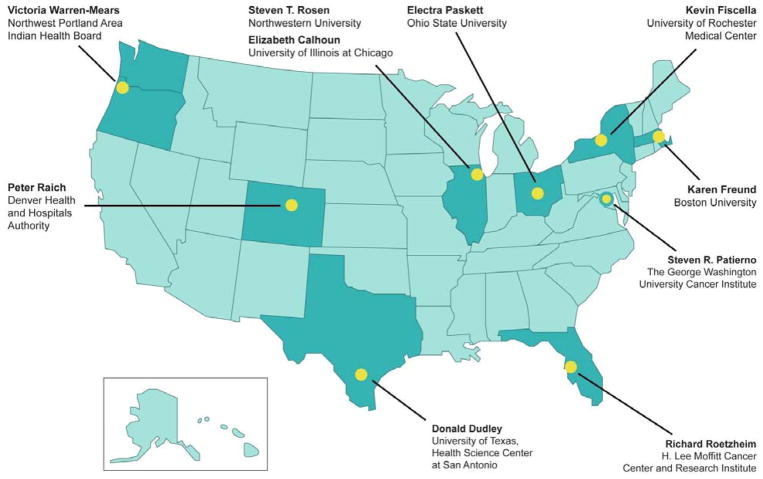
Background: The Patient Navigation Research Program (PNRP) is a cooperative effort of nine research projects, with similar clinical criteria but with different study designs. To evaluate projects such as PNRP, it is desirable to perform a pooled analysis to increase power relative to the individual projects. There is no agreed-upon prospective methodology, however, for analyzing combined data arising from different study designs. Expert opinions were thus solicited from the members of the PNRP Design and Analysis Committee.
Purpose: To review possible methodologies for analyzing combined data arising from heterogeneous study designs.
Methods: The Design and Analysis Committee critically reviewed the pros and cons of five potential methods for analyzing combined PNRP project data. The conclusions were based on simple consensus. The five approaches reviewed included the following: (1) analyzing and reporting each project separately, (2) combining data from all projects and performing an individual-level analysis, (3) pooling data from projects having similar study designs, (4) analyzing pooled data using a prospective meta-analytic technique, and (5) analyzing pooled data utilizing a novel simulated group-randomized design.
Results: Methodologies varied in their ability to incorporate data from all PNRP projects, to appropriately account for differing study designs, and to accommodate differing project sample sizes.
Limitations: The conclusions reached were based on expert opinion and not derived from actual analyses performed.
Conclusions: The ability to analyze pooled data arising from differing study designs may provide pertinent information to inform programmatic, budgetary, and policy perspectives. Multisite community-based research may not lend itself well to the more stringent explanatory and pragmatic standards of a randomized controlled trial design. Given our growing interest in community-based population research, the challenges inherent in the analysis of heterogeneous study design are likely to become more salient. Discussion of the analytic issues faced by the PNRP and the methodological approaches we considered may be of value to other prospective community-based research programs.
References
-
- Robinson-White S, Conroy B, Slavish KH, Rosenzweig M. Patient navigation in breast cancer: a systematic review. Cancer Nurs. 2010 Mar-Apr;33(2):127–140. - PubMed
-
- Friedenreich CM. Methods for pooled analyses of epidemiologic studies. Epidemiology. 1993 Jul;4(4):295–302. - PubMed
-
- Blettner M, Sauerbrei W, Schlehofer B, Scheuchenpflug T, Friedenreich C. Traditional reviews, meta-analyses and pooled analyses in epidemiology. Int J Epidemiol. 1999 Feb;28(1):1–9. - PubMed
Publication types
MeSH terms
Grants and funding
- U01 CA116875/CA/NCI NIH HHS/United States
- U01CA116925/CA/NCI NIH HHS/United States
- U01CA116903/CA/NCI NIH HHS/United States
- U01 CA116924/CA/NCI NIH HHS/United States
- U01CA116924/CA/NCI NIH HHS/United States
- U01 CA116892/CA/NCI NIH HHS/United States
- P30 CA076292/CA/NCI NIH HHS/United States
- U01 CA116925/CA/NCI NIH HHS/United States
- U01 CA117281/CA/NCI NIH HHS/United States
- U01CA116937/CA/NCI NIH HHS/United States
- U01 CA116885/CA/NCI NIH HHS/United States
- U01 CA116903/CA/NCI NIH HHS/United States
- U01 CA116937/CA/NCI NIH HHS/United States
- U01 CA 117281/CA/NCI NIH HHS/United States
- U01CA116885/CA/NCI NIH HHS/United States
- U01CA116875/CA/NCI NIH HHS/United States
LinkOut - more resources
Full Text Sources
Miscellaneous
