


Aryl hydrocarbon receptor (AhR) regulates silica-induced inflammation but not fibrosis
- PMID: 22273745
- PMCID: PMC3307612
- DOI: 10.1093/toxsci/kfs024
Aryl hydrocarbon receptor (AhR) regulates silica-induced inflammation but not fibrosis
Abstract
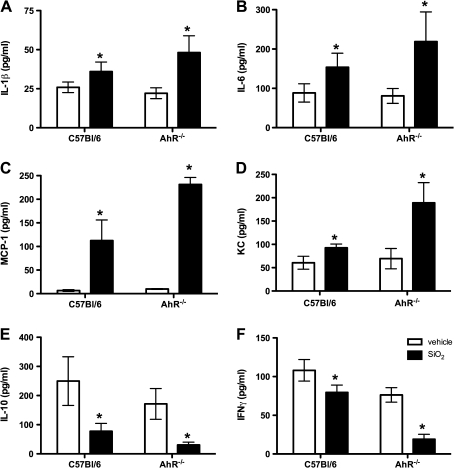
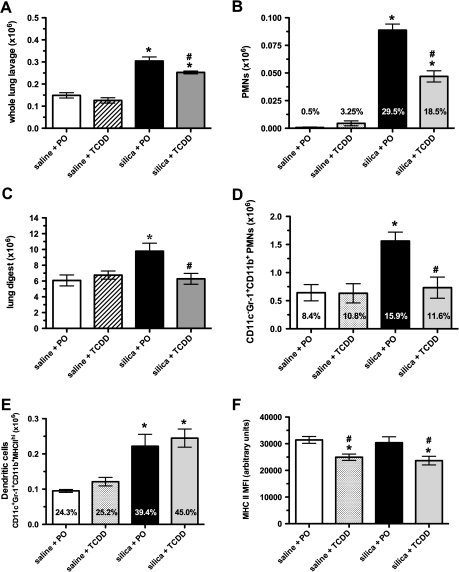
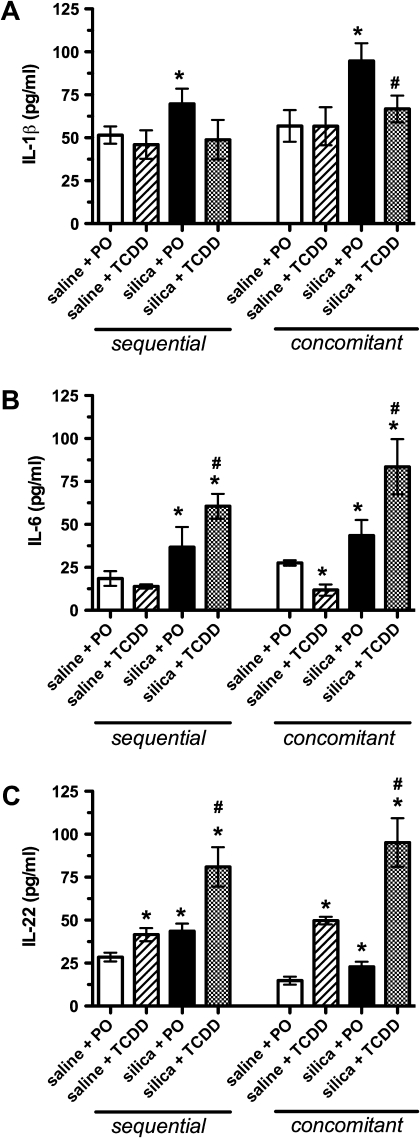
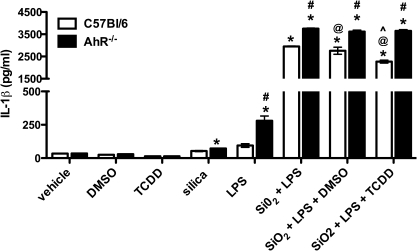
The aryl hydrocarbon receptor (AhR), a ligand-activated transcription factor, is responsible for mediating a variety of pharmacological and toxicological effects caused by halogenated aromatic hydrocarbons such as 2,3,7,8-tetrachlorodibenzo-p-dioxin (TCDD). However, recent evidence has revealed that the AhR also has numerous physiological roles aside from xenobiotic metabolism, including regulation of immune and inflammatory signaling as well as normal development and homeostasis of several organs. To investigate the role of the AhR in crystalline silica (SiO(2))-induced inflammation and fibrosis, C57Bl/6 and AhR(-/)(-) mice were exposed to SiO(2) or vehicle. Similarly, C57Bl/6 mice were exposed to SiO(2) and TCDD either simultaneously or sequentially to assess whether AhR activation alters inflammation and fibrosis. SiO(2)-induced acute lung inflammation was more severe in AhR(-)(/-) mice; however, the fibrotic response of AhR(-)(/-) mice was attenuated compared with C57Bl/6 mice. In a model of chronic SiO(2) exposure, AhR activation by TCDD in C57Bl/6 mice resulted in reduced inflammation; however, the fibrotic response was not affected. Bone marrow-derived macrophages (BMM) from AhR(-)(/-) mice also produced higher levels of cytokines and chemokines in response to SiO(2). Analysis of gene expression revealed that BMM derived from AhR(-)(/-) mice exhibit increased levels of pro-interleukin (IL)-1β, IL-6, and Bcl-2, yet decreased levels of signal transducers and activators of transcription (STAT)2, STAT5a, and serpin B2 (Pai-2) in response to SiO(2).
Figures



References
-
- Beamer CA, Holian A. Scavenger receptor class A type I/II (CD204) null mice fail to develop fibrosis following silica exposure. Am. J. Physiol. Lung Cell. Mol. Physiol. 2005;289:L186–L195. - PubMed
Publication types
MeSH terms
Substances
Grants and funding
LinkOut - more resources
Full Text Sources
Medical
Molecular Biology Databases
Miscellaneous
