Review
. 2012 Mar;27(2):70-81.
doi: 10.1097/HCO.0b013e32835018cd.

Advances in pediatric pulmonary arterial hypertension

Affiliations
Review

Advances in pediatric pulmonary arterial hypertension

Dunbar Ivy. Curr Opin Cardiol. 2012 Mar.

Abstract

Purpose of review: Pulmonary arterial hypertension (PAH) is an important cause of morbidity and mortality in children. Approved medications for the treatment of adult PAH have been used to treat children, but evidence-based treatment algorithms for children are lacking.

Recent findings: Pediatric PAH registries have begun to define the incidence and prevalence of idiopathic PAH and PAH associated with congenital heart disease. A pediatric-specific classification of pulmonary hypertensive vascular disease has been proposed. Furthermore, the first randomized placebo-controlled trial of type-5 phosphodiesterase therapy in treatment-naïve children with PAH has been completed and reported. This trial highlights the importance of the difficulties of performing clinical trials in children with targeted PAH therapy as well as the importance of long-term follow-up of adverse events.

Summary: Classification, clinical trials, and therapy for children with PAH must take into account the unique aspects of PAH in children.


Figures
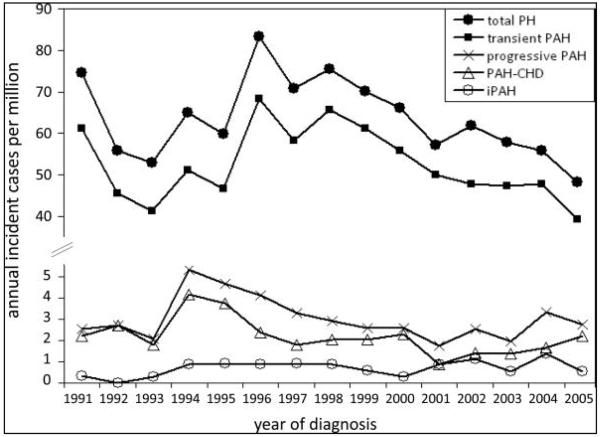
Figure 1
Figure 1
Annual incidence rates for pediatric pulmonary hypertension in the Netherlands. PH indicates pulmonary hypertension; PAH, pulmonary arterial hypertension; PAH-CHD, PAH associated with congenital heart defects; and iPAH, idiopathic PAH. Source: [7] Van Loon RL, et al. Circulation. 2011 Sep 26;124:1755-64.
Figure 2
Figure 2
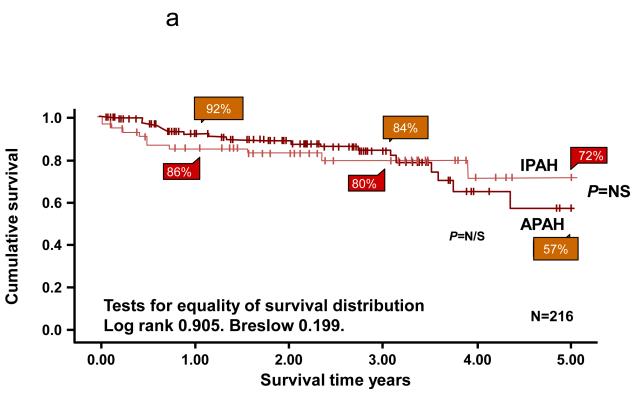
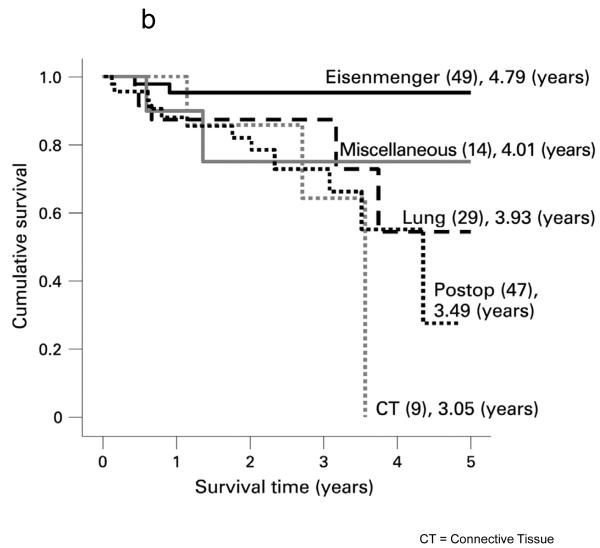
Survival curves for idiopathic pulmonary arterial hypertension (IPAH) and associated pulmonary arterial hypertension (APAH) cases censored for time in the study and for transplantation. There was no significant difference between the two groups. B. Survival curves for the subgroups within the associated pulmonary arterial hypertension (APAH) group. The number in each group (brackets) and the predicted survival out of a possible 5 years are shown. CT: Connective Tissue. Source: [9] Haworth, SG et al. Heart 2009;95:312-317
Figure 2
Figure 2
Survival curves for idiopathic pulmonary arterial hypertension (IPAH) and associated pulmonary arterial hypertension (APAH) cases censored for time in the study and for transplantation. There was no significant difference between the two groups. B. Survival curves for the subgroups within the associated pulmonary arterial hypertension (APAH) group. The number in each group (brackets) and the predicted survival out of a possible 5 years are shown. CT: Connective Tissue. Source: [9] Haworth, SG et al. Heart 2009;95:312-317
Figure 3
Figure 3
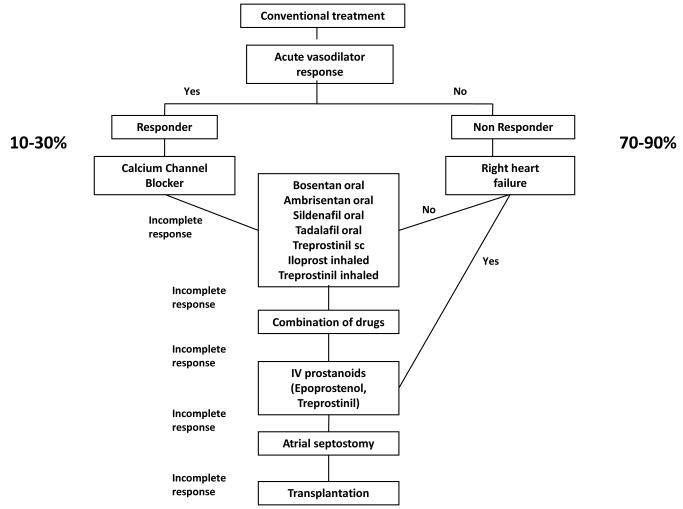
Treatment algorithm in children with severe pulmonary arterial hypertension. Source: [14] Tissot C, et al. J Pediatr. 2010;157:528-532
Figure 4
Figure 4
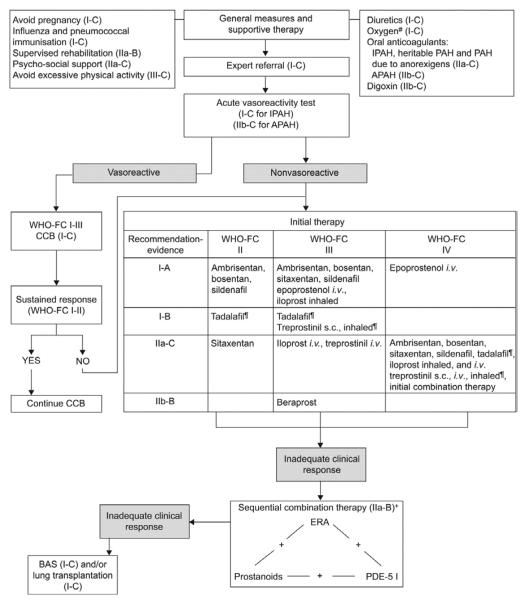
Evidence-based treatment algorithm for pulmonary arterial hypertension adults (for group 1 patients only). APAH: associated pulmonary arterial hypertension; BAS: balloon atrial septostomy; CCB: calcium channel blocker; ERA: endothelin receptor antagonist; IPAH: idiopathic pulmonary arterial hypertension; PAH: pulmonary arterial hypertension; PDE-5 I: phosphodiesterase type-5 inhibitor; s.c.: subcutaneously; WHO-FC: World Health Organization functional class. #: to maintain arterial blood O2 pressure >60 mmHg; : under regulatory review in the European Union; +: IIa-C for WHO-FC II. Source: [16] Galie N et al Eur Heart J. 2009;30(20):2493-2537.
Figure 5
Figure 5
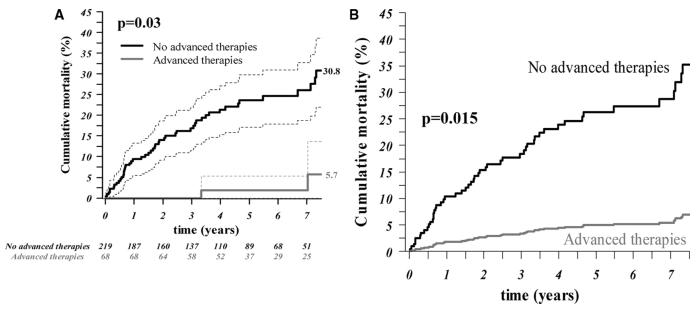
A. Unadjusted survival rate curves (with 95% CIs) by treatment with advanced therapies in adults with Eisenmenger syndrome (AT (n=287). P value refers to Cox model. B. Adjusted survival rate curves, based on the propensity score–adjusted Cox model, of patients within the third propensity score quartile, with and without advanced therapy. Source: [52] Dimopoulos K et al; Circulation. 2010;121:20-25
Figure 6
Figure 6
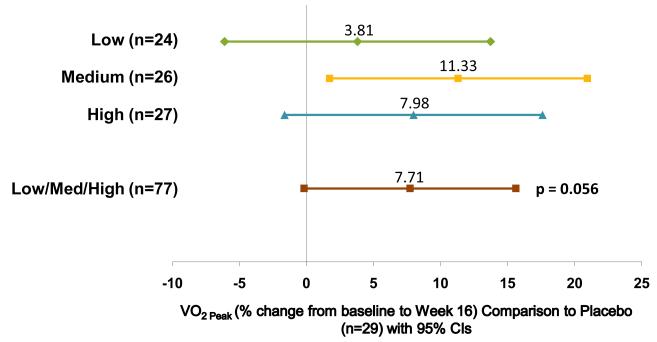
Placebo-adjusted percent change in peak VO2 by cardiopulmonary exercise after 16 weeks of sildenafil or placebo in a randomized, double-blind, placebo-controlled, dose-ranging study of oral sildenafil citrate in treatment-naive children with pulmonary arterial hypertension. Source: [9] Barst RJ, Ivy DD, et al. Circulation. 2011;In Print.

References

    1. Simonneau G, Robbins IM, Beghetti M, Channick RN, Delcroix M, Denton CP, et al. Updated clinical classification of pulmonary hypertension. J Am Coll Cardiol. 2009 Jun 30;54(1 Suppl):S43–54. - PubMed
    1. van Loon RL, Roofthooft MT, van Osch-Gevers M, Delhaas T, Strengers JL, Blom NA, et al. Clinical characterization of pediatric pulmonary hypertension: complex presentation and diagnosis. J Pediatr. 2009 Aug;155(2):176–82. e1. - PubMed
    1. Cerro MJ, Abman S, Diaz G, Freudenthal AH, Freudenthal F, Harikrishnan S, et al. A consensus approach to the classification of pediatric pulmonary hypertensive vascular disease: Report from the PVRI Pediatric Taskforce, Panama 2011. Pulm Circ. 2011;1(2):286–98. ** Novel pediatric specific classification that emphasizes the heterogeneity of pediatric PH and the importance of the deleoping lung.

    1. Fasnacht MS, Tolsa JF, Beghetti M. The Swiss registry for pulmonary arterial hypertension: the paediatric experience. Swiss Med Wkly. 2007 Sep 8;137(35-36):510–3. - PubMed
    1. Haworth SG, Hislop AA. Treatment and survival in children with pulmonary arterial hypertension: the UK Pulmonary Hypertension Service for Children 2001-2006. Heart. 2009 Apr;95(4):312–7. - PubMed

Publication types

MeSH terms

Substances