


Single-nucleotide polymorphisms in the P2X7 receptor gene are associated with post-menopausal bone loss and vertebral fractures
- PMID: 22274585
- PMCID: PMC3355253
- DOI: 10.1038/ejhg.2011.253
Single-nucleotide polymorphisms in the P2X7 receptor gene are associated with post-menopausal bone loss and vertebral fractures
Abstract
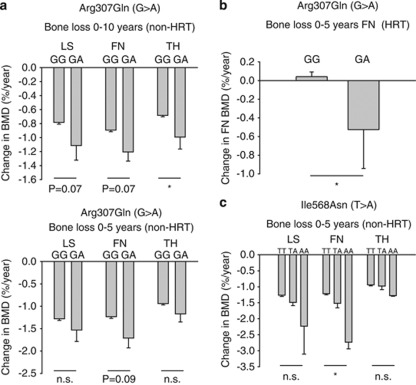
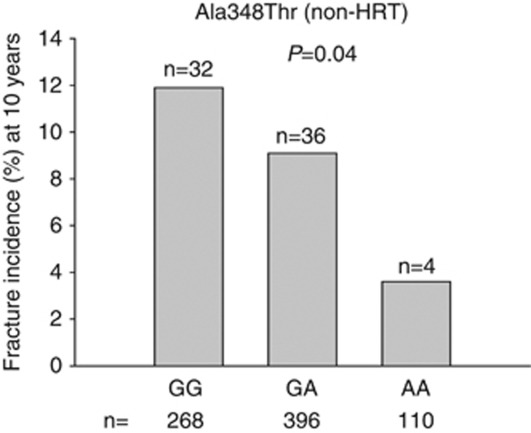
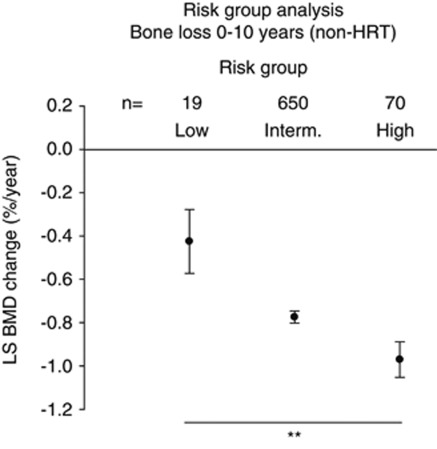
The purinergic P2X7 receptor has a major role in the regulation of osteoblast and osteoclast activity and changes in receptor function may therefore affect bone mass in vivo. The aim of this study was to determine the association of non-synonymous single-nucleotide polymorphisms in the P2RX7 gene to bone mass and fracture incidence in post-menopausal women. A total of 1694 women (aged 45-58) participating in the Danish Osteoporosis Prevention Study were genotyped for 12 functional P2X7 receptor variants. Bone mineral density was determined at baseline and after 10 years. In addition, vertebral fracture incidence was documented at 10 years. We found that the rate of bone loss was clearly associated with the Arg307Gln amino acid substitution such that individuals heterozygous for this polymorphism had a 40% increased rate of bone loss. Furthermore, individuals carrying the Ile568Asn variant allele had increased bone loss. In contrast, the Gln460Arg polymorphism was associated with protection against bone loss. The Ala348Thr polymorphism was associated with a lower vertebral fracture incidence 10 years after menopause. Finally, we developed a risk model, which integrated P2RX7 genotypes. Using this model, we found a clear association between the low-risk (high-P2X7 function) alleles and low rate of bone loss. Conversely, high-risk (reduced P2X7 function) alleles were associated with a high rate of bone loss. In conclusion, an association was demonstrated between variants that reduce P2X7 receptor function and increased rate of bone loss. These data support that the P2X7 receptor is important in regulation of bone mass.
Figures
References
-
- Johnell O, Kanis J. Epidemiology of osteoporotic fractures. Osteoporos Int. 2005;16 (Suppl 2:S3–S7. - PubMed
-
- Ralston SH. Genetic determinants of susceptibility to osteoporosis. Curr Opin Pharmacol. 2003;3:286–290. - PubMed
-
- Khakh BS, North RA. P2X receptors as cell-surface ATP sensors in health and disease. Nature. 2006;442:527–532. - PubMed
-
- Surprenant A, Rassendren F, Kawashima E, North RA, Buell G. The Cytolytic P2Z receptor for extracellular ATP identified as a P2X receptor (P2X7) Science. 1996;272:735–738. - PubMed
Publication types
MeSH terms
Substances
Grants and funding
LinkOut - more resources
Full Text Sources
Medical
Miscellaneous
