Clinical Trial
. 2012 Mar 1;205(5):772-81.
doi: 10.1093/infdis/jir850. Epub 2012 Jan 24.

Clinical assessment of a recombinant simian adenovirus ChAd63: a potent new vaccine vector

Affiliations
Clinical Trial

Clinical assessment of a recombinant simian adenovirus ChAd63: a potent new vaccine vector

Geraldine A O'Hara et al. J Infect Dis. .

Abstract

Background: Vaccine development in human Plasmodium falciparum malaria has been hampered by the exceptionally high levels of CD8(+) T cells required for efficacy. Use of potently immunogenic human adenoviruses as vaccine vectors could overcome this problem, but these are limited by preexisting immunity to human adenoviruses.

Methods: From 2007 to 2010, we undertook a phase I dose and route finding study of a new malaria vaccine, a replication-incompetent chimpanzee adenovirus 63 (ChAd63) encoding the preerythrocytic insert multiple epitope thrombospondin-related adhesion protein (ME-TRAP; n = 54 vaccinees) administered alone (n = 28) or with a modified vaccinia virus Ankara (MVA) ME-TRAP booster immunization 8 weeks later (n = 26). We observed an excellent safety profile. High levels of TRAP antigen-specific CD8(+) and CD4(+) T cells, as detected by interferon γ enzyme-linked immunospot assay and flow cytometry, were induced by intramuscular ChAd63 ME-TRAP immunization at doses of 5 × 10(10) viral particles and above. Subsequent administration of MVA ME-TRAP boosted responses to exceptionally high levels, and responses were maintained for up to 30 months postvaccination.

Conclusions: The ChAd63 chimpanzee adenovirus vector appears safe and highly immunogenic, providing a viable alternative to human adenoviruses as vaccine vectors for human use.

Clinical trials registration: NCT00890019.


Figures
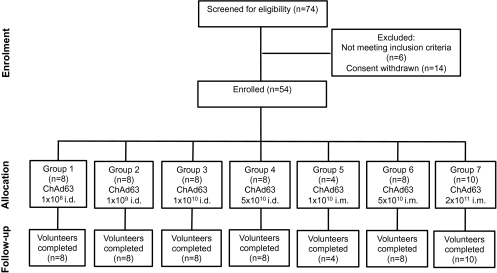
Figure 1.
Figure 1.
CONSORT chart. Abbreviations: ChAd63, chimpanzee adenovirus; i.d., intradermal; i.m., intramuscular; MVA, modified vaccinia virus Ankara.
Figure 2.
Figure 2.
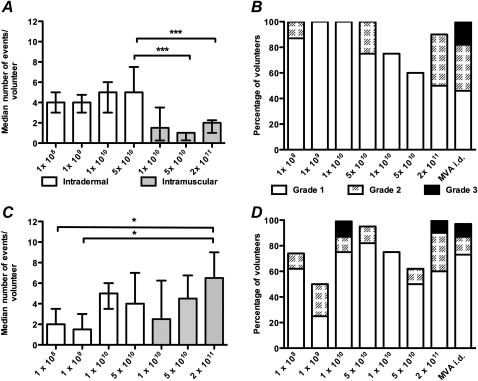
Adverse events. Local and systemic adverse events occurring post ChAd63 ME-TRAP (AD) and MVA ME-TRAP (B and D). Median and interquartile range number of local (A) and systemic (C) adverse events reported per volunteer post ChAd63 ME-TRAP at different doses and routes. Panels B and D show percentage of volunteers reporting at least 1 local or systemic adverse event; shading indicates severity (highest severity of adverse events reported by volunteers is presented). (*P < .05; ***P < .001; analyzed by Kruskal-Wallis test with Dunn post test.) Abbreviations: ChAd63, chimpanzee adenovirus; i.d., intradermal; ME-TRAP, multiple epitope-thrombospondin–related adhesion protein; MVA, modified vaccinia virus Ankara.
Figure 3.
Figure 3.
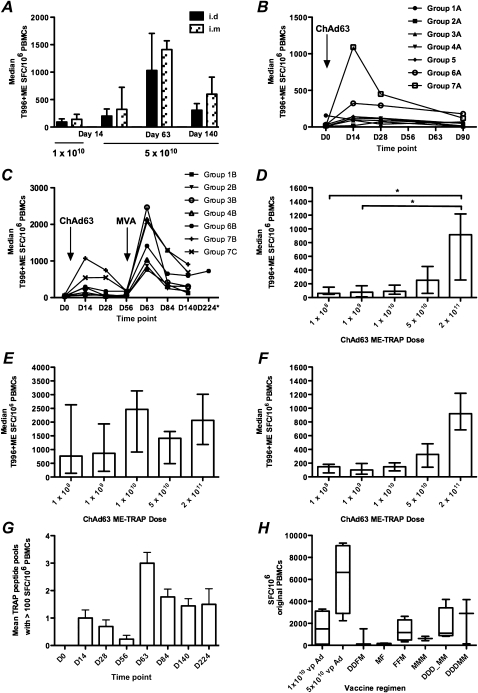
ELISPOT assays. A, Comparison of median ELISPOT responses at comparable doses via intradermal and intramuscular routes. Error bars represent interquartile ranges (IQRs); no significant differences were observed. B and C, Median ELISPOT responses postvaccination in A groups and B groups. D and E, Median ELISPOT responses day 14 and day 63 grouped by priming dose ChAd63 ME-TRAP; error bars represent IQRs. F, Peak median ELISPOT response by priming dose ChAd63 ME-TRAP; error bars represent IQRs. G, Mean number of peptide pools recognized at different time points (data for all volunteers analyzed using 1-way analysis of variance with Bonferroni post test; error bars represent standard errors of the mean. H, Cultured ELISPOT responses compared with previous trials (data shown represents median and IQR, analyzed by Kruskal-Wallis test with Dunn post test. (*P < .05; x-axis displays regimes used in previous clinical trials D = DNA ME-TRAP, F = FP9 ME-TRAP, M = MVA ME-TRAP.) Abbreviations: ChAd63, chimpanzee adenovirus; ELISPOT, enzyme-linked immunospot; i.d., intradermal; i.m., intramuscular; ME-TRAP, multiple epitope-thrombospondin–related adhesion protein; MVA, modified vaccinia virus Ankara; PBMCs, peripheral blood mononuclear cells; vp; viral particles.
Figure 4.
Figure 4.
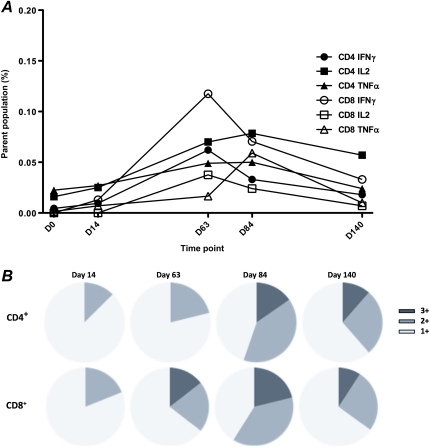
Flow cytometry. A, Percentage of parent populations (CD4+ or CD8+) secreting named cytokine over time. IFN-γ responses peak 7 days post-MVA boost with the frequency of CD8+ T cells secreting IFN-γ increasing significantly between baseline and D63 (P < .05, Kruskal-Wallis with Dunn posttest correction). B, Polyfunctionality of TRAP-specific CD4+ or CD8+ T cells over time. T cells capable of secreting all 3 cytokines are only detected after boosting with MVA. Abbreviations: IFN, interferon; IL, interleukin; MVA, modified vaccinia virus Ankara; TNF, tumor necrosis factor; TRAP, thrombospondin-related adhesion protein.
Figure 5.
Figure 5.
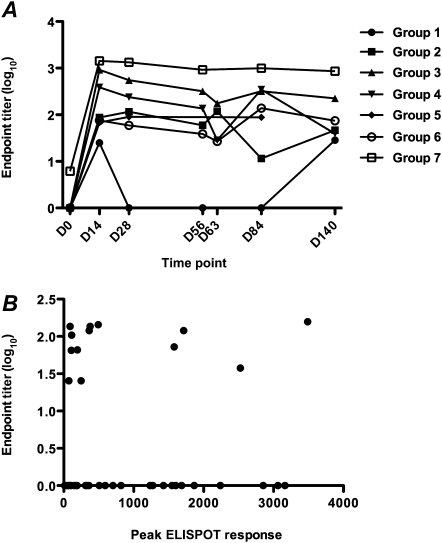
Antibodies. A, Median anti-ChAd63 antibody titers postvaccination. B, Correlation between day 0 anti-ChAd63 antibody titer and peak enzyme-linked immunospot result (r = 0.031, P = .85 by Spearman rank correlation [95% confidence interval, −.2843 to .3400]). Abbreviation: ChAd63, chimpanzee adenovirus.
Figure 6.
Figure 6.
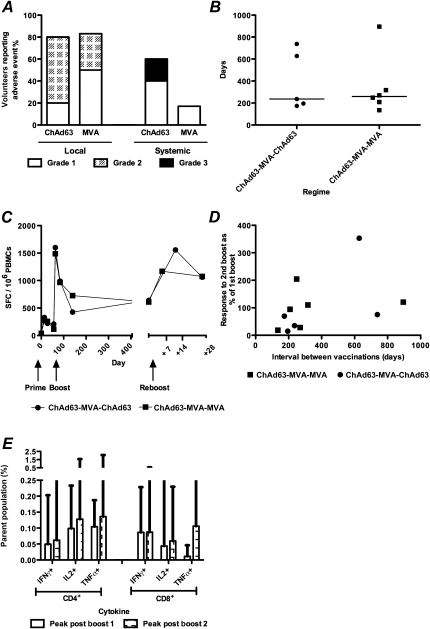
Reboosting. A, Local and systemic adverse events occurring post reboosting with ChAd63 ME-TRAP and MVA ME-TRAP. B, Interval between first boosting vaccination with MVA and reboosting with either vector. Bar represents median interval for each group. C, Median enzyme-linked immunospot (ELISPOT) responses after reboosting; peak response post-MVA reboost 1169 SFC/106 peripheral blood mononuclear cells (PBMCs), peak response post-ChAd63 reboost 1558SFC/106 PBMCs). D, Relationship between reboosting interval and response to reboost (Spearman rank correlation r = 0.64, P = .035). E, Cytokine responses to first and second boosting vaccinations for all subjects in group 8, showing percentage of parent population (either CD4+ or CD8+ T cells), secreting named cytokine. Abbreviations: ChAd63, chimpanzee adenovirus; IFN, interferon; IL, interleukin; ME-TRAP, multiple epitope thrombospondin-related adhesion protein; MVA, modified vaccinia virus Ankara; TNF, tumor necrosis factor.

References

    1. Crompton PD, Pierce SK, Miller LH. Advances and challenges in malaria vaccine development. J Clin Invest. 2010;120:4168–78. - PMC - PubMed
    1. Nussenzweig RS, Vanderberg J, Most H, Orton C. Protective immunity produced by the injection of X-irradiated sporozoites of Plasmodium berghei. Nature. 1967;216:160–2. - PubMed
    1. Khusmith S, Sedegah M, Hoffman SL. Complete protection against Plasmodium yoelii by adoptive transfer of a CD8+ cytotoxic T-cell clone recognizing sporozoite surface protein 2. Infect Immun. 1994;62:2979–83. - PMC - PubMed
    1. Romero P, Maryanski JL, Corradin G, Nussenzweig RS, Nussenzweig V, Zavala F. Cloned cytotoxic T cells recognize an epitope in the circumsporozoite protein and protect against malaria. Nature. 1989;341:323–6. - PubMed
    1. Reyes-Sandoval A, Wyllie DH, Bauza K, et al. CD8+ T effector memory cells protect against liver-stage malaria. J Immunol. 2011;187:1347–57. - PMC - PubMed

Publication types

MeSH terms

Associated data