


Health facility characteristics and their relationship to coverage of PMTCT of HIV services across four African countries: the PEARL study
- PMID: 22276130
- PMCID: PMC3262794
- DOI: 10.1371/journal.pone.0029823
Health facility characteristics and their relationship to coverage of PMTCT of HIV services across four African countries: the PEARL study
Abstract
Background: Health facility characteristics associated with effective prevention of mother-to-child transmission of HIV (PMTCT) coverage in sub-Saharan are poorly understood.
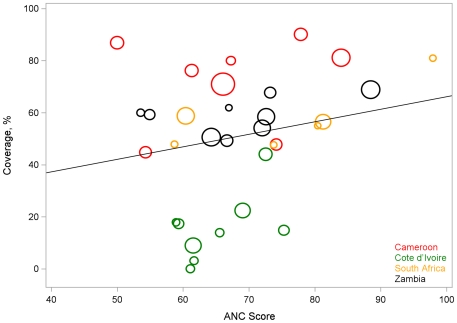
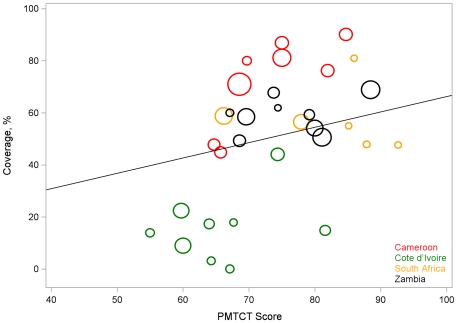
Methodology/principal findings: We conducted surveys in health facilities with active PMTCT services in Cameroon, Cote d'Ivoire, South Africa, and Zambia. Data was compiled via direct observation and exit interviews. We constructed composite scores to describe provision of PMTCT services across seven topical areas: antenatal quality, PMTCT quality, supplies available, patient satisfaction, patient understanding of medication, and infrastructure quality. Pearson correlations and Generalized Estimating Equations (GEE) to account for clustering of facilities within countries were used to evaluate the relationship between the composite scores, total time of visit and select individual variables with PMTCT coverage among women delivering. Between July 2008 and May 2009, we collected data from 32 facilities; 78% were managed by the government health system. An opt-out approach for HIV testing was used in 100% of facilities in Zambia, 63% in Cameroon, and none in Côte d'Ivoire or South Africa. Using Pearson correlations, PMTCT coverage (median of 55%, (IQR: 33-68) was correlated with PMTCT quality score (rho = 0.51; p = 0.003); infrastructure quality score (rho = 0.43; p = 0.017); time spent at clinic (rho = 0.47; p = 0.013); patient understanding of medications score (rho = 0.51; p = 0.006); and patient satisfaction quality score (rho = 0.38; p = 0.031). PMTCT coverage was marginally correlated with the antenatal quality score (rho = 0.304; p = 0.091). Using GEE adjustment for clustering, the, antenatal quality score became more strongly associated with PMTCT coverage (p<0.001) and the PMTCT quality score and patient understanding of medications remained marginally significant.
Conclusions/results: We observed a positive relationship between an antenatal quality score and PMTCT coverage but did not identify a consistent set of variables that predicted PMTCT coverage.
Conflict of interest statement
Figures
References
-
- WHO/UNAIDS/UNICEF. Towards Universal Access. Scaling up priority HIV/AIDS interventions in the health sector. 2009. Progress Report June 2009.; Available: http://www.who.int/hiv/pub/2009progressreport/en/. Accessed: 24 October 2011.
-
- Ekouevi DK, Leroy V, Viho A, Bequet L, Horo A, et al. Acceptability and uptake of a package to prevent mother-to-child transmission using rapid HIV testing in Abidjan, Cote d'Ivoire. AIDS. 2004;4:697–700. - PubMed
-
- Rollins N, Little K, Mzolo S, Horwood C, Newell ML. Surveillance of mother-to-child transmission prevention programmes at immunization clinics: the case for universal screening. Aids. 2007;10:1341–7. - PubMed
-
- Stringer EM, Ekouevi DK, Coetzee D, Tih PM, Creek TL, et al. Coverage of nevirapine-based services to prevent mother-to-child HIV transmission in 4 African countries. JAMA. 2011;3:293–302. - PubMed
Publication types
MeSH terms
Grants and funding
LinkOut - more resources
Full Text Sources
Medical
