


Statistical inference for valued-edge networks: the generalized exponential random graph model
- PMID: 22276151
- PMCID: PMC3261863
- DOI: 10.1371/journal.pone.0030136
Statistical inference for valued-edge networks: the generalized exponential random graph model
Abstract
Across the sciences, the statistical analysis of networks is central to the production of knowledge on relational phenomena. Because of their ability to model the structural generation of networks based on both endogenous and exogenous factors, exponential random graph models are a ubiquitous means of analysis. However, they are limited by an inability to model networks with valued edges. We address this problem by introducing a class of generalized exponential random graph models capable of modeling networks whose edges have continuous values (bounded or unbounded), thus greatly expanding the scope of networks applied researchers can subject to statistical analysis.
Conflict of interest statement
Figures
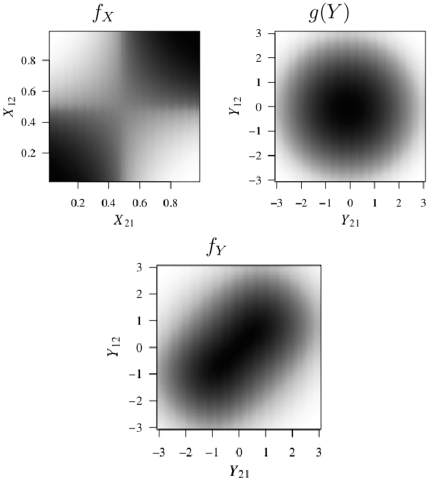
 is the standard normal PDF (b), and
  (a) is defined by
  , and
, and  , representing negative density and positive reciprocity effects.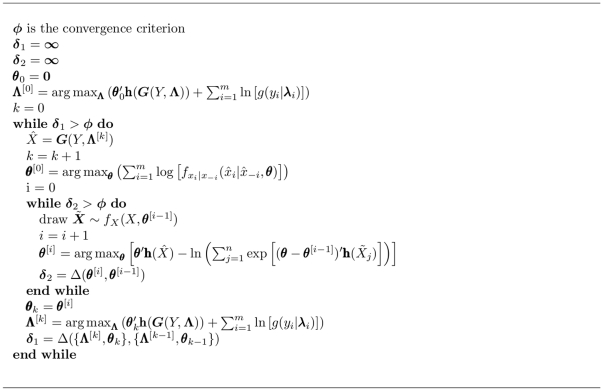
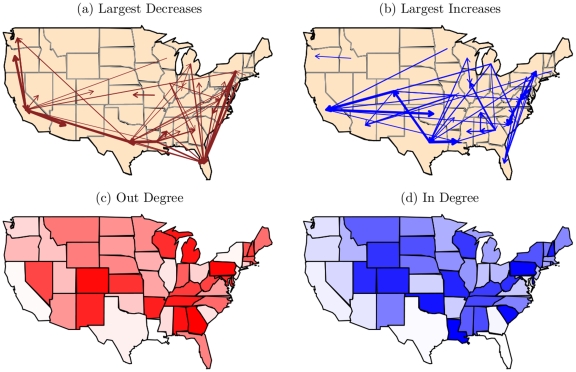
 with a standard normal
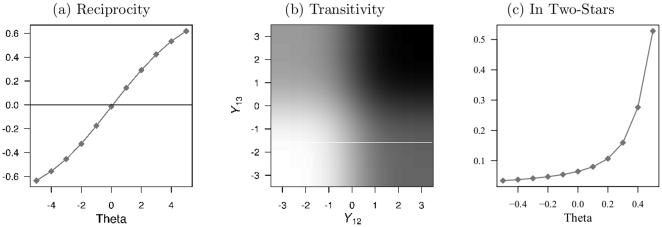
 . The Y-axis in (a) is the Pearson's correlation coefficient between edges in a dyad. The transitivity graphic in (b) is shaded to reflect the mean value of
  , with darker values indicating higher values. The parameter value is set to 1. The Y-axis in plot (c) depicts the variance in the in-degrees across vertices.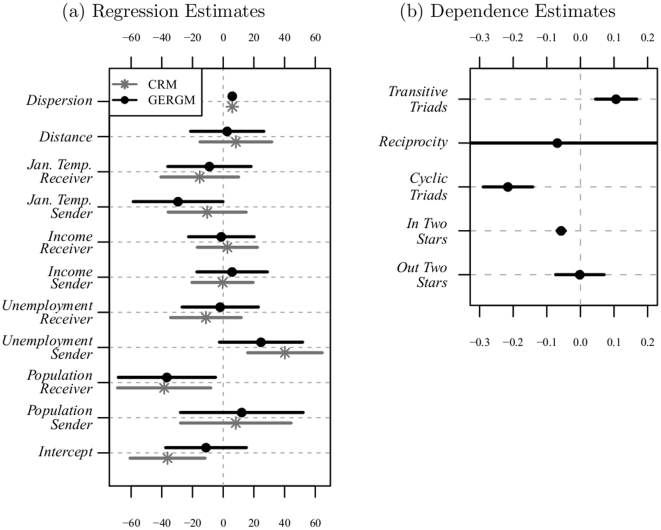
References
Publication types
MeSH terms
LinkOut - more resources
Full Text Sources
Other Literature Sources
