


Trends in the discovery of new marine natural products from invertebrates over the last two decades--where and what are we bioprospecting?
- PMID: 22276216
- PMCID: PMC3262841
- DOI: 10.1371/journal.pone.0030580
Trends in the discovery of new marine natural products from invertebrates over the last two decades--where and what are we bioprospecting?
Abstract
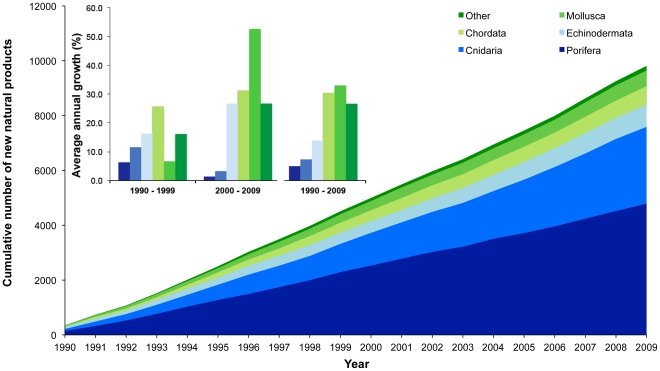
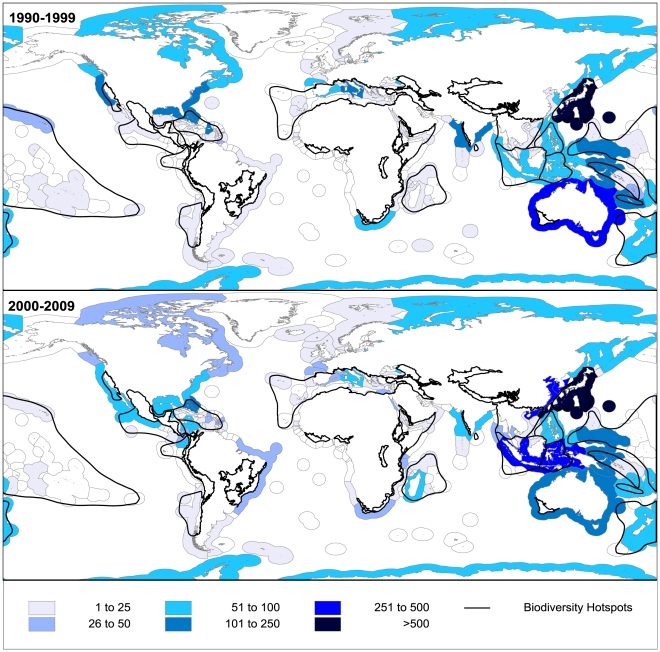
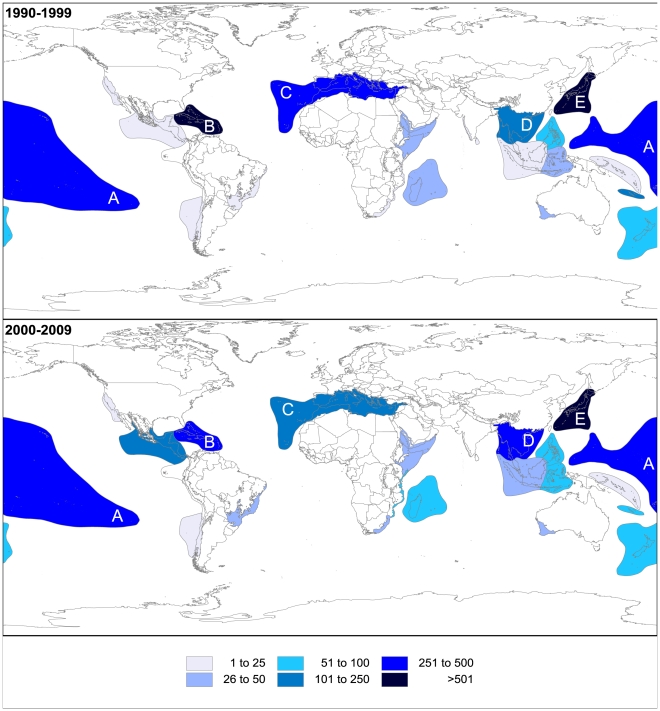
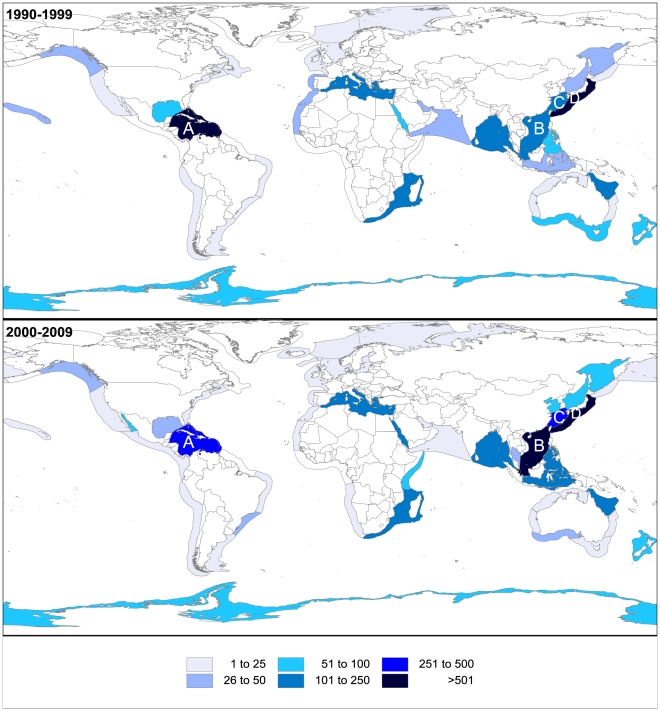
It is acknowledged that marine invertebrates produce bioactive natural products that may be useful for developing new drugs. By exploring untapped geographical sources and/or novel groups of organisms one can maximize the search for new marine drugs to treat human diseases. The goal of this paper is to analyse the trends associated with the discovery of new marine natural products from invertebrates (NMNPI) over the last two decades. The analysis considers different taxonomical levels and geographical approaches of bioprospected species. Additionally, this research is also directed to provide new insights into less bioprospected taxa and world regions. In order to gather the information available on NMNPI, the yearly-published reviews of Marine Natural Products covering 1990-2009 were surveyed. Information on source organisms, specifically taxonomical information and collection sites, was assembled together with additional geographical information collected from the articles originally describing the new natural product. Almost 10000 NMNPI were discovered since 1990, with a pronounced increase between decades. Porifera and Cnidaria were the two dominant sources of NMNPI worldwide. The exception was polar regions where Echinodermata dominated. The majority of species that yielded the new natural products belong to only one class of each Porifera and Cnidaria phyla (Demospongiae and Anthozoa, respectively). Increased bioprospecting efforts were observed in the Pacific Ocean, particularly in Asian countries that are associated with the Japan Biodiversity Hotspot and the Kuroshio Current. Although results show comparably less NMNPI from polar regions, the number of new natural products per species is similar to that recorded for other regions. The present study provides information to future bioprospecting efforts addressing previously unexplored taxonomic groups and/or regions. We also highlight how marine invertebrates, which in some cases have no commercial value, may become highly valuable in the ongoing search for new drugs from the sea.
Conflict of interest statement
Figures
References
-
- McGinn AP. Danvers: Worldwatch Institute; 1999. Safeguarding the Health of Oceans; Peterson JA, editor.87
-
- Ausubel J, Crist DT, Waggoner PE. Washington DC: Census of Marine Life; 2010. First Census of Marine Life 2010: Highlights of a decade of discovery.68
-
- Paul VJ, Ritson-Williams R. Marine chemical ecology. Natural Product Reports. 2008;25:662–695. - PubMed
-
- Paul VJ, Puglisi MP. Chemical mediation of interactions among marine organisms. Natural Product Reports. 2004;21:189–209. - PubMed
-
- Haefner B. Drugs from the deep: marine natural products as drug candidates. Drug Discovery Today. 2003;8:536–544. - PubMed
Publication types
MeSH terms
Substances
LinkOut - more resources
Full Text Sources
Other Literature Sources
Miscellaneous
