


Screening for exercise-induced bronchoconstriction in college athletes
- PMID: 22276571
- PMCID: PMC3832203
- DOI: 10.3109/02770903.2011.652329
Screening for exercise-induced bronchoconstriction in college athletes
Abstract
Objective: Previous studies have reported that the prevalence of exercise-induced bronchoconstriction (EIB) in athletes is higher than that of the general population. There is increasing evidence that athletes fail to recognize and report symptoms of EIB. As a result, there has been debate whether athletes should be screened for EIB, particularly in high-risk sports.
Methods: We prospectively studied 144 athletes from six different varsity sports at a large National Collegiate Athletic Association Division I collegiate athletic program. Baseline demographics and medical history were obtained and the presence of asthma symptoms during exercise was documented. Each athlete subsequently underwent a eucapnic voluntary hyperventilation (EVH) test to document the presence of EIB. Exhaled nitric oxide (eNO) quantification was performed immediately before EVH testing. EIB was defined as a ≥10% decline in forced expiratory volume in 1 second compared with baseline.
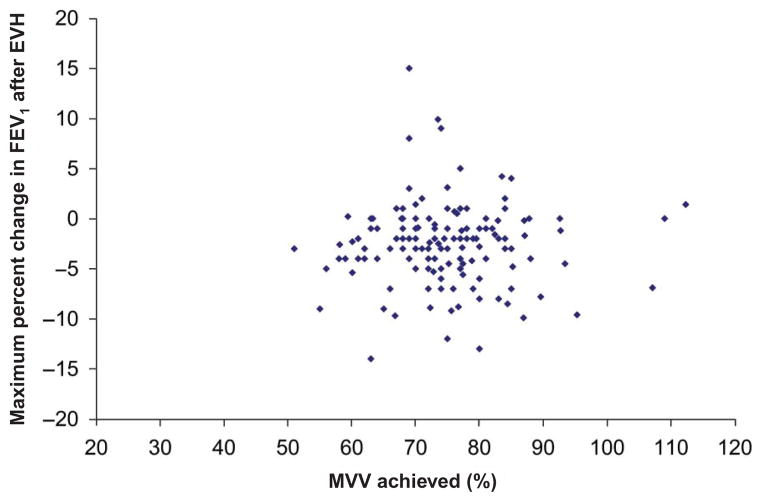
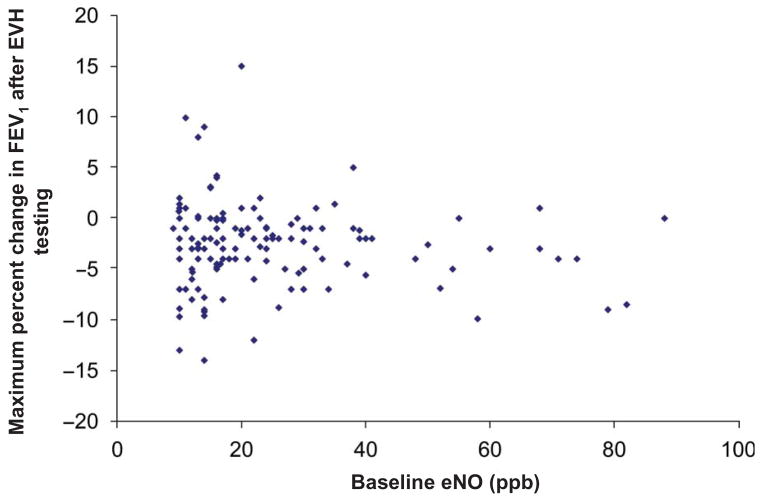
Results: Only 4 of 144 (2.7%) athletes were EIB-positive after EVH testing. The presence of symptoms was not predictive of EIB as only 2 of the 64 symptomatic athletes (3%) were EIB-positive based on EVH testing. Two of the four athletes who were found to be EIB-positive denied such symptoms. The mean baseline eNO in the four EIB-positive athletes was 13.25 parts per billion (ppb) and 24.5 ppb in the EIB-negative athletes.
Conclusions: Our data argue that screening for EIB is not recommended given the surprisingly low prevalence of EIB in the population we studied. In addition, the presence or absence of symptoms was not predictive of EIB and eNO testing was not effective in predicting EIB.
Conflict of interest statement
Declaration of Interest
The authors report no conflicts of interest. The authors alone are responsible for the content and writing of this article.
Figures
References
-
- Gotshall RW. Exercise-induced bronchoconstriction. Drugs. 2002;62 (12):1725–1739. - PubMed
-
- Weiler JM, Bonini S, Coifman R, Craig T, Delgado L, Capão-Filipe M, Passali D, Randolph C, Storms W. American Academy of Allergy, Asthma & Immunology Work Group Report: Exercise-induced asthma. J Allergy Clin Immunol. 2007;119(6):1349–1358. - PubMed
-
- Parsons JP, Mastronarde JG. Exercise-induced bronchoconstriction in athletes. Chest. 2005;128(6):3966–3974. - PubMed
-
- Rundell KW, Jenkinson DM. Exercise-induced bronchospasm in the elite athlete. Sports Med. 2002;32(9):583–600. - PubMed
-
- Parsons JP, Kaeding C, Phillips G, Jarjoura D, Wadley G, Mastronarde JG. Prevalence of exercise-induced bronchospasm in a cohort of varsity college athletes. Med Sci Sports Exerc. 2007;39(9):1487–1492. - PubMed
MeSH terms
Substances
Grants and funding
LinkOut - more resources
Full Text Sources
Medical
Research Materials
