Review
. 2012 Mar;33(3):154-64.
doi: 10.1016/j.tips.2011.12.003. Epub 2012 Jan 23.

GRK2: multiple roles beyond G protein-coupled receptor desensitization

Affiliations
Review

GRK2: multiple roles beyond G protein-coupled receptor desensitization

Tama Evron et al. Trends Pharmacol Sci. 2012 Mar.

Abstract

G protein-coupled receptor kinases (GRKs) regulate numerous G protein-coupled receptors (GPCRs) by phosphorylating the intracellular domain of the active receptor, resulting in receptor desensitization and internalization. GRKs also regulate GPCR trafficking in a phosphorylation-independent manner via direct protein-protein interactions. Emerging evidence suggests that GRK2, the most widely studied member of this family of kinases, modulates multiple cellular responses in various physiological contexts by either phosphorylating non-receptor substrates or interacting directly with signaling molecules. In this review, we discuss traditional and newly discovered roles of GRK2 in receptor internalization and signaling as well as its impact on non-receptor substrates. We also discuss novel exciting roles of GRK2 in the regulation of dopamine receptor signaling and in the activation and trafficking of the atypical GPCR, Smoothened (Smo).


Conflict of interest statement

Conflict: The authors declare no conflict of interest.

Figures
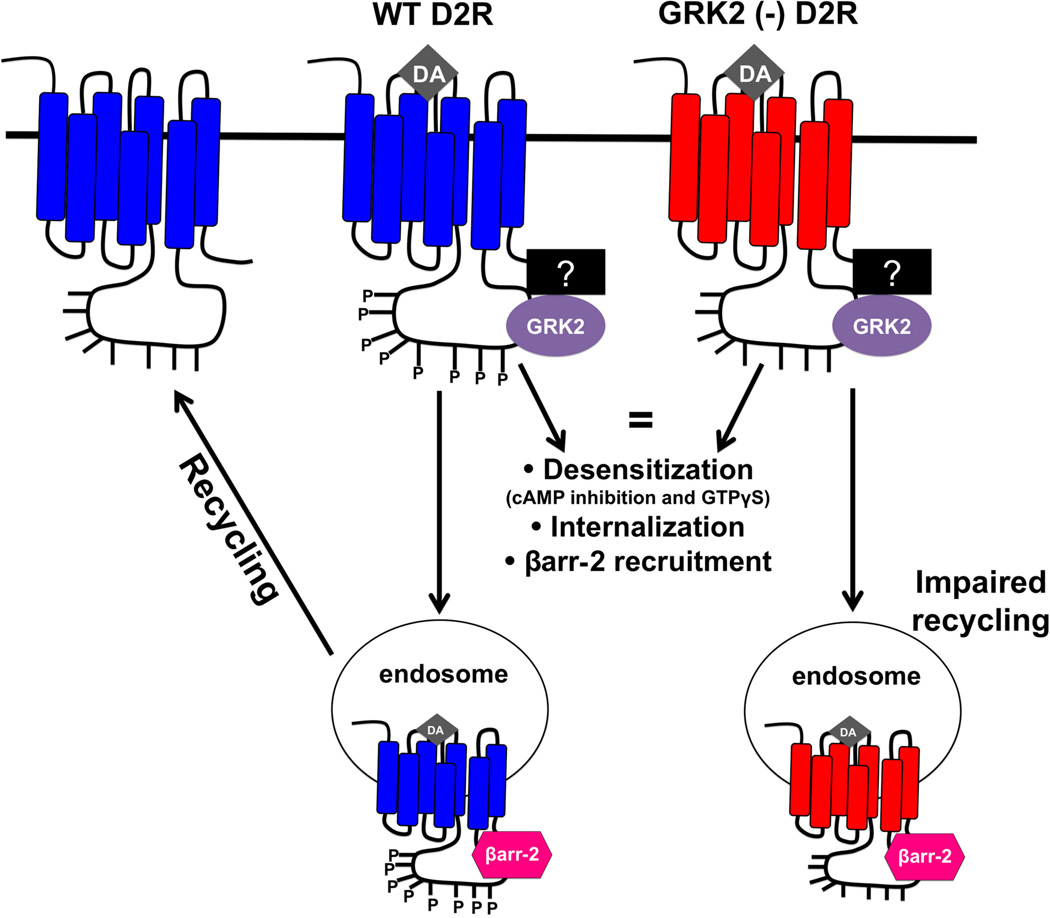
Figure 1
Figure 1. Phosphorylation-independent role for GRK2 in the regulation of D2R trafficking
Namkung et al. identified eight serine and threonine residues located within the third intracellular loop of the rat D2 long receptor that are all GRK2 phosphorylation sites [77]. Mutation of all of these sites to either alanine or valine residues generates a D2 receptor that cannot be phosphorylated by GRK2 (GRK2 (−) D2R). Stimulation of wild-type (WT) or GRK2 (−) D2Rs with dopamine (DA) results in an equivalent amount of receptor desensitization (evidenced by the extent of inhibition of forskolin-induced cAMP levels and GTPγS binding), internalization and β-arrestin-2 (βarr-2) recruitment. However, GRK2 (−) D2Rs do not recycle as efficiently (50% reduction) compared to wild-type receptors [77]. GRK2 was found to be associated with both the wild-type and mutant D2Rs under both basal conditions and in the presence of agonist [78]. The association of GRK2 with either the wild-type or phosphorylation-null D2R may be direct or may be mediated indirectly by currently unknown interacting proteins (denoted as a question mark (?) in the figure).
Figure 2
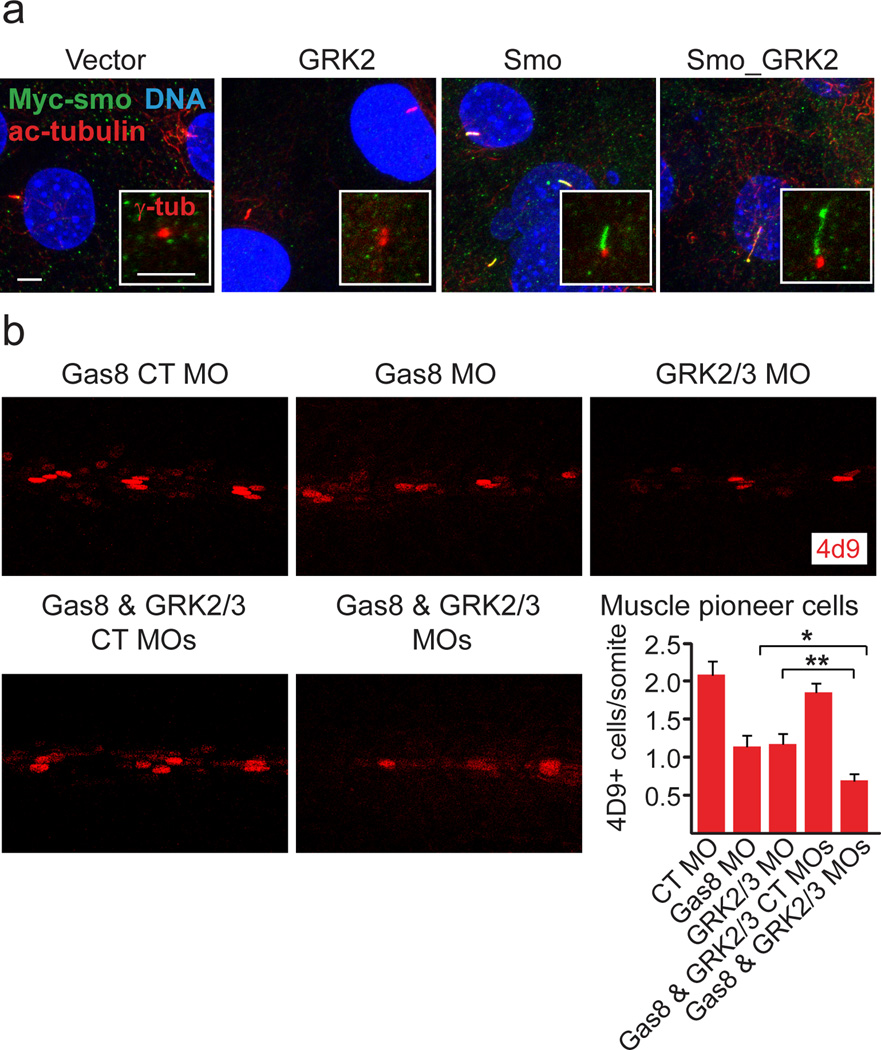
Figure 2. GRK2 effects on cilia elongation and zebrafish slow muscle development
a. Stable overexpression of GRK2 and Smo leads to increased cilia length and accumulation of Smo within the cilia shaft. Cilia of C3H10T1/2 cells stably expressing GRK2, Myc tagged Smo (Smo), Myc tagged Smo and GRK2 (Smo_GRK2) or two empty vectors are labeled using antibodies against acetylated tubulin and the Myc tag. Insets show co-staining of γ-tubulin (basal body of the cilia, red) and anti Myc (green). Scales are 5 µm. b. A synergistic effect of zebrafish Gas8 and GRK2/3 knockdown on muscle pioneer cells. Analysis of engrailed+ muscle pioneer cells (4d9) in 27 hours post fertilization embryos injected with the indicated antisense morpholinos (MOs). Bar graphs represent numbers of engrailed+ cells ± SEM measured in several somites. Separate injections of Gas8 MO and GRK2/3 MO lead to a reduction in muscle pioneer cells as compared with Gas8 control (CT) MO. Co-injection of Gas8 and GRK2/3 MO leads to a more pronounced reduction in muscle pioneer cells as compared to separate injections of either Gas8 MO or GRK2/3 MO. *, P<0.01; **, P<0.05. Embryos are shown in lateral view, anterior to the left. Modified from [15].
Figure 3
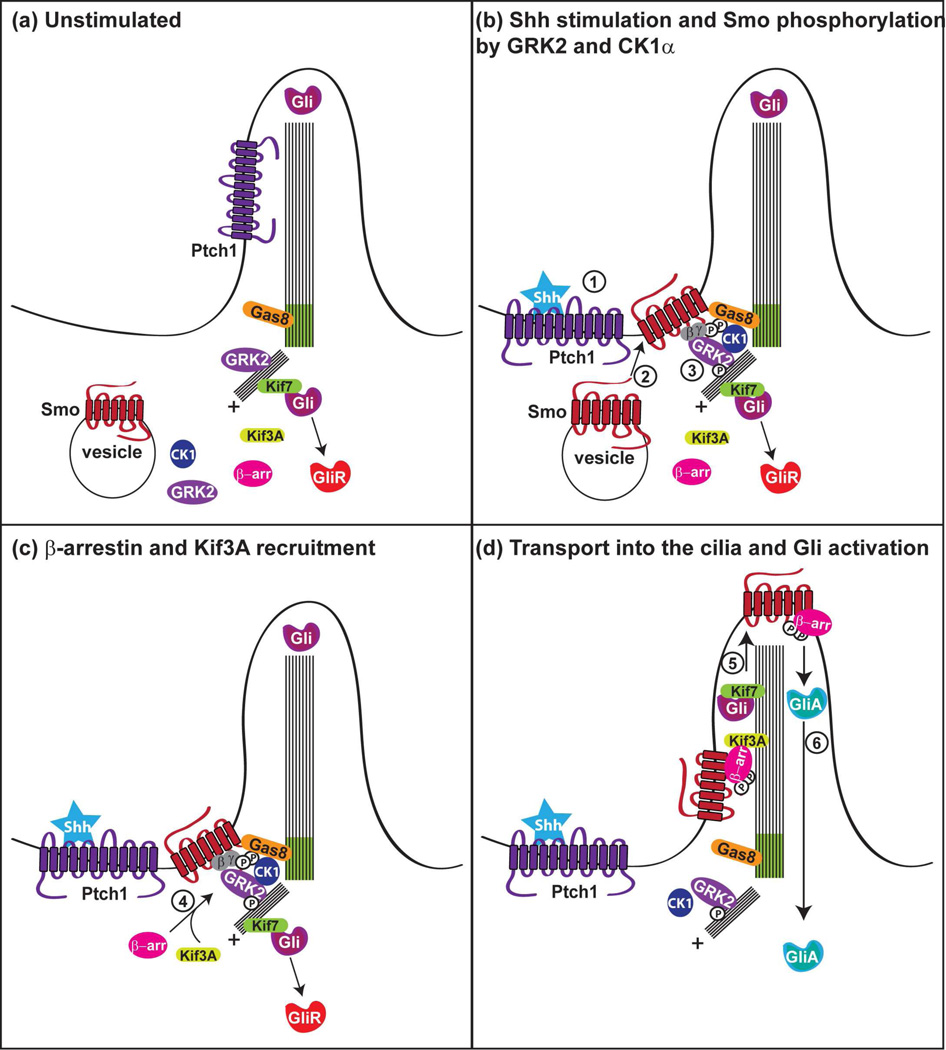
Figure 3. Proposed model for GRK2 regulation of vertebrate Hh signaling
a. In the absence of ligand, Ptch1 is localized to the cilium while Smo remains in cytoplasmic vesicles (outside of the cilium). Gli transcription factors are held outside of the cilium in a complex of proteins. This complex likely includes the kinesin motor protein, Kif7, which prevents the entry of Gli into the cilium and promotes the processing of Gli repressors (GliR). b. In response to Shh ligand stimulation (step 1), Ptch1 leaves the cilium whereas Smo translocates to the ciliary membrane (step 2). The kinases CK1α and GRK2 phosphorylate Smo at the basal body of the cilium (step 3), a critical step for the recruitment of β-arrestin (β -arr) to the receptor and their consequent interaction with the kinesin motor protein, Kif3A (step 4 in c). GRK2 also cooperates with Gas8 to promote efficient trafficking and signaling of Smo (step 5 in d). Kif7 translocates to the cilium, thereby allowing Gli accumulation in the cilia. Additionally, the GRK2-mediated phosphorylation of tubulin is likely important for ciliary microtubule maintenance. Successful activation of Smo leads to the activation of Glis (GliA) at the cilia tip and their subsequent trafficking out of the cilium toward the nucleus (step 6 in d).

References

    1. Takeda S, et al. Identification of G protein-coupled receptor genes from the human genome sequence. FEBS Lett. 2002;520:97–101. - PubMed
    1. Pierce KL, et al. Seven-transmembrane receptors. Nat Rev Mol Cell Biol. 2002;3:639–650. - PubMed
    1. Lefkowitz RJ, Shenoy SK. Transduction of receptor signals by beta-arrestins. Science. 2005;308:512–517. - PubMed
    1. Pitcher JA, et al. G protein-coupled receptor kinases. Annu Rev Biochem. 1998;67:653–692. - PubMed
    1. Shenoy SK, Lefkowitz RJ. Multifaceted roles of beta-arrestins in the regulation of seven-membrane-spanning receptor trafficking and signalling. Biochem J. 2003;375:503–515. - PMC - PubMed

Publication types

Substances