


Antiretroviral restriction factors
- PMID: 22278313
- PMCID: PMC3263365
- DOI: 10.1016/j.coviro.2011.10.007
Antiretroviral restriction factors
Abstract
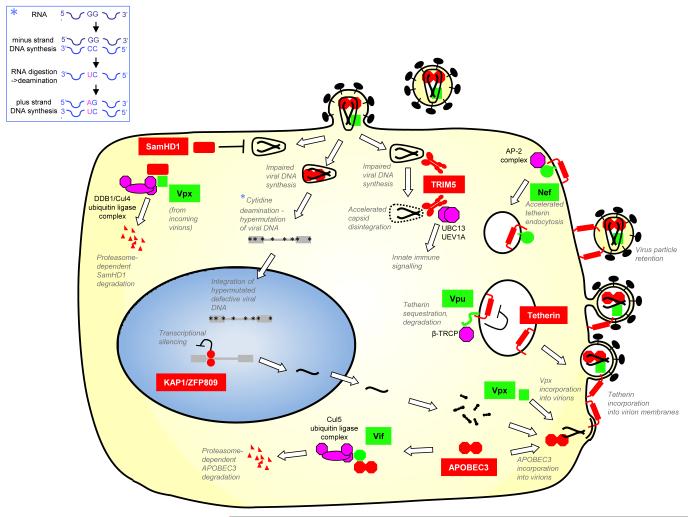
Studies of retroviruses have been instrumental in revealing the existence of an array of antiviral proteins, or restriction factors, and the mechanisms by which they function. Some restriction factors appear to specifically inhibit retrovirus replication, while others have a broader antiviral action. Here, we briefly review current understanding of the mechanisms by which several such proteins exert antiviral activity. We also discuss how retroviruses have evolved to evade or antagonize antiviral proteins, including through the action of viral accessory proteins. Restriction factors, their viral targets and antagonists have exerted evolutionary pressure on each other, resulting in specialization and barriers to cross-species transmission. Potentially, this recently revealed intrinsic system of antiviral immunity might be mobilized for therapeutic benefit.
Figures
References
-
-
Sheehy AM, Gaddis NC, Choi JD, Malim MH. Isolation of a human gene that inhibits HIV-1 infection and is suppressed by the viral Vif protein. Nature. 2002;418:646–650. **Using complementary DNA substraction this paper first identified huAPOBEC3G (CEM15) as the protein that inhibits HIV-1 and is overcome by Vif. This is the first description of a cellular protein with specific activity against HIV-1 and marks the beginning of an explosion of interest in research on ‘restriction factors’.
-
-
- Conticello SG, Thomas CJ, Petersen-Mahrt SK, Neuberger MS. Evolution of the AID/APOBEC family of polynucleotide (deoxy)cytidine deaminases. Mol Biol Evol. 2005;22:367–377. - PubMed
-
-
Chiu YL, Greene WC. The APOBEC3 cytidine deaminases: an innate defensive network opposing exogenous retroviruses and endogenous retroelements. Annu Rev Immunol. 2008;26:317–353. * In this compehensive review, Table 1 is especially useful as it summarizes the activity of various APOBEC3 viruses against exogenous and endogenous retroviruses and other viruses. See also reference #18.
-
-
- Schafer A, Bogerd HP, Cullen BR. Specific packaging of APOBEC3G into HIV-1 virions is mediated by the nucleocapsid domain of the gag polyprotein precursor. Virology. 2004;328:163–168. - PubMed
Publication types
MeSH terms
Substances
Grants and funding
LinkOut - more resources
Full Text Sources
