


Effects of electronegative VLDL on endothelium damage in metabolic syndrome
- PMID: 22279032
- PMCID: PMC3322679
- DOI: 10.2337/dc11-1623
Effects of electronegative VLDL on endothelium damage in metabolic syndrome
Abstract
Objective: Biochemical heterogeneity governs functional disparities among lipoproteins. We examined charge-defined VLDL subfractions in metabolic syndrome (MetS) to determine whether their increased electronegativity is associated with increased cytotoxicity and whether high concentrations of highly electronegative subfractions render VLDL harmful to the vascular endothelium.
Research design and methods: Plasma VLDL of normal individuals (control subjects) (n = 13) and of those with MetS (n = 13) was resolved into subfractions with increasing negative charge (V1-V5) by anion-exchange chromatography. Human aortic endothelial cells were treated with V1-V5 or unfractionated VLDL.
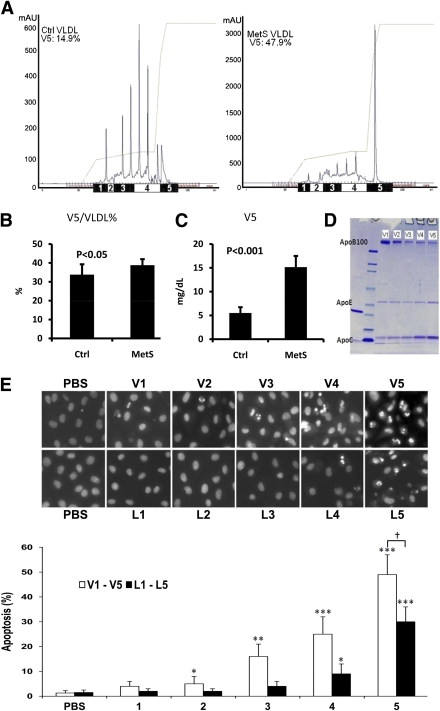
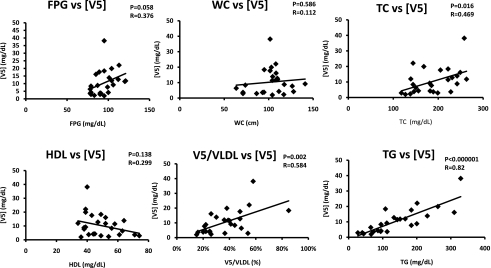
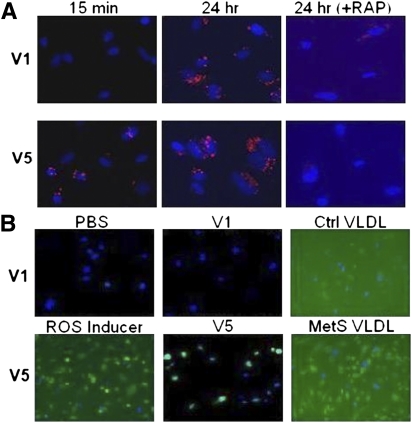
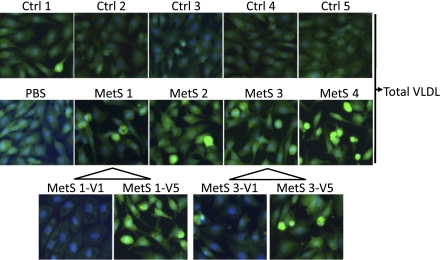
Results: Compared with the control subjects, individuals with MetS had a significantly higher percentage of V5 VLDL (V5/VLDL%) (34 ± 20 vs. 39 ± 11%, respectively; P < 0.05) and plasma V5 concentration ([V5]) (5.5 ± 4.4 vs. 15.2 ± 8.5 mg/dL, respectively; P < 0.001). Apolipoprotein (apo)B100 levels decreased and apoC levels increased from V1 to V5, indicating that V5 is apoC-rich VLDL. Regression analyses of all 26 individuals showed that [V5] was positively correlated with total cholesterol (P = 0.016), triglyceride (P < 0.000001), and V5/VLDL% (P = 0.002). Fasting plasma glucose, but not waist circumference, exhibited a positive trend (P = 0.058); plasma HDL cholesterol exhibited a weak inverse trend (P = 0.138). V5 (10 μg/mL) induced apoptosis in ~50% of endothelial cells in 24 h. V5 was the most rapidly (<15 min) internalized subfraction and induced the production of reactive oxygen species (ROS) in endothelial cells after 20 min. Unfractionated MetS VLDL, but not control VLDL, also induced ROS production and endothelial cell apoptosis.
Conclusions: In populations with increased risk of diabetes, the vascular endothelium is constantly exposed to VLDL that contains a high proportion of V5. The potential impact of V5-rich VLDL warrants further investigation.
Figures
References
-
- Krauss RM. Lipids and lipoproteins in patients with type 2 diabetes. Diabetes Care 2004;27:1496–1504 - PubMed
-
- Liao Y, Kwon S, Shaughnessy S, et al. Critical evaluation of adult treatment panel III criteria in identifying insulin resistance with dyslipidemia. Diabetes Care 2004;27:978–983 - PubMed
-
- Kawakami A, Aikawa M, Libby P, Alcaide P, Luscinskas FW, Sacks FM. Apolipoprotein CIII in apolipoprotein B lipoproteins enhances the adhesion of human monocytic cells to endothelial cells. Circulation 2006;113:691–700 - PubMed
Publication types
MeSH terms
Substances
Grants and funding
LinkOut - more resources
Full Text Sources
Medical
