. 2012 Apr;19(2):153-64.
doi: 10.1093/dnares/dsr048. Epub 2012 Jan 24.

Molecular phylogenetic and expression analysis of the complete WRKY transcription factor family in maize

Affiliations

Molecular phylogenetic and expression analysis of the complete WRKY transcription factor family in maize

Kai-Fa Wei et al. DNA Res. 2012 Apr.

Abstract

The WRKY transcription factors function in plant growth and development, and response to the biotic and abiotic stresses. Although many studies have focused on the functional identification of the WRKY transcription factors, much less is known about molecular phylogenetic and global expression analysis of the complete WRKY family in maize. In this study, we identified 136 WRKY proteins coded by 119 genes in the B73 inbred line from the complete genome and named them in an orderly manner. Then, a comprehensive phylogenetic analysis of five species was performed to explore the origin and evolutionary patterns of these WRKY genes, and the result showed that gene duplication is the major driving force for the origin of new groups and subgroups and functional divergence during evolution. Chromosomal location analysis of maize WRKY genes indicated that 20 gene clusters are distributed unevenly in the genome. Microarray-based expression analysis has revealed that 131 WRKY transcripts encoded by 116 genes may participate in the regulation of maize growth and development. Among them, 102 transcripts are stably expressed with a coefficient of variation (CV) value of <15%. The remaining 29 transcripts produced by 25 WRKY genes with the CV value of >15% are further analysed to discover new organ- or tissue-specific genes. In addition, microarray analyses of transcriptional responses to drought stress and fungal infection showed that maize WRKY proteins are involved in stress responses. All these results contribute to a deep probing into the roles of WRKY transcription factors in maize growth and development and stress tolerance.


Figures
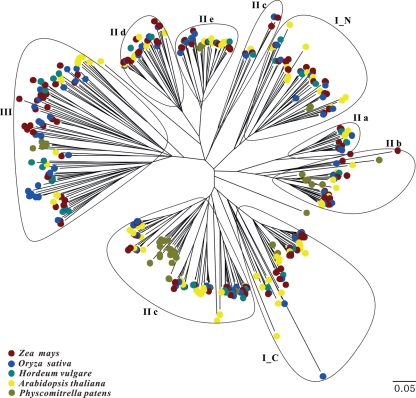
Figure 1.
Figure 1.
Unrooted Neighbor-Joining phylogenetic tree of WRKY domains in five plants. The tree is reconstructed using WRKY domain sequences from the complete WRKY gene families in A. thaliana (yellow), Z. mays (B73, brown), O. sativa (blue), H. vulgare (green) and P. patens (khaki). The evolutionary distances are computed using the p-distance method and are in the units of the number of amino acid substitutions per site.
Figure 2.
Figure 2.
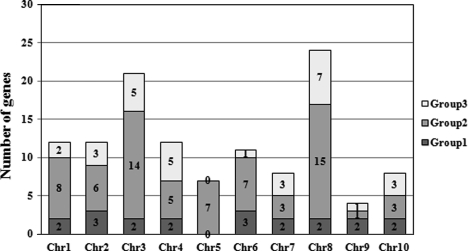
Histogram showing the number and distribution of WRKY genes of three groups on 10 chromosomes.
Figure 3.
Figure 3.
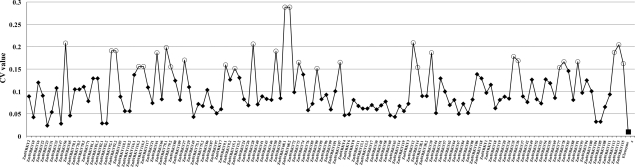
Line graph showing the CV of the signal intensities of 131 WRKY transcripts across 60 developmental stages. Normalized signal intensities of 131 ZmWRKY transcripts are displayed (according to MaizePlex), and corresponding ZmWRKY transcripts are presented on the x-axis with the order according to the groups. The transcripts with CV ≥15% are represented by a tiny hollow circle. The reference gene which encodes E2 enzyme is shown as a small square.
Figure 4.
Figure 4.
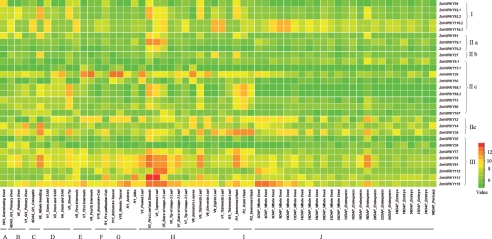
Heat map showing the signal intensities of 29 ZmWRKY transcripts with CV ≥15% in 11 specific organs. The alphabet represents specific developmental stages: A, germinating seed; B, primary root; C, whole seedling; D, stem and SAM; E, internode; F, cob; G, tassel and anthers; H, leaves; I, husk; J, seed.
Figure 5.
Figure 5.
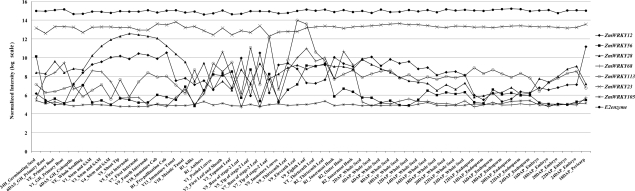
Line graph of the signal intensities of six interest ZmWRKY transcripts with CV ≥20% in 11 specific organs, as well as three reference transcripts.

References

    1. Ulker B., Somssich I.E. WRKY transcription factors: from DNA binding towards biological function. Curr. Opin. Plant Biol. 2004;7:491–8. - PubMed
    1. Ciolkowski I., Wanke D., Birkenbihl R.P., Somssich I.E. Studies on DNA-binding selectivity of WRKY transcription factors lend structural clues into WRKY-domain function. Plant Mol. Biol. 2008;68:81–92. - PMC - PubMed
    1. Eulgem T., Rushton P.J., Schmelzer E., Hahlbrock K., Somssich I.E. Early nuclear events in plant defence signalling: rapid gene activation by WRKY transcription factors. EMBO J. 1999;18:4689–99. - PMC - PubMed
    1. Johnson C.S., Kolevski B., Smyth D.R. TRANSPARENT TESTA GLABRA2, a trichome and seed coat development gene of Arabidopsis, encodes a WRKY transcription factor. Plant Cell. 2002;14:1359–75. - PMC - PubMed
    1. Luo M., Dennis E.S., Berger F., Peacock W.J., Chaudhury A. MINISEED3 (MINI3), a WRKY family gene, and HAIKU2 (IKU2), a leucine-rich repeat (LRR) KINASE gene, are regulators of seed size in Arabidopsis. Proc. Natl Acad. Sci. USA. 2005;102:17531–6. - PMC - PubMed

Publication types