


IncP-1ε Plasmids are Important Vectors of Antibiotic Resistance Genes in Agricultural Systems: Diversification Driven by Class 1 Integron Gene Cassettes
- PMID: 22279444
- PMCID: PMC3260659
- DOI: 10.3389/fmicb.2012.00002
IncP-1ε Plasmids are Important Vectors of Antibiotic Resistance Genes in Agricultural Systems: Diversification Driven by Class 1 Integron Gene Cassettes
Abstract
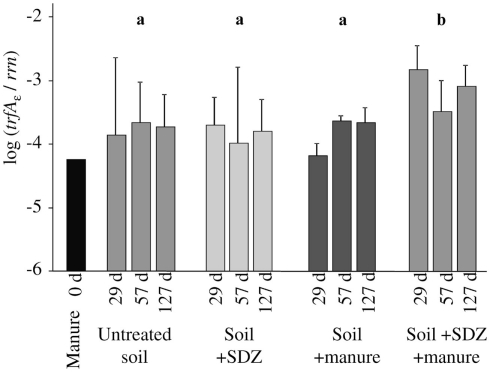
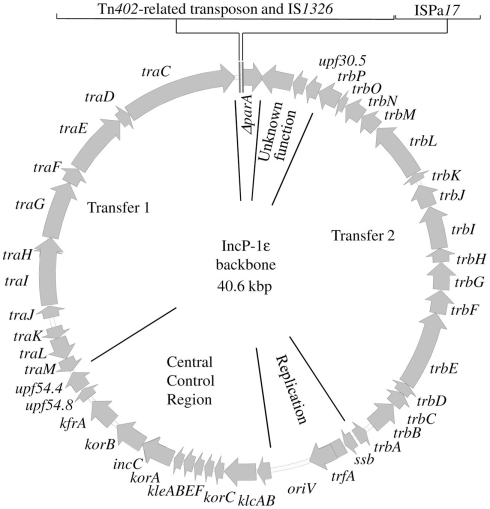
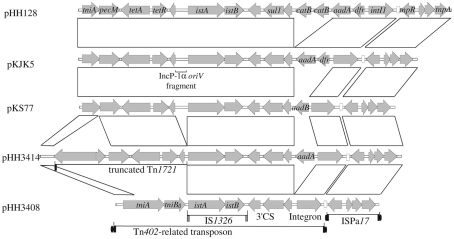
The role of broad-host range IncP-1ε plasmids in the dissemination of antibiotic resistance in agricultural systems has not yet been investigated. These plasmids were detected in total DNA from all of 16 manure samples and in arable soil based on a novel 5'-nuclease assay for real-time PCR. A correlation between IncP-1ε plasmid abundance and antibiotic usage was revealed. In a soil microcosm experiment the abundance of IncP-1ε plasmids was significantly increased even 127 days after application of manure containing the antibiotic compound sulfadiazine, compared to soil receiving only manure, only sulfadiazine, or water. Fifty IncP-1ε plasmids that were captured in E. coli CV601gfp from bacterial communities of manure and arable soil were characterized by PCR and hybridization. All plasmids carried class 1 integrons with highly varying sizes of the gene cassette region and the sul1 gene. Three IncP-1ε plasmids captured from soil bacteria and one from manure were completely sequenced. The backbones were nearly identical to that of the previously described IncP-1ε plasmid pKJK5. The plasmids differed mainly in the composition of a Tn402-like transposon carrying a class 1 integron with varying gene cassettes, IS1326, and in three of the plasmids the tetracycline resistance transposon Tn1721 with various truncations. Diverse Beta- and Gammaproteobacteria were revealed as hosts of one of the IncP-1ε plasmids in soil microcosms. Our data suggest that IncP-1ε plasmids are important vectors for horizontal transfer of antibiotic resistance in agricultural systems.
Keywords: IncP-1ε plasmid; arable soil; complete sequence; exogenous isolation; gene cassette; pig manure; qPCR.
Figures
References
-
- Bahl M. I., Hansen L. H., Goesmann A., Sorensen S. J. (2007). The multiple antibiotic resistance IncP-1 plasmid pKJK5 isolated from a soil environment is phylogenetically divergent from members of the previously established alpha, beta and delta sub-groups. Plasmid 58, 31–4310.1016/j.plasmid.2006.11.007 - DOI - PubMed
LinkOut - more resources
Full Text Sources
