


What you may not see might slow you down anyway: masked images and driving
- PMID: 22279549
- PMCID: PMC3261158
- DOI: 10.1371/journal.pone.0029857
What you may not see might slow you down anyway: masked images and driving
Abstract
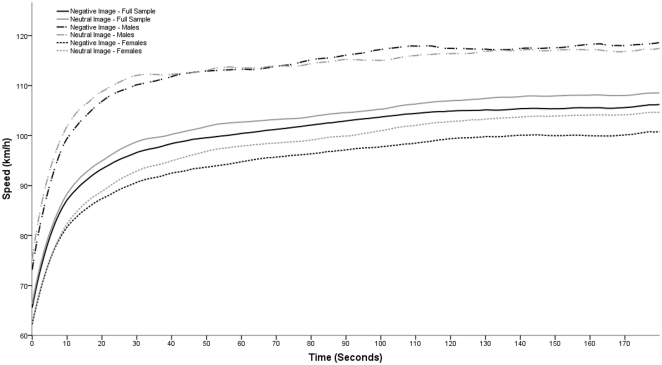
Many theories of driver behaviour suggest that unconscious or implicit emotions play a functional role in the shaping and control of behaviour. This has not been experimentally tested however. Therefore, in this study the effects of emotive masked images on driver behaviour were examined. While driving a simulator, participants were repeatedly exposed to negative or neutral emotionally laden target images that were sandwich masked by emotionally neutral images. These images were encountered across two different trials each of which consisted of 3-4 minutes of driving on a rural road. The results indicate an effect of the negative target images primarily in reducing the extent of familiarisation occurring between the first and second experimental drives. This is evident in a reduced decrease in heart rate and a reduced increase in high band heart rate variability and actual travelling speed from the first to second drives if the negative target image was presented in the second drive. In addition to these findings there was no clear effect of the target image on subjective ratings of effort or feelings of risk. There was however an effect of gender, with the majority of the effects found in the study being limited to the larger female dataset. These findings suggest that unconscious or implicit emotional stimuli may well influence driver behaviour without explicit awareness.
Conflict of interest statement
Figures


References
-
- Fuller R. Towards a general theory of driver behaviour. Accident Analysis & Prevention. 2005;37(3):461–472. - PubMed
-
- Fuller R, Bates H, Gormley M, Hannigan B, Stradling S, et al. The conditions for inappropriate high speed: A review of the research literature from 1995 to 2006. 2008. Report Under Contract Number PPRO.
-
- Fuller R. Driver control theory: From task difficulty homeostasis to risk allostasis. In: Porter B, editor. Handbook of the 4th International Conference on Traffic and Transport Psychology. Washington DC: 2011.
-
- Summala H. Traffic psychology theories: Towards understanding driving behaviour and safety efforts. In: Underwood G, editor. Traffic and Transport Psychology. Amsterdam: Elsevier; 2005. pp. 383–394.
-
- Vaa T. Survival or deviance? 2003. A model for driver behaviour–Summary. TOI report 666/2003.
Publication types
MeSH terms
LinkOut - more resources
Full Text Sources
Medical
