. 2012 Jan;131(1):442-54.
doi: 10.1121/1.3651823.

Cross-linguistic studies of children's and adults' vowel spaces

Affiliations

Cross-linguistic studies of children's and adults' vowel spaces

Hyunju Chung et al. J Acoust Soc Am. 2012 Jan.

Abstract

This study examines cross-linguistic variation in the location of shared vowels in the vowel space across five languages (Cantonese, American English, Greek, Japanese, and Korean) and three age groups (2-year-olds, 5-year-olds, and adults). The vowels /a/, /i/, and /u/ were elicited in familiar words using a word repetition task. The productions of target words were recorded and transcribed by native speakers of each language. For correctly produced vowels, first and second formant frequencies were measured. In order to remove the effect of vocal tract size on these measurements, a normalization approach that calculates distance and angular displacement from the speaker centroid was adopted. Language-specific differences in the location of shared vowels in the formant values as well as the shape of the vowel spaces were observed for both adults and children.


Figures

Figure 1
Figure 1
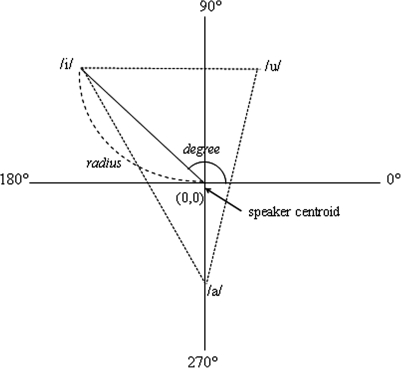
A Cartesian coordinate system showing how the radius and degree values for /i/ were calculated.
Figure 2
Figure 2
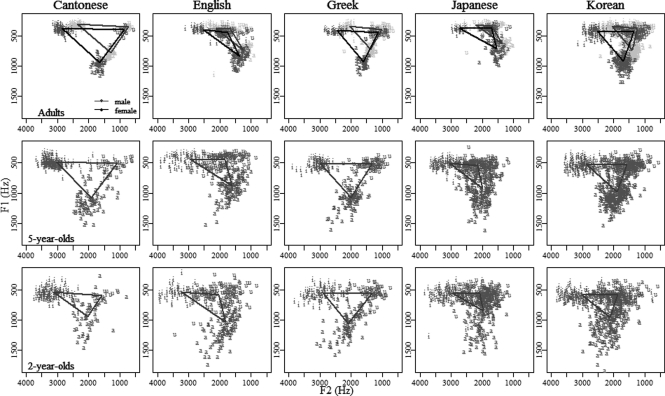
Scatter plots of F1 and F2 by language and age for both males (grey) and females (black). Each point represents the production of a single vowel by a single speaker. The vowel space was drawn by connecting the mean F1–F2 value of all productions of each vowel for each language and age group.
Figure 3
Figure 3
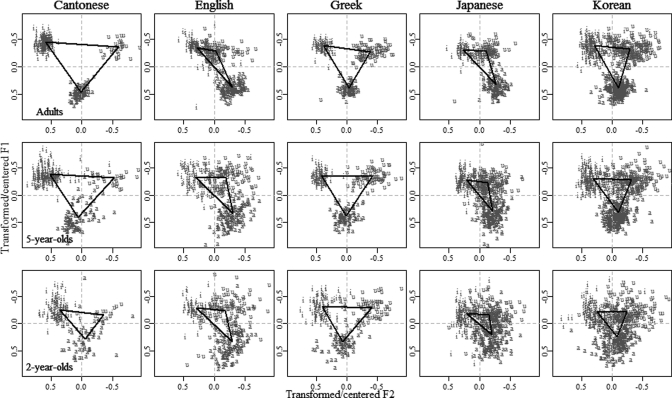
Scatter plots of transformed F1–F2 by language and age. The transformations were made by subtracting each individual’s mean F1 and F2 values from log-transformed F1 and F2 values of each token. The measurements were centered at the origin (0, 0), the speaker centroid. The vowel space was drawn by connecting the mean log-transformed F1–F2 value of all productions of each vowel for each language and age group.
Figure 4
Figure 4
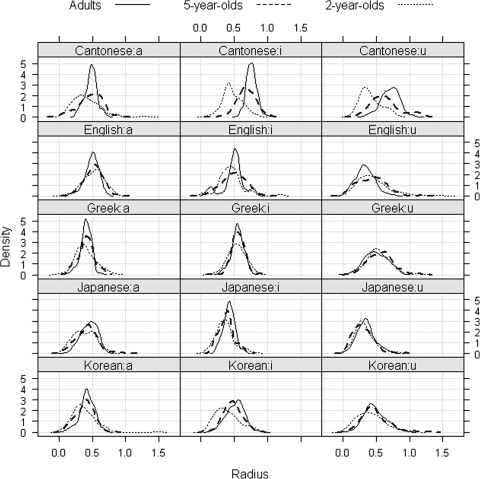
(Color online) Density plots of radius values sorted by language, age, and vowel. The x axis shows radius values, and the y axis represents the density, which is the relative frequency of occurrence for different radius values. Solid lines show data for adults; dotted lines show data for 5-year-olds; and small dotted lines show data for 2-year-olds.
Figure 5
Figure 5
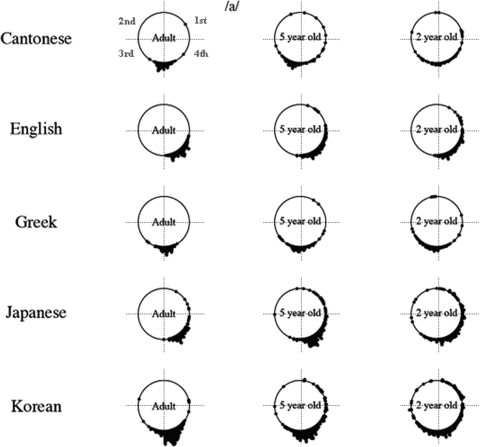
Circular plots for /a/. Each dot represents degree values of each vowel. The degree values were calculated and placed on the arc of a circle from the origin (0,0).
Figure 6
Figure 6
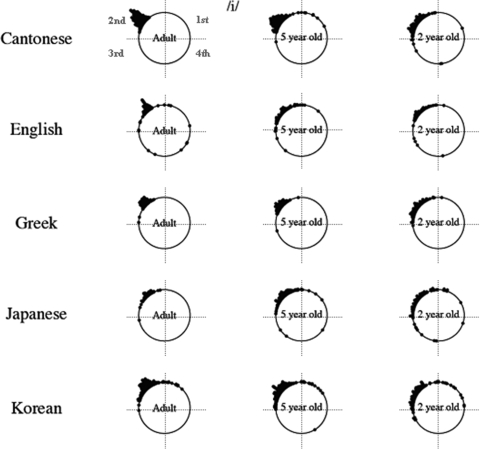
Circular plots for /i/.
Figure 7
Figure 7
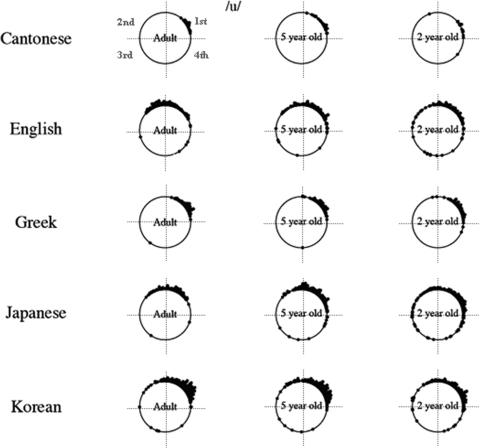
Circular plots for /u/.

References

    1. Adank, P., Smits. R., and, van Hout, R. (2004). “A comparison of vowel normalization procedures for language variation research,” J. Acoust. Soc. Am. 116, 3099–3107. 10.1121/1.1795335 - DOI - PubMed
    1. Amano, S., and Kondo, T. (1999). Nihongo-no goitokusei (Lexical Properties of Japanese) (Sanseido, Tokyo: ).
    1. Bates, D., and Maechler, M. (2009). “Lme4: Linear mixed-effects models using S4 classes,” R package version 0.999375-32.
    1. Boersma, P., and Weenink, D. (2006). “Praat: Doing phonetics by computer [Computer program],”http://www.praat.org (Last viewed September 20, 2010).
    1. Bradlow, A. R. (1995). “A comparative acoustic study of English and Spanish vowels,” J. Acoust. Soc. Am. 97, 1916–1924. 10.1121/1.412064 - DOI - PubMed

Publication types