


Association of factor V gene polymorphism with arteriovenous graft failure
- PMID: 22281051
- PMCID: PMC3328616
- DOI: 10.1053/j.ajkd.2011.11.036
Association of factor V gene polymorphism with arteriovenous graft failure
Abstract
Background: Dialysis grafts fail due to recurrent stenosis and thrombosis. Vasoactive and prothrombotic substances affecting intimal hyperplasia or thrombosis may modify graft outcomes.
Study design: Genetic polymorphisms association study of patients enrolled in a multicenter randomized clinical trial.
Setting & participants: 354 Dialysis Access Consortium (DAC) Study patients receiving a new graft with DNA samples obtained. Participants were randomly assigned to treatment with aspirin plus dipyridamole versus placebo.
Predictor: DNA sequence polymorphisms for the following candidate genes and their interaction with the study intervention: methylenetetrahydrofolate reductase (MTHFR), heme oxygenase 1 (HO-1), factor V (F5), transforming growth factor β1 (TGFβ1), klotho, nitric oxide synthase (NOS), and angiotensin-converting enzyme (ACE).
Outcome: Graft failure (>50% stenosis, angioplasty, thrombosis, surgical intervention, or permanent loss of function).
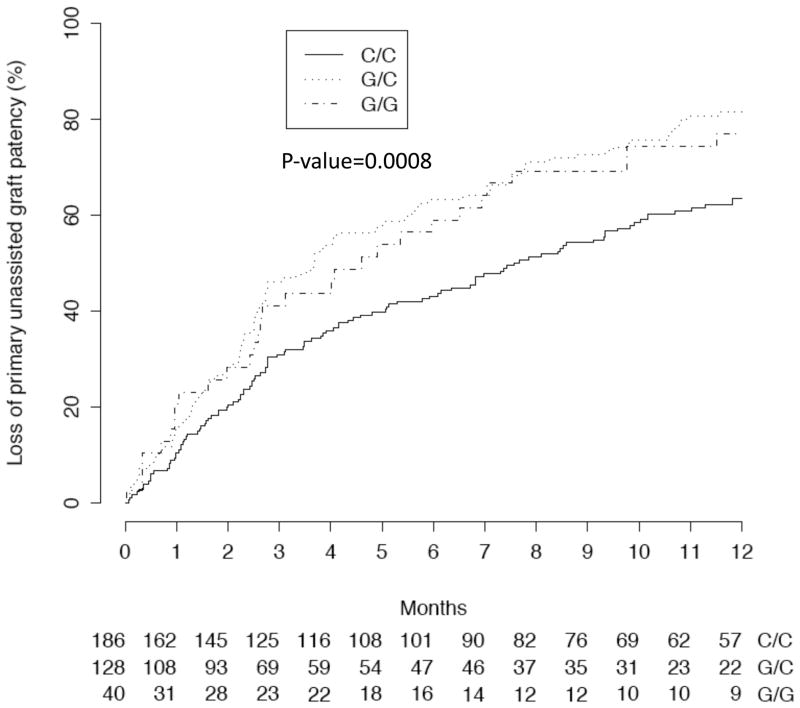
Results: During a median patient follow-up of 34.3 months, 304 grafts failed. After adjusting for clinical factors (patient age, sex, access location, diabetes, cardiovascular disease, baseline aspirin use, body mass index, timing of graft placement, and study treatment) and genetic ancestral background, single-nucleotide polymorphism rs6019 of the factor V gene was associated significantly with graft failure in a dominant model (HR of 1.70 [95% CI, 1.32-2.19; P < 0.001] for G/C and G/G genotypes vs C/C genotypes). There was no significant association between graft failure and polymorphisms of MTHFR, HO-1, TGFβ1, klotho, NOS, or ACE.
Limitations: Small sample size.
Conclusion: The rs6019 genotype of Factor V is associated with increased risk of graft failure. Anticoagulation may reduce graft failure in patients with the G/C or G/G genotypes.
Copyright © 2012 National Kidney Foundation, Inc. Published by Elsevier Inc. All rights reserved.
Figures
References
-
- Allon M. Current management of vascular access. Clin J Am Soc Nephrol. 2007;2:786–800. - PubMed
-
- Roy-Chaudhury P, Kelly BS, Miller MA, et al. Venous neointimal hyperplasia in polytetrafluoroethylene dialysis grafts. Kidney Int. 2001;59:2325–34. - PubMed
-
- Roy-Chaudhury P, Sukhatme VP, Cheung AK. Hemodialysis vascular access dysfunction: A cellular and molecular viewpoint. J Am Soc Nephrol. 2006;17:1112–27. - PubMed
-
- Roy-Chaudhury P, Arend L, Zhang J, et al. Neointimal hyperplasia in early arteriovenous fistula failure. Am J Kidney Dis. 2007;50:782–90. - PubMed
-
- Chang CJ, Ko PJ, Hsu LA, et al. Highly increased cell proliferation activity in restenotic hemodialysis vascular access after percutaneous transluminal angioplasty: Implication in prevention of stenosis. Am J Kidney Dis. 2004;43:74–84. - PubMed
Publication types
MeSH terms
Substances
Grants and funding
LinkOut - more resources
Full Text Sources
Medical
Miscellaneous
