Review
. 2012 Aug 15;62(2):720-5.
doi: 10.1016/j.neuroimage.2012.01.049. Epub 2012 Jan 14.

The rapid development of high speed, resolution and precision in fMRI

Affiliations
Review

The rapid development of high speed, resolution and precision in fMRI

David A Feinberg et al. Neuroimage. .

Abstract

MRI pulse sequences designed to increase the speed and spatial resolution of fMRI have always been a hot topic. Here, we review and chronicle the history behind some of the pulse sequence ideas that have contributed not only to the enhancement of fMRI acquisition but also to diffusion imaging. (i) Partial Fourier EPI allows lengthening echo trains for higher spatial resolution while maintaining optimal TE and BOLD sensitivity. (ii) Inner-volume EPI renamed zoomed-EPI, achieves extremely high spatial resolution and has been applied to fMRI at 7Tesla to resolve cortical layer activity and columnar level fMRI. (iii) An early non-BOLD approach while unsuccessful for fMRI created a diffusion sequence of bipolar pulses called 'twice refocused spin echo' now widely used for high-resolution DTI and HARDI neuronal fiber track imaging. (iv) Multiplexed EPI shortens TR to a few hundred milliseconds, increasing sampling rates and statistical power in fMRI.


Figures

Fig. 1
Fig. 1
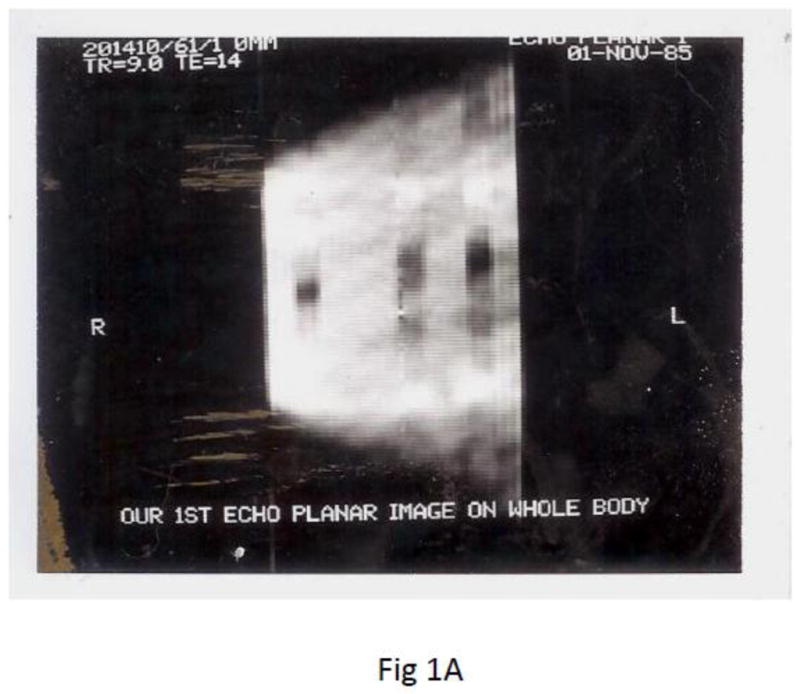
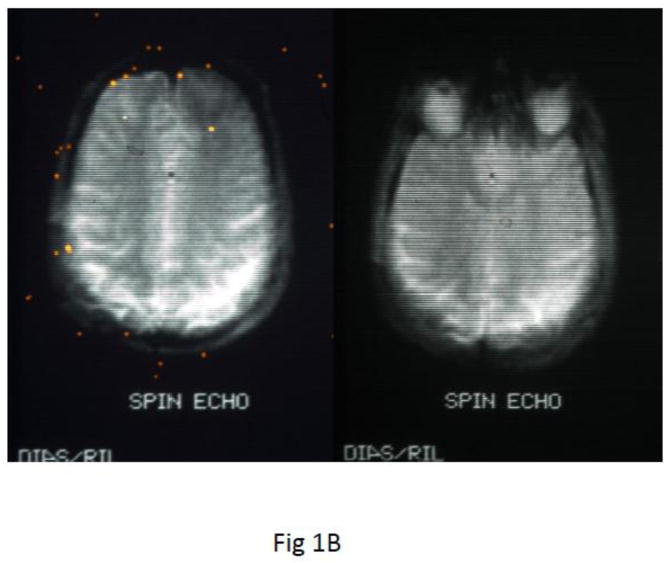
Earliest known EPI images in North American made on a 0.35 Tesla superconducting magnet P-0 scanner at UCSF RIL. A) EPI image of phantom made with slow gradient switching. To compensate for the only possible few echoes refocused, the EPI pulse sequence combined 3 novel techniques i) inner-volume (zoomed-EPI) to achieve 4 times higher resolution, ii) half Fourier for earlier TE to increase SNR and iii) spin echo CPMG refocusing for multiple gradient echoes and spin echoes to reduce field inhomogeneity errors. Spatial resolution 1.7mm × 1.7mm and 10mm thick (Feinberg and Hale, 1986). B) half Fourier spin echo EPI acquired on a faster gradient coil insert (Crooks et al., 1986) eliminated the first half of k-space allowing the center of k-space (Ko) to move to the beginning of the echo train, TE=14 ms for higher SNR.
Fig. 1
Fig. 1
Earliest known EPI images in North American made on a 0.35 Tesla superconducting magnet P-0 scanner at UCSF RIL. A) EPI image of phantom made with slow gradient switching. To compensate for the only possible few echoes refocused, the EPI pulse sequence combined 3 novel techniques i) inner-volume (zoomed-EPI) to achieve 4 times higher resolution, ii) half Fourier for earlier TE to increase SNR and iii) spin echo CPMG refocusing for multiple gradient echoes and spin echoes to reduce field inhomogeneity errors. Spatial resolution 1.7mm × 1.7mm and 10mm thick (Feinberg and Hale, 1986). B) half Fourier spin echo EPI acquired on a faster gradient coil insert (Crooks et al., 1986) eliminated the first half of k-space allowing the center of k-space (Ko) to move to the beginning of the echo train, TE=14 ms for higher SNR.
Fig. 2
Fig. 2
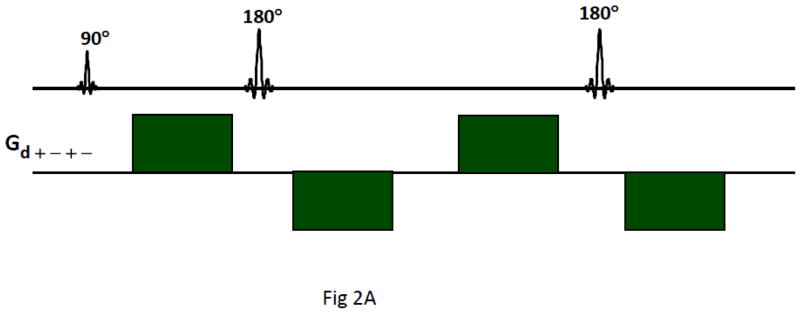
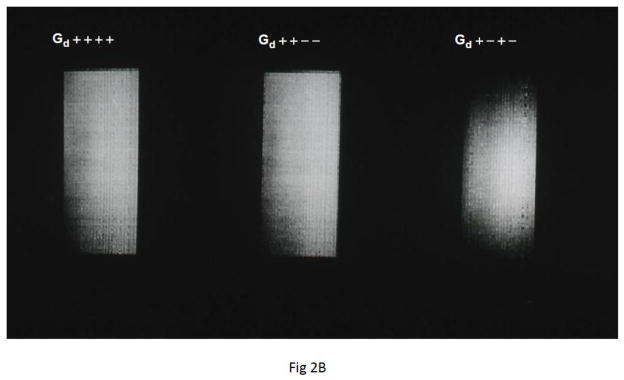
A) Twice refocused spin echo (TRSE) diffusion sequence with bipolar alternating polarity gradients was innovated for early fMRI experiments (Feinberg and Jakab, 1990). B) Initial comparison of diffusion encoding schemes revealed higher signal attenuation hence highest b-values in bipolar TRSE sequence (right) labeled Gd (+−+−) compared to the two monopolar gradient schemes (++++ and ++−−) in same time. One line from each image (horizontal axis) varying gradient amplitudes (vertical axis) incremented from maximum (−Gs to +Gs) in 128 TR repetitions, phantom 30mm diameter bottle of gadolinium doped water, acquired with inner-volume zoomed-EPI and fly-back k-space trajectory.
Fig. 2
Fig. 2
A) Twice refocused spin echo (TRSE) diffusion sequence with bipolar alternating polarity gradients was innovated for early fMRI experiments (Feinberg and Jakab, 1990). B) Initial comparison of diffusion encoding schemes revealed higher signal attenuation hence highest b-values in bipolar TRSE sequence (right) labeled Gd (+−+−) compared to the two monopolar gradient schemes (++++ and ++−−) in same time. One line from each image (horizontal axis) varying gradient amplitudes (vertical axis) incremented from maximum (−Gs to +Gs) in 128 TR repetitions, phantom 30mm diameter bottle of gadolinium doped water, acquired with inner-volume zoomed-EPI and fly-back k-space trajectory.
Fig. 3
Fig. 3
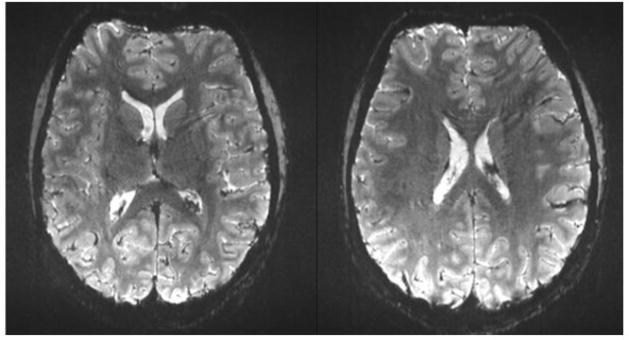
Recent 7 Tesla GE-EPI images acquired with high spatial resolution 0.75 mm isotropic resolution. Shown are two of 128 slices acquired in TR =5s. Image parameters: matrix 256×256 partial Fourier=5/8, parallel imaging IPAT=4, TE=20 msec, 48 msec readout per image.
Fig. 4
Fig. 4
Comparison of resting state fMRI performed with whole brain imaging using conventional GE-EPI at TR= 2.5 sec and multiplexed-EPI at TR = 0.4 sec with noticeably improved definition of resting state networks (Feinberg et al., 2010).

References

    1. Adriany G, Pfeuffer J, Yacoub E, Van de Moortele P-F, Shmuel A, Andersen P, Hu X, Vaughan JT, Ugurbil K. A half-volume transmit/receive coil combination for 7 Tesla applications. ISMRM; Glasgow, U.K: 2001. p. 1097.
    1. Avram H, Crooks LE. Effect of self-diffusion on echo planar imaging. Proc. of 7th Annual Soc Mag Res Med; San Francisco. 1988.
    1. Basser PJ, Mattiello J, LeBihan D. Estimation of the effective self-diffusion tensor from the NMR spin echo. J Magn Reson B. 1994;103:247–254. - PubMed
    1. Basser PJ, Pierpaoli C. Microstructural and physiological features of tissues elucidated by quantitative-diffusion-tensor MRI. J Magn Reson B. 1996;111:209–219. - PubMed
    1. Breuer FA, Blaimer M, Heidemann RM, Mueller MF, Griswold MA, Jakob PM. Controlled aliasing in parallel imaging results in higher acceleration (CAIPIRINHA) for multi-slice imaging. Magn Reson Med. 2005;53:684–691. - PubMed

MeSH terms