. 2012 Sep;33(9):2174-88.
doi: 10.1002/hbm.21351.

Mesolimbic recruitment by nondrug rewards in detoxified alcoholics: effort anticipation, reward anticipation, and reward delivery

Affiliations

Mesolimbic recruitment by nondrug rewards in detoxified alcoholics: effort anticipation, reward anticipation, and reward delivery

James M Bjork et al. Hum Brain Mapp. 2012 Sep.

Abstract

Aberrant sensitivity of incentive neurocircuitry to nondrug rewards has been suggested as either a risk factor for or consequence of drug addiction. Using functional magnetic resonance imaging, we tested whether alcohol-dependent patients (ADP: n = 29) showed altered recruitment of ventral striatal (VS) incentive neurocircuitry compared to controls (n = 23) by: (1) cues to respond for monetary rewards, (2) post-response anticipation of rewards, or (3) delivery of rewards. Using an instrumental task with two-stage presentation of reward-predictive information, subjects saw cues signaling opportunities to win $0, $1, or $10 for responding to a target. Following this response, subjects were notified whether their success would be indicated by a lexical notification (“Hit?”) or by delivery of a monetary reward (“Win?”). After a variable interval, subjects then viewed the trial outcome. We found no significant group differences in voxelwise activation by task contrasts, or in signal change extracted from VS. Both ADP and controls showed significant VS and other limbic recruitment by pre-response reward anticipation. In addition, controls also showed VS recruitment by post-response reward-anticipation, and ADP had appreciable subthreshold VS activation. Both groups also showed similar mesolimbic responses to reward deliveries. Across all subjects, a questionnaire measure of “hot” impulsivity correlated with VS recruitment by post-response anticipation of low rewards and with VS recruitment by delivery of low rewards. These findings indicate that incentive-motivational processing of nondrug rewards is substantially maintained in recovering alcoholics, and that reward-elicited VS recruitment correlates more with individual differences in trait impulsivity irrespective of addiction.


Figures
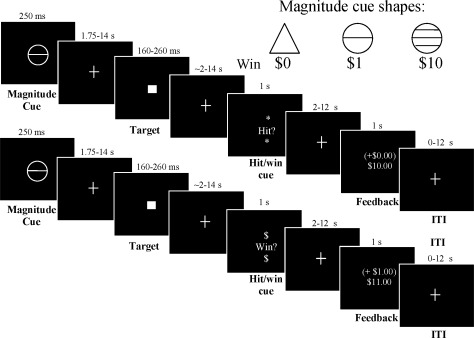
Figure 1
Figure 1
Modified monetary incentive delay (MID) task. Each trial began with presentation of one of three magnitude (response‐anticipatory) cues that signaled the opportunity to either win money (circles) or to respond for no incentive (triangle). Trial success required recording a button press during subsecond presentation of a white square target after a variable interval. After target presentation and the motor response, the subject then waited across a variable delay for a second cue (either “*hit?*” or “Win?$”) that signaled whether a successful response to the target would result in lexical feedback alone (HIT trials, top panel series) or would result in an actual delivery of a reward (WIN trials, bottom panel series). The linear contrast between WIN versus HIT signals across the $1 and $10 magnitude trial types is interpreted here as (affect‐based) post‐response reward anticipation. After another variable interval, the subject was notified of whether he or she hit the target and/or won money. Intratrial intervals between task stimuli and intertrial intervals were pseudorandomly varied in uniform distributions.
Figure 2
Figure 2
Pre‐response and post‐response activation by anticipatory cues for reward. In these and subsequent statistical maps: (1) all images are right‐left reversed per radiological convention, (2) the underlay is a T1‐weighted structural image from a representative subject, (3) the Talairach coordinate of the image plane is indicated, and (4) illuminated voxels in group‐wise maps survive false discovery rate (FDR) correction to P < 0.05 unless otherwise noted. Both controls (A) and ADP (B) showed significant activation of bilateral ventral striatum, anterior cingulate cortex, and other limbic structures by a contrast between presentations of response‐anticipatory cues that signaled prospective rewards ($1 or $10) versus presentation of cues signaling no potential reward ($0). Following target presentation and motor response, both controls (C) and ADP (D) showed subsequent activation of ventral striatal voxels by the contrast between seeing WIN cues versus HIT cues across the $1 and $10 reward trial series at the voxel‐wise significance threshold indicated. The group map of activation in the ADP (D) did not survive FDR correction, but voxels are illuminated at the same threshold to document noncorrected activation. In either contrast, there were no voxels that indicated a significant difference in activation between controls and ADP that survived FDR correction.
Figure 3
Figure 3
Activation by notification of winning rewards. A higher‐order contrast calculated activation by notification of having won a reward versus failing to win a monetary reward (in WIN trials), while masking out activation by notification of successful motor performance alone (in HIT trials). This contrast detected bilateral ventral striatum activation and anterior cingulate cortex activation in both controls (A) and in ADP (B). As with reward‐anticipatory activation, there were no voxels that indicated a significant difference in notification activation between controls and ADP that survived FDR correction.
Figure 4
Figure 4
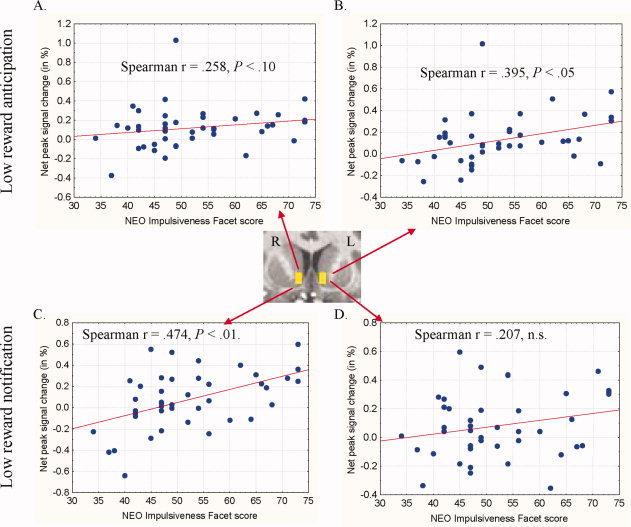
Correlations between NEO Impulsiveness Facet scores and post‐response NAcc activation by anticipation and delivery of low rewards. Signal was averaged across masks drawn in right and left nucleus accumbens (NAcc; inset image, Y = 10). For each of the low ($1) and high ($10) trial types, post‐response reward anticipation was calculated as the net signal change following WIN cues minus signal change following HIT cues for that reward magnitude. Post‐response low reward anticipation correlated with NEO‐IF scores in the left NAcc (B) with a trend in right NAcc (A). Post‐response activation by high reward anticipation, in contrast, did not correlate with NEO‐IF scores. For each of the low ($1) and high ($10) WIN trial subtypes, reward notification activation was calculated as the net signal change following actual wins versus notification of failure to win. NEO‐IF scores correlated with net activation by notification of low rewards in right NAcc (C), but not left NAcc (D). NAcc activation by high reward notification did not correlate with NEO‐IF scores.

References

    1. Beck A, Schlagenhauf F, Wustenberg T, Hein J, Kienast T, Kahnt T, Schmack K, Hagele C, Knutson B, Heinz A, Wrase J ( 2009): Ventral striatal activation during reward anticipation correlates with impulsivity in alcoholics. Biol Psychiatry 66:734–742. - PubMed
    1. Bjork JM, Hommer DW ( 2007): Anticipating instrumentally obtained and passively‐received rewards: A factorial fMRI investigation. Behav Brain Res 177: 165–170. - PMC - PubMed
    1. Bjork JM, Hommer DW, Grant SJ, Danube C ( 2004a) Impulsivity in abstinent alcohol‐dependent patients: Relation to control subjects and type 1‐/type 2‐like traits. Alcohol 34: 133–150. - PubMed
    1. Bjork JM, Knutson B, Fong GW, Caggiano DM, Bennett SM, Hommer DW ( 2004b) Incentive‐elicited brain activation in adolescents: Similarities and differences from young adults. J Neurosci 24: 1793–1802. - PMC - PubMed
    1. Bjork JM, Knutson B, Hommer DW ( 2008a) Incentive‐elicited striatal activation in adolescent children of alcoholics. Addiction 103: 1308–1319. - PubMed

Publication types

MeSH terms