


NT-PGC-1α protein is sufficient to link β3-adrenergic receptor activation to transcriptional and physiological components of adaptive thermogenesis
- PMID: 22282499
- PMCID: PMC3308807
- DOI: 10.1074/jbc.M111.320200
NT-PGC-1α protein is sufficient to link β3-adrenergic receptor activation to transcriptional and physiological components of adaptive thermogenesis
Abstract
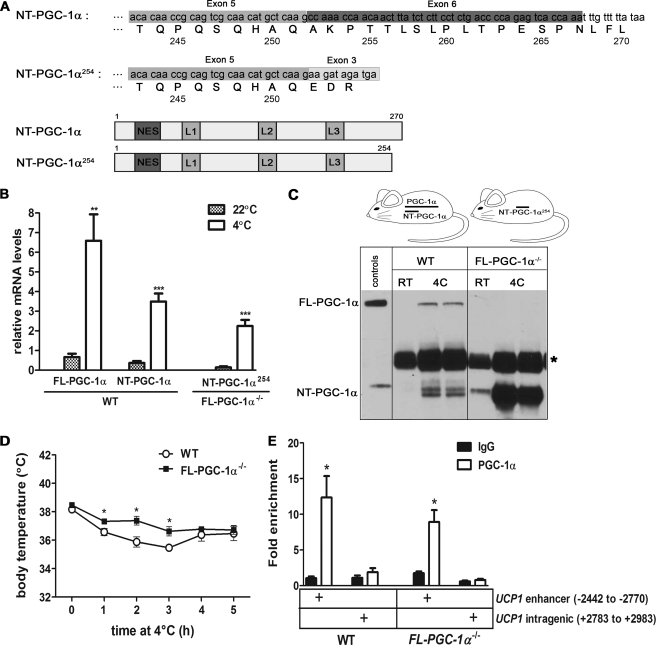
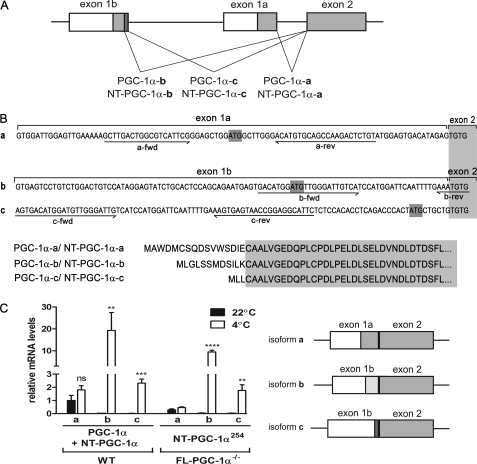
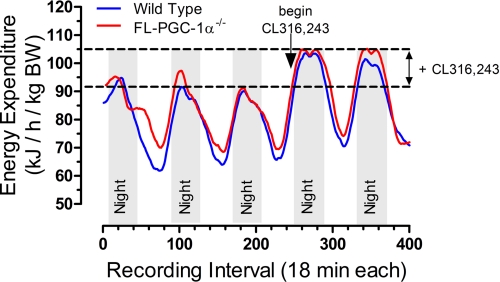
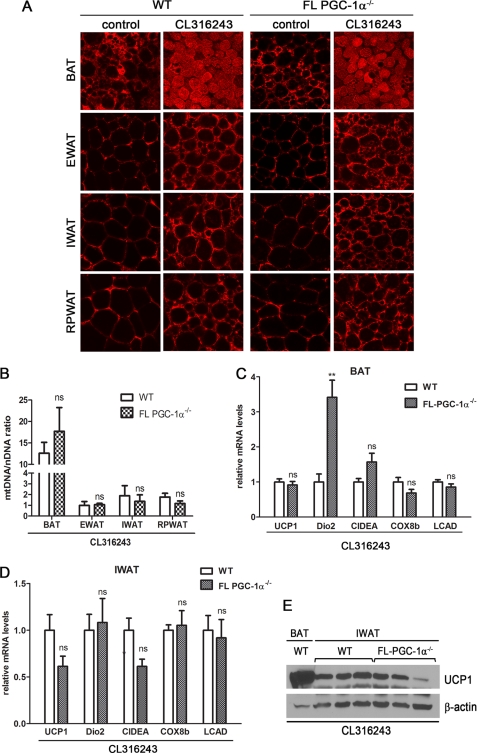
PGC-1α is an inducible transcriptional coactivator that regulates cellular energy metabolism and adaptation to environmental and nutritional stimuli. In tissues expressing PGC-1α, alternative splicing produces a truncated protein (NT-PGC-1α) corresponding to the first 267 amino acids of PGC-1α. Brown adipose tissue also expresses two novel exon 1b-derived isoforms of PGC-1α and NT-PGC-1α, which are 4 and 13 amino acids shorter in the N termini than canonical PGC-1α and NT-PGC-1α, respectively. To evaluate the ability of NT-PGC-1α to substitute for PGC-1α and assess the isoform-specific role of NT-PGC-1α, adaptive thermogenic responses of adipose tissue were evaluated in mice lacking full-length PGC-1α (FL-PGC-1(-/-)) but expressing slightly shorter but functionally equivalent forms of NT-PGC-1α (NT-PGC-1α(254)). At room temperature, NT-PGC-1α and NT-PGC-1α(254) were produced from conventional exon 1a-derived transcripts in brown adipose tissue of wild type and FL-PGC-1α(-/-) mice, respectively. However, cold exposure shifted transcription to exon 1b, increasing exon 1b-derived mRNA levels. The resulting transcriptional responses produced comparable increases in energy expenditure and maintenance of core body temperature in WT and FL-PGC-1α(-/-) mice. Moreover, treatment of the two genotypes with a selective β(3)-adrenergic receptor agonist produced similar increases in energy expenditure, mitochondrial DNA, and reductions in adiposity. Collectively, these findings illustrate that the transcriptional and physiological responses to sympathetic input are unabridged in FL-PGC-1α(-/-) mice, and that NT-PGC-1α is sufficient to link β(3)-androgenic receptor activation to adaptive thermogenesis in adipose tissue. Furthermore, the transcriptional shift from exon 1a to 1b supports isoform-specific roles for NT-PGC-1α in basal and adaptive thermogenesis.
Figures
References
-
- Puigserver P., Wu Z., Park C. W., Graves R., Wright M., Spiegelman B. M. (1998) A cold-inducible coactivator of nuclear receptors linked to adaptive thermogenesis. Cell 92, 829–839 - PubMed
-
- Wu Z., Puigserver P., Andersson U., Zhang C., Adelmant G., Mootha V., Troy A., Cinti S., Lowell B., Scarpulla R. C., Spiegelman B. M. (1999) Mechanisms controlling mitochondrial biogenesis and respiration through the thermogenic coactivator PGC-1. Cell 98, 115–124 - PubMed
-
- Mootha V. K., Lindgren C. M., Eriksson K. F., Subramanian A., Sihag S., Lehar J., Puigserver P., Carlsson E., Ridderstråle M., Laurila E., Houstis N., Daly M. J., Patterson N., Mesirov J. P., Golub T. R., Tamayo P., Spiegelman B., Lander E. S., Hirschhorn J. N., Altshuler D., Groop L. C. (2003) PGC-1α-responsive genes involved in oxidative phosphorylation are coordinately down-regulated in human diabetes. Nat. Genet. 34, 267–273 - PubMed
Publication types
MeSH terms
Substances
Grants and funding
LinkOut - more resources
Full Text Sources
Molecular Biology Databases
Research Materials
