. 2012 Apr;158(Pt 4):1005-1015.
doi: 10.1099/mic.0.055459-0. Epub 2012 Jan 27.

Ribosomal multilocus sequence typing: universal characterization of bacteria from domain to strain

Affiliations

Ribosomal multilocus sequence typing: universal characterization of bacteria from domain to strain

Keith A Jolley et al. Microbiology (Reading). 2012 Apr.

Abstract

No single genealogical reconstruction or typing method currently encompasses all levels of bacterial diversity, from domain to strain. We propose ribosomal multilocus sequence typing (rMLST), an approach which indexes variation of the 53 genes encoding the bacterial ribosome protein subunits (rps genes), as a means of integrating microbial genealogy and typing. As with multilocus sequence typing (MLST), rMLST employs curated reference sequences to identify gene variants efficiently and rapidly. The rps loci are ideal targets for a universal characterization scheme as they are: (i) present in all bacteria; (ii) distributed around the chromosome; and (iii) encode proteins which are under stabilizing selection for functional conservation. Collectively, the rps loci exhibit variation that resolves bacteria into groups at all taxonomic and most typing levels, providing significantly more resolution than 16S small subunit rRNA gene phylogenies. A web-accessible expandable database, comprising whole-genome data from more than 1900 bacterial isolates, including 28 draft genomes assembled de novo from the European Bioinformatics Institute (EBI) sequence read archive, has been assembled. The rps gene variation catalogued in this database permits rapid and computationally non-intensive identification of the phylogenetic position of any bacterial sequence at the domain, phylum, class, order, family, genus, species and strain levels. The groupings generated with rMLST data are consistent with current nomenclature schemes and independent of the clustering algorithm used. This approach is applicable to the other domains of life, potentially providing a rational and universal approach to the classification of life that is based on one of its fundamental features, the translation mechanism.


Figures
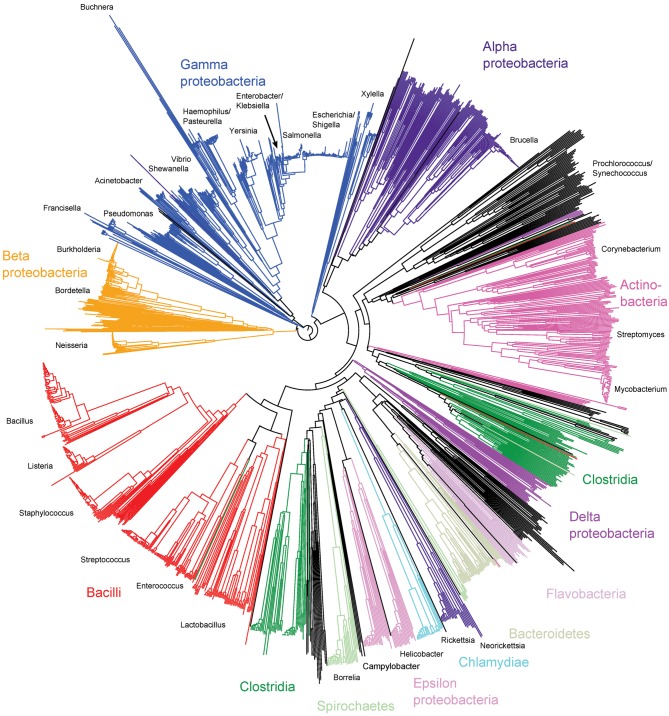
Fig. 1.
Fig. 1.
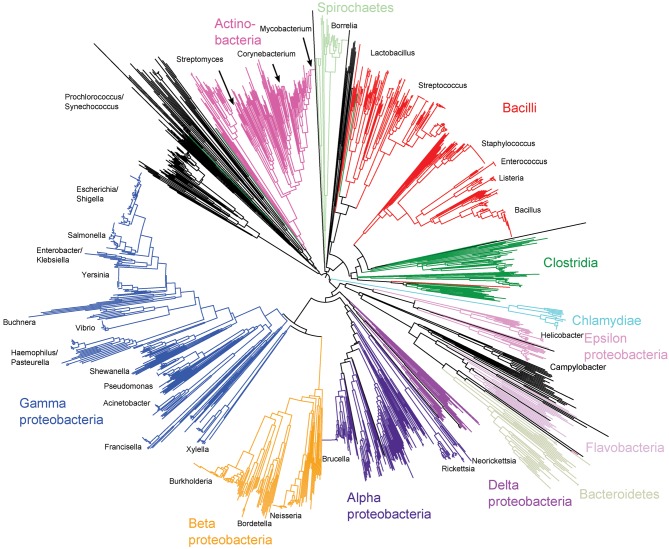
Neighbour-joining tree of the entire bacterial domain reconstructed from concatenated ribosomal protein gene sequences. The analysis involved 1565 sequences from genomes with at least 52 tagged ribosomal protein genes. Subspecies-level resolution is evident.
Fig. 2.
Fig. 2.
Neighbour-joining tree of the entire bacterial domain reconstructed from 16S rRNA gene sequences extracted from whole-genome data of 1663 strains.
Fig. 3.
Fig. 3.
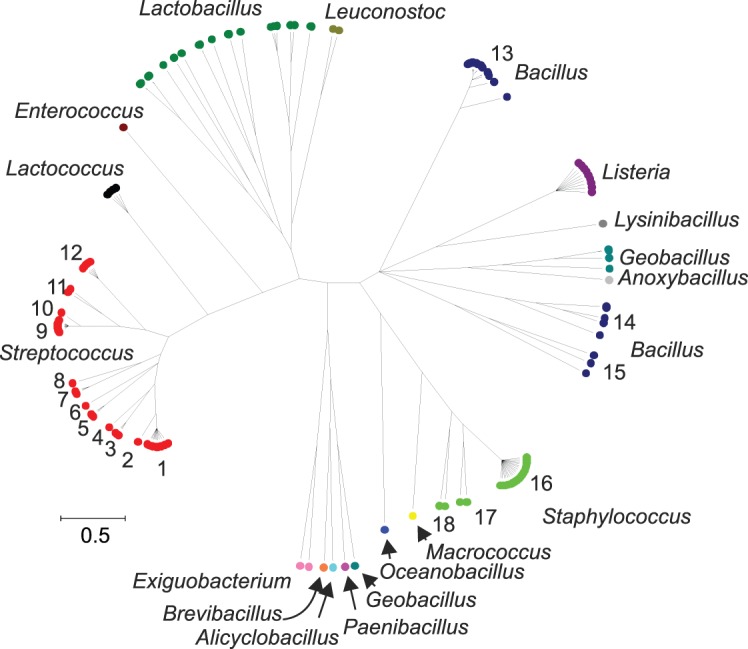
clonalframe tree of the class Bacilli using ribosomal protein gene sequences. Two independent, converged runs were merged and a 95 % consensus tree generated. Only finished genomes with 53 ribosomal protein genes identified and tagged were included in the analysis (n = 144). Key: 1, Streptococcus pyogenes; 2, Streptococcus dysgalactiae; 3, Streptococcus equi/Streptococcus zooepidemicus; 4, Streptococcus. uberis; 5, Streptococcus agalactiae; 6, Streptococcus mutans; 7, Streptococcus thermophilus; 8, Streptococcus gallolyticus; 9, S. pneumoniae; 10, Streptococcus mitis; 11, Streptococcus gordonii/Streptococcus sanguinis; 12, Streptococcus suis; 13, B. anthracis/B. cereus/B. weihenstephanensis; 14, B. licheniformis/B. amyloliquefaciens/B. subtilis/B. pumilus; 15, B. halodurans/B. pseudofirmus/B. clausii; 16, Staphylococcus aureus; 17, Staphylococcus epidermidis/Staphylococcus haemolyticus; 18, Staphylococcus carnosus/Staphylococcus saprophyticus.
Fig. 4.
Fig. 4.
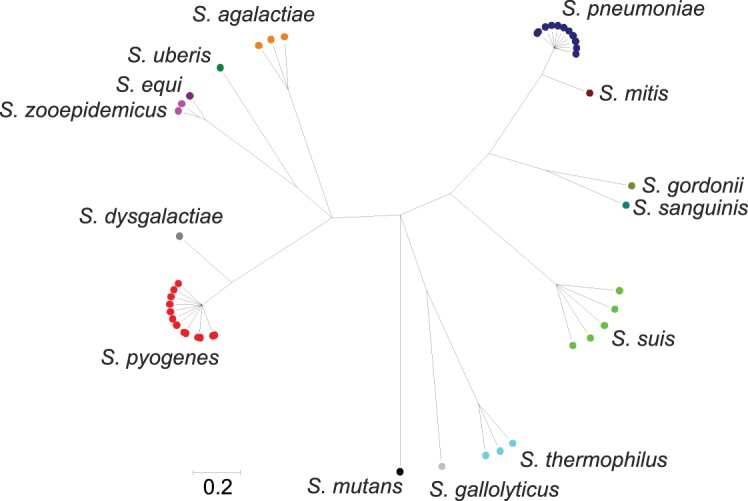
clonalframe tree of the genus Streptococcus. Three independent, converged runs were merged and a 95 % consensus tree generated. Only finished genomes with 53 ribosomal protein genes identified and tagged were included in the analysis (n = 45).
Fig. 5.
Fig. 5.
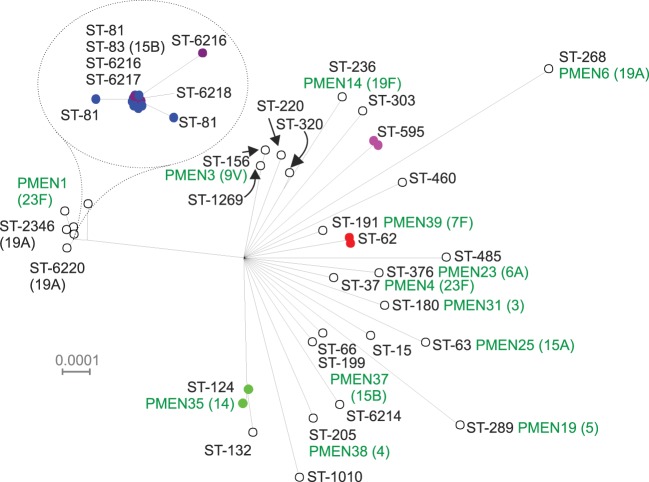
Split decomposition of concatenated ribosomal protein genes from S. pneumoniae isolates (n = 57). The rpmG gene was not included, since there appear to be three loci within the S. pneumoniae genome that can exhibit different rpmG alleles. The different PMEN clones within the dataset are clearly resolved and the heavily represented PMEN1 group centred around ST-81 shows sub-sequence type resolution.

Comment in

References

    1. Achtman M. (2008). Evolution, population structure, and phylogeography of genetically monomorphic bacterial pathogens. Annu Rev Microbiol 62, 53–70. 10.1146/annurev.micro.62.081307.162832 - DOI - PubMed
    1. Achtman M., Wagner M. (2008). Microbial diversity and the genetic nature of microbial species. Nat Rev Microbiol 6, 431–440. - PubMed
    1. Altschul S. F., Madden T. L., Schäffer A. A., Zhang J., Zhang Z., Miller W., Lipman D. J. (1997). Gapped blast and psi-blast: a new generation of protein database search programs. Nucleic Acids Res 25, 3389–3402. 10.1093/nar/25.17.3389 - DOI - PMC - PubMed
    1. Bashan A., Yonath A. (2008). Correlating ribosome function with high-resolution structures. Trends Microbiol 16, 326–335. 10.1016/j.tim.2008.05.001 - DOI - PubMed
    1. Bishop C. J., Aanensen D. M., Jordan G. E., Kilian M., Hanage W. P., Spratt B. G. (2009). Assigning strains to bacterial species via the internet. BMC Biol 7, 3. 10.1186/1741-7007-7-3 - DOI - PMC - PubMed

Publication types