


Free Fatty acids and delayed cerebral ischemia after subarachnoid hemorrhage
- PMID: 22282893
- PMCID: PMC4198386
- DOI: 10.1161/STROKEAHA.111.636035
Free Fatty acids and delayed cerebral ischemia after subarachnoid hemorrhage
Abstract
Background and purpose: The purpose of this study was to understand factors related to increases in serum free fatty acid (FFA) levels and association with delayed cerebral ischemia (DCI) after subarachnoid hemorrhage.
Methods: We performed serial measurement of systemic oxygen consumption by indirect calorimetry and FFA levels by liquid chromatography/mass spectrometry in the first 14 days after ictus in 50 consecutive patients with subarachnoid hemorrhage. Multivariable generalized estimating equation models identified associations with FFA levels in the first 14 days after SAH and Cox proportional hazards model used to identified associations with time to DCI.
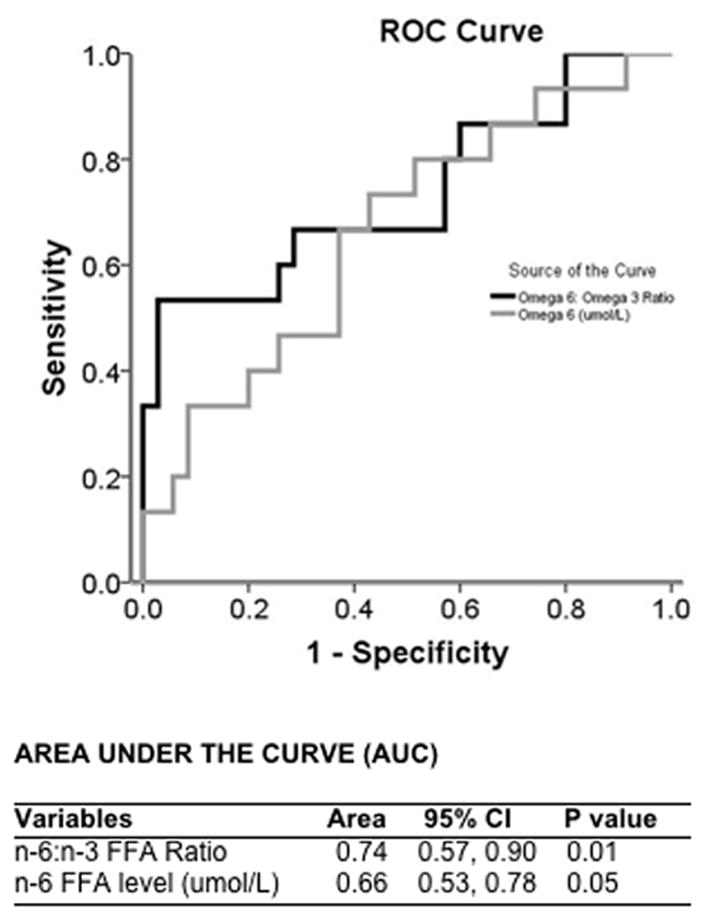
Results: There were 187 measurements in 50 patients with subarachnoid hemorrhage (mean age, 56±14 years old; 66% women) with a median Hunt-Hess score of 3. Adjusting for Hunt-Hess grade and daily caloric intake, n-6 and n-3 FFA levels were both associated with oxygen consumption and the modified Fisher score. Fourteen (28%) patients developed DCI on median postbleed Day 7. The modified Fisher score (P=0.01), mean n-6:n-3 FFA ratio (P=0.02), and mean oxygen consumption level (P=0.04) were higher in patients who developed DCI. In a Cox proportional hazards model, the mean n-6:n-3 FFA ratio (P<0.001), younger age (P=0.05), and modified Fisher scale (P=0.004) were associated with time to DCI.
Conclusions: Injury severity and oxygen consumption hypermetabolism are associated with higher n-FFA levels and an increased n-6:n-3 FFA ratio is associated with DCI. This may indicate a role for interventions that modulate both oxygen consumption and FFA levels to reduce the occurrence of DCI.
Figures
References
-
- Frontera JA, Fernandez A, Schmidt JM, Claassen J, Wartenberg KE, Badjatia N, et al. Defining vasospasm after subarachnoid hemorrhage: What is the most clinically relevant definition? Stroke. 2009;40:1963–1968. - PubMed
-
- Schmidt JM, Wartenberg KE, Fernandez A, Claassen J, Rincon F, Ostapkovich ND, et al. Frequency and clinical impact of asymptomatic cerebral infarction due to vasospasm after subarachnoid hemorrhage. J Neurosurg. 2008;109:1052–1059. - PubMed
-
- Singer P, Shapiro H, Theilla M, Anbar R, Singer J, Cohen J. Anti-inflammatory properties of n--3 fatty acids in critical illness: Novel mechanisms and an integrative perspective. Intensive Care Med. 2008;34:1580–1592. - PubMed
-
- Weitzel LR, Wischmeyer PE. Glutamine in critical illness: The time has come, the time is now. Crit Care Clin. 2010;26:515–525. ix–x. - PubMed
Publication types
MeSH terms
Substances
Grants and funding
LinkOut - more resources
Full Text Sources
