


Antitubercular drug resistance in four healthcare facilities in North India
- PMID: 22283032
- PMCID: PMC3259721
Antitubercular drug resistance in four healthcare facilities in North India
Abstract
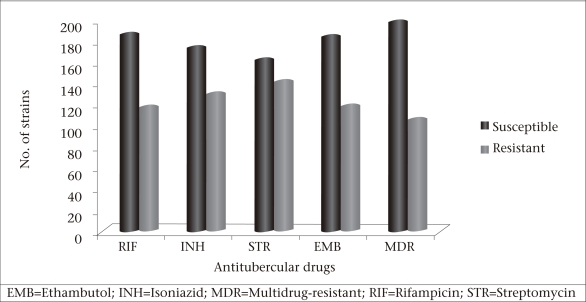
Tuberculosis (TB) is a major public-health problem in India, having the highest number of incident and multidrug-resistant (MDR) TB cases. The study was carried out to appraise the prevalence of first-line anti-TB drug resistance in Mycobacterium tuberculosis (MTB) and its patterns among different types of TB patients from different settings in a province of North India. Of 3,704 clinical specimens, 345 (9.3%) were culture-positive, and drug-susceptibility testing was carried out for 301 MTB strains. A high level of primary and acquired drug resistance of MTB was observed in the region studied, with weighted mean of 10.5% and 28.08%, 12.81% and 29.72%, 17.12% and 29.94%, 11.97% and 27.84%, and 10.74% and 23.54% for rifampicin, isoniazid, streptomycin, ethambutol-resistant and MDR cases respectively. Drug resistance was significantly higher in pulmonary (p = 0.014) and acquired drug-resistant TB cases (p < 0.001). Any drug resistance (p = 0.002) and MDR TB were significantly (p = 0.009) associated with HIV-seropositive cases. An urgent plan is needed to continuously monitor the transmission trends of drug-resistant strains, especially MDR-TB strains, in the region.
Figures
References
-
- Aziz MA, Wright A, Laszlo A, De Muynck A, Portaels F, Van Deun A, et al. Epidemiology of antituberculosis drug resistance (the Global Project on Anti-tuberculosis Drug Resistance Surveillance): an updated analysis. Lancet. 2006;368:2142–54. - PubMed
-
- World Health Organization . Stop TB partnership, 2009 update: tuberculosis facts. Geneva: World Health Organization; 2009. p. 1. ( http://www.who.int/tb/publications/2009/tbfactsheet_2009update_one_page.pdf, accessed on 15 December 2009).
-
- World Health Organization . Global tuberculosis control: epidemiology, strategy, financing. Geneva: WorldHealth Organization,; 2009. p. 78. (WHO report no. HTM/TB/2009.411).
-
- World Health Organization . TB/HIV: a clinical manual. Geneva: World Health Organization,; 2004. p. 210. ( http://libdoc.who.int/publications/2004/9241546344.pdf, accessed on 25 May 2008).
-
- Swaminathan S, Ramachandran R, Baskaran G, Paramasivan CN, Ramanathan U, Venkatesan P, et al. Risk of development of tuberculosis in HIV infected patients. Int J Tuberc Lung Dis. 2000;4:839–44. - PubMed
MeSH terms
Substances
LinkOut - more resources
Full Text Sources