. 2012 Feb 15;134(6):2898-901.
doi: 10.1021/ja2109745. Epub 2012 Feb 1.

Genetically encoded tetrazine amino acid directs rapid site-specific in vivo bioorthogonal ligation with trans-cyclooctenes

Affiliations

Genetically encoded tetrazine amino acid directs rapid site-specific in vivo bioorthogonal ligation with trans-cyclooctenes

Jason L Seitchik et al. J Am Chem Soc. .

Abstract

Bioorthogonal ligation methods with improved reaction rates and less obtrusive components are needed for site-specifically labeling proteins without catalysts. Currently no general method exists for in vivo site-specific labeling of proteins that combines fast reaction rate with stable, nontoxic, and chemoselective reagents. To overcome these limitations, we have developed a tetrazine-containing amino acid, 1, that is stable inside living cells. We have site-specifically genetically encoded this unique amino acid in response to an amber codon allowing a single 1 to be placed at any location in a protein. We have demonstrated that protein containing 1 can be ligated to a conformationally strained trans-cyclooctene in vitro and in vivo with reaction rates significantly faster than most commonly used labeling methods.


Figures
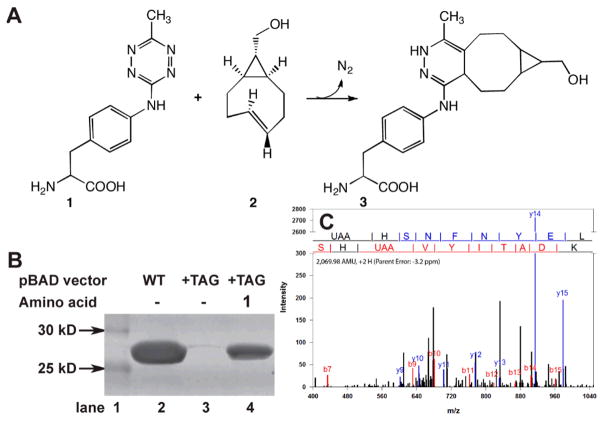
Figure 1
Figure 1
Genetic incorporation of 4-(6-methyl-s-tetrazin-3-yl)aminophenylalanine, 1, into proteins. (A) Amino acid 1 reacts with sTCO, 2, then loses nitrogen gas to form in the stable conjugate 3. (B) The evolved MjRS/tRNACUA pair in pDule-mtaF allows for site-specific incorporation of 1 in response to an amber codon. Lane 2 shows expression levels of GFP-wt from pBad-GFP-His6. Production of GFP-1 from pBad-GFP-150TAG-His6 is dependent on 1 in the growth media, lane 3 without 1 present, lane 4 with 1 mM 1 present. Protein was purified by Co+2 affinity chromatography, separated by SDS-PAGE and stained with Coomassie. (C) MS/MS fragmentation of tryptic peptides derived from GFP-1 samples demonstrates the efficient high-fidelity incorporation of a single 1 UAA in response to an amber stop codon using the mtaF synthetase. The spectra confirm 1 incorporation at codon 150. The fragmentation sites are illustrated above the spectrum.
Figure 2
Figure 2
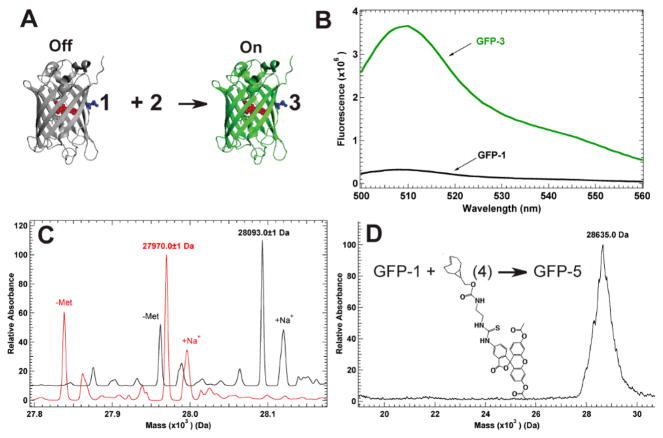
Characterization of tetrazine transcyclooctene reaction on GFP. (A) Quenched GFP-1 is “turned on” by coupling with 2, forming fluorescence GFP-3. (B) Excitation at 488 nm produces low flourescene for GFP-1, while the reaction forming GFP-3 produces full fluorescence for GFP. (C) ESI-Q-Tof MS analysis of product from GFP-1 with 2 demonstrates specific and quantitative labeling of GFP-1. (D) MALDI MS analysis of GFP-1 reaction with diacetyl-fluorescein labeled sTCO.
Figure 3
Figure 3
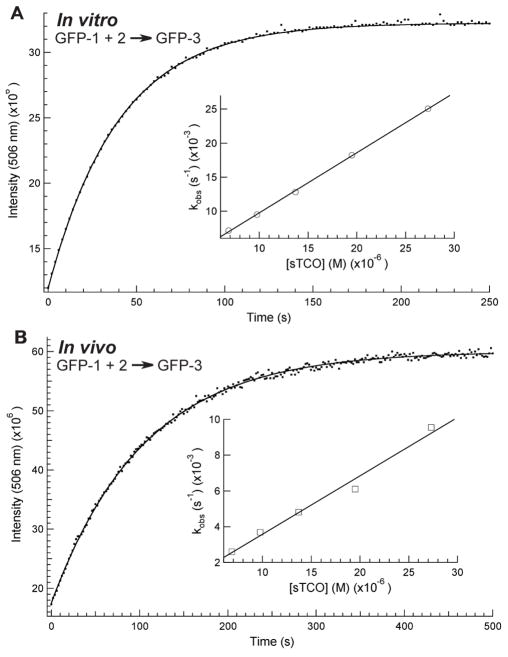
Rate constant determination for in vitro and in vivo reaction of GFP-1 and 2. (A) In vitro kinetics resulted in rate k= 880±10 M−1s−1 (B) In vivo kinetics resulted in k= 330±20 M−1s−1. For both experiments unimolecular rate constants were calculated by fitting the rate of GFP-3 formation to a single exponential at five different concentrations of 2. Inset is bimolecular rate constant determination using unimolecular kobs=k[2].

References

    1. Agard NJ, Baskin JM, Prescher JA, Lo A, Bertozzi CR. ACS Chem Biol. 2006;1:644. - PubMed
    2. Sletten EM, Bertozzi CR. Acc Chem Res. 2011;44:666. - PMC - PubMed
    3. Debets MF, van Berkel SS, Dommerholt J, Dirks AT, Rutjes FP, van Delft FL. Acc Chem Res. 2011;44:805. - PubMed
    1. Hao Z, Song Y, Lin S, Yang M, Liang Y, Wang J, Chen PR. Chem Commun (Camb) 2011;47:4502. - PubMed
    2. Nguyen DP, Lusic H, Neumann H, Kapadnis PB, Deiters A, Chin JW. J Am Chem Soc. 2009;131:8720. - PubMed
    3. Fekner T, Li X, Lee MM, Chan MK. Angew Chem Int Ed Engl. 2009;48:1633. - PubMed
    4. Deiters A, Schultz PG. Bioorg Med Chem Lett. 2005;15:1521. - PubMed
    5. Deiters A, Cropp TA, Mukherji M, Chin JW, Anderson JC, Schultz PG. J Am Chem Soc. 2003;125:11782. - PubMed
    1. Plass T, Milles S, Koehler C, Schultz C, Lemke EA. Angew Chem Int Ed Engl. 2011;50:3878. - PMC - PubMed
    1. Nguyen DP, Elliott T, Holt M, Muir TW, Chin JW. J Am Chem Soc. 2011;133:11418. - PubMed
    2. Wang J, Zhang W, Song W, Wang Y, Yu Z, Li J, Wu M, Wang L, Zang J, Lin Q. J Am Chem Soc. 2010;132:14812. - PMC - PubMed
    3. Wang Y, Song W, Hu WJ, Lin Q. Angew Chem Int Ed Engl. 2009;48:5330. - PMC - PubMed
    1. Carrico ZM, Romanini DW, Mehl RA, Francis MB. Chem Commun (Camb) 2008:1205. - PubMed
    2. Mehl RA, Anderson JC, Santoro SW, Wang L, Martin AB, King DS, Horn DM, Schultz PG. J Am Chem Soc. 2003;125:935. - PubMed
    3. Wang L, Zhang Z, Brock A, Schultz PG. Proc Natl Acad Sci U S A. 2003;100:56. - PMC - PubMed
    4. Baskin JM, Prescher JA, Laughlin ST, Agard NJ, Chang PV, Miller IA, Lo A, Codelli JA, Bertozzi CR. Proc Natl Acad Sci U S A. 2007;104:16793. - PMC - PubMed
    5. Sletten EM, Bertozzi CR. Angew Chem Int Ed Engl. 2009;48:6974. - PMC - PubMed
    6. Hao Z, Hong S, Chen X, Chen PR. Acc Chem Res. 2011;44:742. - PubMed
    7. Devaraj NK, Weissleder R. Acc Chem Res. 2011;44:816. - PMC - PubMed

Publication types

MeSH terms