. 2012 Apr;33(11):3187-94.
doi: 10.1016/j.biomaterials.2012.01.028. Epub 2012 Jan 26.

Mechanisms underlying the synergistic enhancement of self-assembled neocartilage treated with chondroitinase-ABC and TGF-β1

Affiliations

Mechanisms underlying the synergistic enhancement of self-assembled neocartilage treated with chondroitinase-ABC and TGF-β1

Donald J Responte et al. Biomaterials. 2012 Apr.

Abstract

Developing a platform for in vitro cartilage formation would enhance the study of cartilage development, pathogenesis, and regeneration. To improve neocartilage formation, our group developed a novel self-assembly process for articular chondrocytes, which has been improved in this study using a novel combination of catabolic and anabolic agents. TGF-β1 was applied in conjunction with the enzyme chondroitinase-ABC (C-ABC) to additively increase tensile properties and synergistically enhance collagen content. Additionally, microarray analysis indicated that TGF-β1 up-regulated MAPK signaling in contrast to C-ABC, which did not enrich genetic pathways. The lack of genetic signaling spurred investigation of the biophysical role of C-ABC, which showed that C-ABC treatment increased collagen fibril diameter and density. After four weeks of culture in nude mice, neocartilage exhibited stability and maturation. This study illustrated an innovative strategy for improving in vitro and in vivo articular cartilage formation and elucidated mechanisms underlying TGF-β1 and C-ABC treatment.


Figures

Figure 1
Figure 1
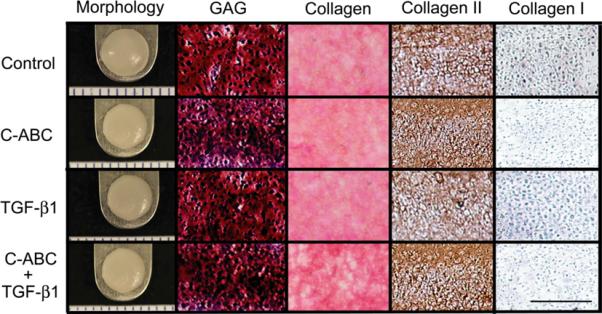
Histology and gross morphology at 4 weeks. Neocartilage treated with chondroitinase-ABC (C-ABC), intermittent TGF-β1, or C-ABC combined with TGF-β1. Histology showed that control and treated constructs had uniform distributions of glycosaminoglycans (GAGs), total collagen, and collagen II without exhibiting collagen I staining. Picrosirius Red was used to stain total collagen and Saf-O/fast green was used for GAG staining. IHC was employed to assess collagen I and collagen II distributions. Scale bar is 200 μm for histology images and gross morphology markings are 1 mm.
Figure 2
Figure 2
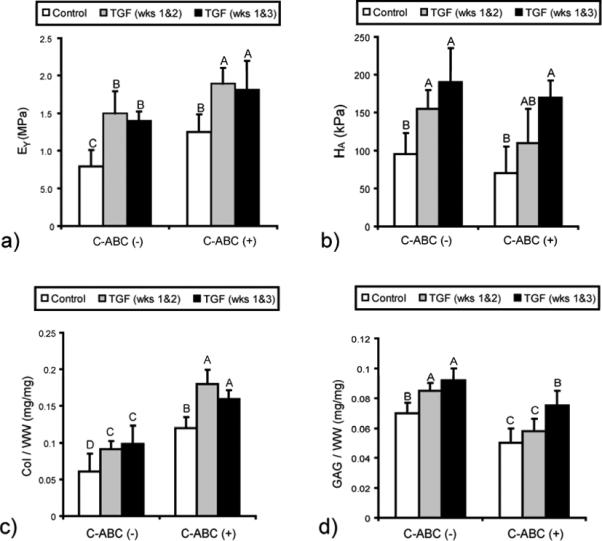
Biomechanical and biochemical properties at 4 weeks. Neocartilage was treated with chondroitinase-ABC (C-ABC), TGF-β1, or C-ABC and TGF-β1. (a) Tensile stiffness was enhanced by C-ABC and TGF-β1 treatments and additively increased for combined treatment groups. (b) Compressive stiffness was highest for groups treated with intermittent TGF-β1. (c) Combined C-ABC and TGF-β1 treatment synergistically increased collagen content. (d) GAG content was highest for groups treated with TGF-β1. Bars labeled with different letters exhibit significant differences (p < 0.05).
Figure 3
Figure 3
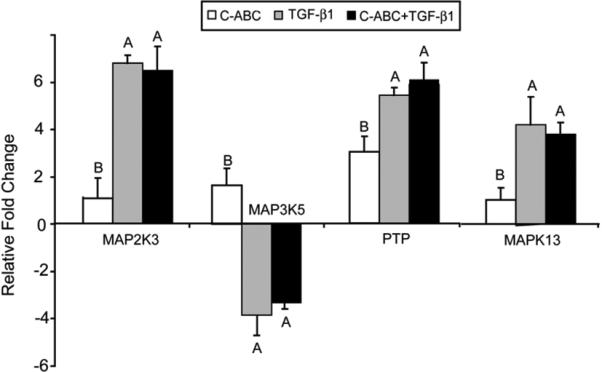
PCR of MAPK signaling genes in neocartilage treated with C-ABC and/or TGF-β1 at 2 weeks. Gene expression levels for MAP3K5, MAPK13, protein tyrosine phosphatase (PTP), and MAP2K3 were normalized to control values. Combined treatments and TGF-β1 treatments generally had gene expression levels that were not statistically distinct. Negative values reflect down-regulation in relation to control. Bars labeled with different letters exhibit significant differences (p < 0.05).
Figure 4
Figure 4
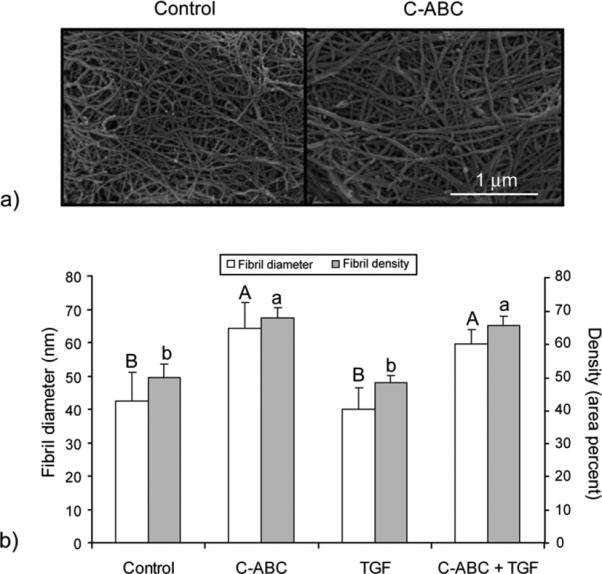
SEM analysis of neotissue at 4 weeks. (a) Representative SEM images of control neotissue and neocartilage treated with chondroitinase-ABC (C-ABC). (b) Quantification of fibril diameters based on image analysis of 3 locations on each neotissue sample with n=3. Bars labeled with different letters exhibit significant differences (p < 0.05).
Figure 5
Figure 5
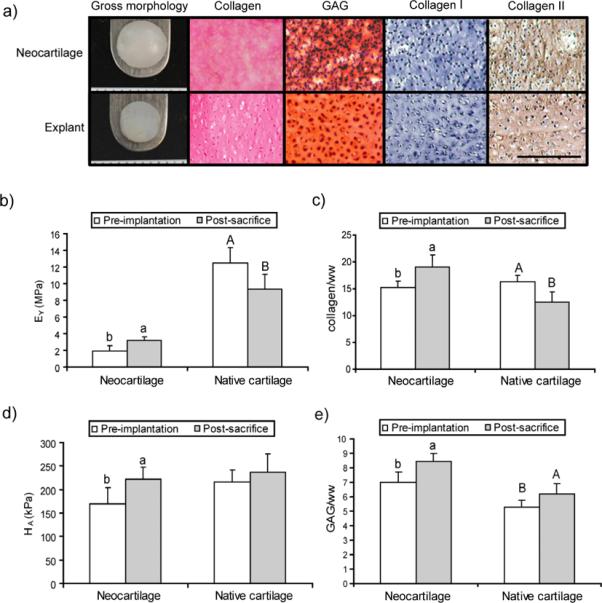
Properties of constructs post-sacrifice after in vivo culture in nude mice. Self-assembled articular cartilage was cultured for 4 weeks with TGF-β1 treatment during weeks 1&3 and chondroitinase-ABC (C-ABC) administration at day 14. Neocartilage was then implanted in nude mice for 4 weeks with condylar cartilage explants as controls (n=4). (a) Gross morphology and histology using Picrosirius Red for collagen, Safranin-O/fast green for glycosaminoglycans, and immunohistochemistry for collagen I and collagen II. Scale bar is 200 μm. (b) Post-sacrifice tensile stiffness increased for neocartilage while explant stiffness decreased. (c) Collagen content increased for constructs post-sacrifice while it decreased for native cartilage. (d) Compressive stiffness increased for constructs but did not significantly change for explants. (e) Glycosaminoglycan (GAG) content increased for both native tissue and neocartilage post-sacrifice. Bars labeled with different letters exhibit significant differences (p < 0.05).

References

    1. Hoben GM, Hu JC, James RA, Athanasiou KA. Self-assembly of fibrochondrocytes and chondrocytes for tissue engineering of the knee meniscus. Tissue Eng. 2007;13:939–46. - PubMed
    1. Hu JC, Athanasiou KA. A self-assembling process in articular cartilage tissue engineering. Tissue Eng. 2006;12:969–79. - PubMed
    1. Williamson AK, Chen AC, Masuda K, Thonar EJ, Sah RL. Tensile mechanical properties of bovine articular cartilage: variations with growth and relationships to collagen network components. J Orthop Res. 2003;21:872–80. - PubMed
    1. Williamson AK, Masuda K, Thonar EJ, Sah RL. Growth of immature articular cartilage in vitro: correlated variation in tensile biomechanical and collagen network properties. Tissue Eng. 2003;9:625–34. - PubMed
    1. Natoli RM, Responte DJ, Lu BY, Athanasiou KA. Effects of multiple chondroitinase ABC applications on tissue engineered articular cartilage. Journal of Orthopaedic Research. 2009;27:949–56. - PMC - PubMed

Publication types

Substances