. 2012 May;151(5):736-44.
doi: 10.1016/j.surg.2011.12.014. Epub 2012 Jan 28.

Liposome-encapsulated curcumin suppresses neuroblastoma growth through nuclear factor-kappa B inhibition

Affiliations

Liposome-encapsulated curcumin suppresses neuroblastoma growth through nuclear factor-kappa B inhibition

Wayne S Orr et al. Surgery. 2012 May.

Retraction in

Abstract

Background: Nuclear factor-κB (NF-κB) has been implicated in tumor cell proliferation and survival and in tumor angiogenesis. We sought to evaluate the effects of curcumin, an inhibitor of NF-κB, on a xenograft model of disseminated neuroblastoma.

Methods: For in vitro studies, neuroblastoma cell lines NB1691, CHLA-20, and SK-N-AS were treated with various doses of liposomal curcumin. Disseminated neuroblastoma was established in vivo by tail vein injection of NB1691-luc cells into SCID mice, which were then treated with 50 mg/kg/day of liposomal curcumin 5 days/week intraperitoneally.

Results: Curcumin suppressed NF-κB activation and proliferation of all neuroblastoma cell lines in vitro. In vivo, curcumin treatment resulted in a significant decrease in disseminated tumor burden. Curcumin-treated tumors had decreased NF-κB activity and an associated significant decrease in tumor cell proliferation and an increase in tumor cell apoptosis, as well as a decrease in tumor vascular endothelial growth factor levels and microvessel density.

Conclusion: Liposomal curcumin suppressed neuroblastoma growth, with treated tumors showing a decrease in NF-κB activity. Our results suggest that liposomal curcumin may be a viable option for the treatment of neuroblastoma that works via inhibiting the NF-κB pathway.


Figures

Figure 1
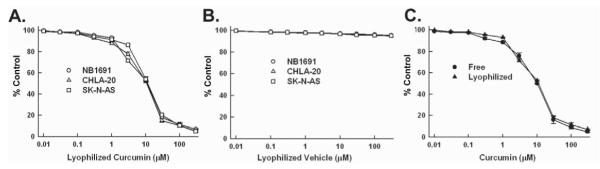
Figure 1. Effects of curcumin on tumor cell viability
(A) Dose-dependent decrease in tumor cell viability in all 3 neuroblastoma cell lines tested (NB-1691, CHLA-20, SK-N-AS). The IC50s varied from 10.57 mol for CHLA-20 to 17.97 mol for SK-N-AS. (B) Treatment of all three cell lines with empty liposome had no effect. (C) No significant differences were found in cell viability when NB1691 cells were treated with liposomal curcumin versus curcumin dissolved in DMSO.
Figure 2
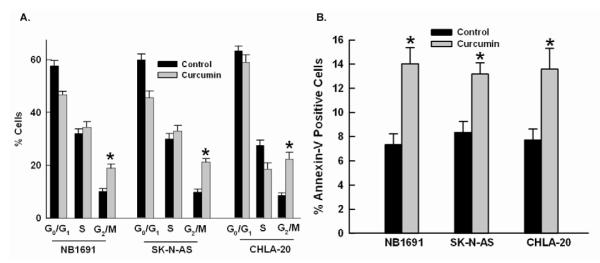
Figure 2. Effects of curcumin on cell cycle and apoptosis
(A) Curcumin treated cells showed an increased percentage of cells in the G2/M phase of cell cycle compared to control cells. (B) Curcumin treatment resulted in an increase in Annexin V-positive apoptotic cells.
Figure 3
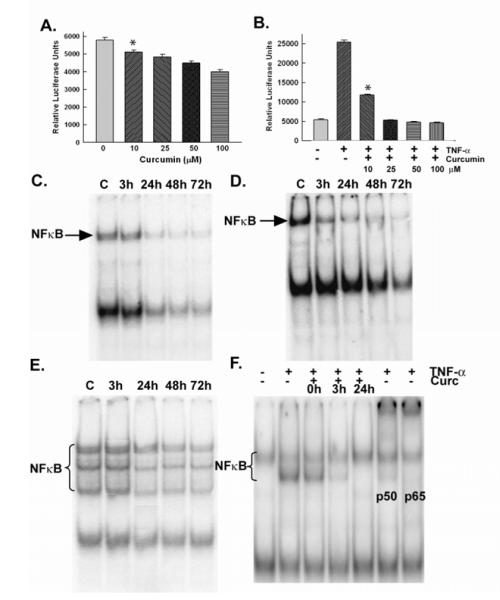
Figure 3. Effects of curcumin on NF-κB in vitro
(A) NB1691 NF-kB luc cells showed a dose dependent decrease in NF-kB activity after 3 hours of treatment. (B) Pretreating NB1691 NF-κB luc cells with curcumin before being stimulated with TNFα prevented NF-κB activation. (C-E) All three cell lines (NB1691, CHLA-20, SK-N-AS, respectively) were treated with 5 mol of curcumin for 3 hours, 24 hours, 48 hours and 72 hours. EMSA showed time dependent inhibition of NF-κB activity in all three cell lines. (F) NB1691 cells stimulated with TNFα showed an increase in NF-κB activity, that was abrogated when curcumin was added 24 hours before TNFα. Antibody supershift shows that TNFα induced NF-κB complexes contains the p50 and p65 subunits.
Figure 4
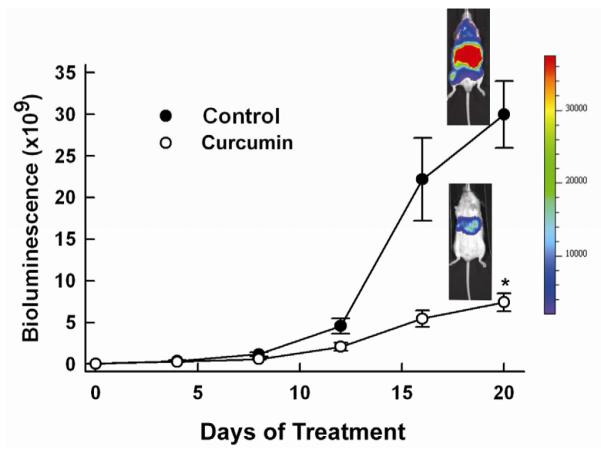
Figure 4. Effect of curcumin on tumor burden in a murine model of disseminated neuroblastoma
Bioluminescence imaging showed a reduction in tumor burden in the mice with disseminated neuroblastoma after 3 weeks of curcumin therapy. *p value = 0.00003. Also shown are representative photographs of bioluminescence in treat and control mice.
Figure 5
Figure 5. Effects of curcumin treatment on disseminated tumor burden
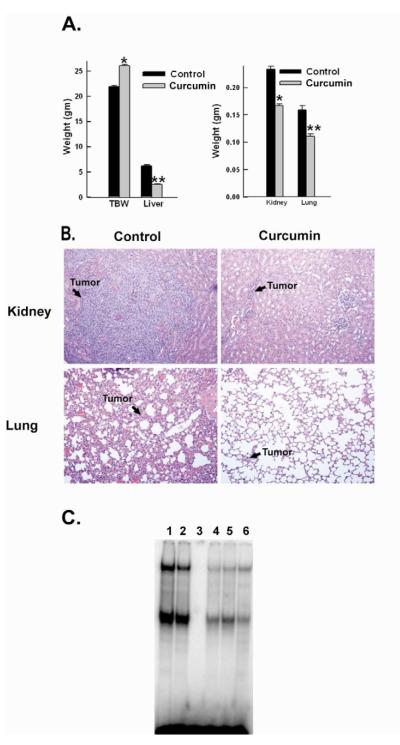
(A) After 3 weeks of treatment, control mice appeared ill and cachetic compared to treatment group. At necropsy, the control group was found to have bulky tumor replacement of the liver compared to treatment group. *p value = 0.00003, **p value = 0.00002 (B) The control group also had significant tumor replacement in the kidney and the lung compared to treatment group *p value = 0.0005, **p value = 0.0004 (C) Hematoxylin and eosin staining of representative kidney and lung sections. Magnification 200x (D) EMSA shows diminished activity in curcumin treated tumors
Figure 6
Figure 6. Curcumin treatment decreased tumor cell proliferation and increased tumor cell apoptosis
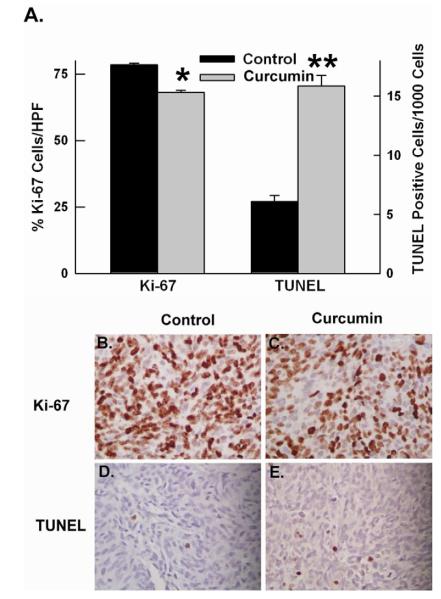
(A) Quanitative assessment of tumor cell proliferation (Ki-67 staining) and apoptosis (TUNEL staining). *p value = 0.006 **p value = 0.0003 (B-C) Representative images of Ki67 staining of control and treated tumor, respectively, (D-E) Representative images of TUNEL staining of control and treatment tumor, respectively. Magnification 400x.
Figure 7
Figure 7. Curcumin inhibits tumor angiogenesis
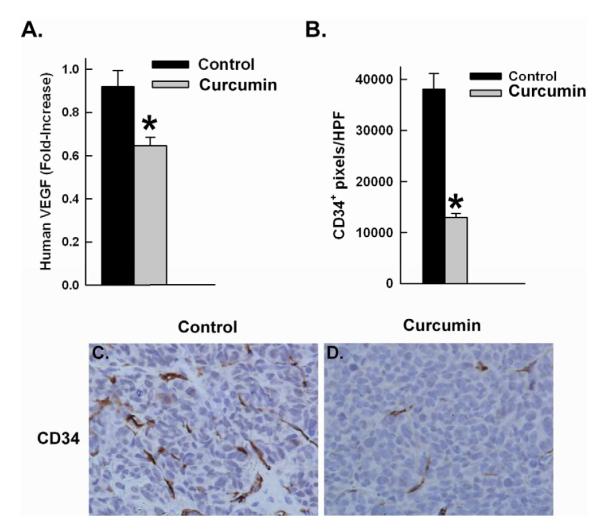
A) VEGF was assessed by RT-PCR. Curcumin treated tumors showed a significant decrease in VEGF levels. *p value = 0.005. (B) Tumor endothelial cell density was assessed by CD34 immunohistochemistry. Curcumin treated tumors showed a signficant decrease tumor vascular endothelial cells. *p value = 0.0003. (C-D) Representative images of CD34 immunohistochemistry of control and treated tumors, respectively. Magnification 400x.

References

    1. Maris JM. Recent advances in neuroblastoma. N.Engl.J Med. 2010;362:2202–11. - PMC - PubMed
    1. Bonizzi G, Karin M. The two NF-kappaB activation pathways and their role in innate and adaptive immunity. Trends Immunol. 2004;25:280–8. - PubMed
    1. Gilmore TD. Introduction: The Rel/NF-kappaB signal transduction pathway. Semin.Cancer Biol. 1997;8:61–2. - PubMed
    1. Baldwin AS., Jr The NF-kappa B and I kappa B proteins: new discoveries and insights. Annu.Rev.Immunol. 1996;14:649–83. - PubMed
    1. Aravindan N, Madhusoodhanan R, Ahmad S, Johnson D, Herman TS. Curcumin inhibits NFkappaB mediated radioprotection and modulate apoptosis related genes in human neuroblastoma cells. Cancer Biol.Ther. 2008;7:569–76. - PubMed

Publication types

MeSH terms