. 2012 Apr;153(4):614-9.
doi: 10.1016/j.ajo.2011.10.001. Epub 2012 Jan 28.

Changes in health-related quality of life 1 year following strabismus surgery

Affiliations

Changes in health-related quality of life 1 year following strabismus surgery

Sarah R Hatt et al. Am J Ophthalmol. 2012 Apr.

Abstract

Purpose: To report changes in health-related quality of life (HRQOL) 1 year following strabismus surgery.

Design: Retrospective cohort study.

Methods: Seventy-three adults undergoing strabismus surgery in a single clinical practice completed the Adult Strabismus-20 (AS-20) HRQOL questionnaire preoperatively and at 6 weeks and 1 year postoperatively. All included adults were successfully aligned at 6 weeks postoperatively. Success was defined based on clinical criteria. Change in AS-20 psychosocial and function scores was evaluated as: 1) difference in scores between 6 weeks and 1 year postoperatively and 2) proportions exceeding previously published limits of agreement at 6 weeks and 1 year.

Results: For patients successfully aligned at both 6 weeks and 1 year (n=51), further improvement in median scores was seen from 6 weeks to 1 year for both the psychosocial scale (83.8 vs 93.8; P<.0001) and the function scale (72.5 vs 77.5; P=.007). Also, a greater proportion exceeded limits of agreement at 1 year than at 6 weeks (psychosocial: 48% vs 30%; P=.007, function: 67% vs 51%; P=.01). For patients who became partial success (n=18) or failure (n=4) at 1 year there was a numerical decrease in scores at 1 year.

Conclusions: Adult strabismus patients who remain successfully aligned show continued improvement in both psychosocial and function scores from 6 weeks to 1 year postoperatively, indicating that improvement in HRQOL is long-lasting. Evaluation of HRQOL should be considered when reporting strabismus surgery outcomes in clinical trials, and may prove helpful in assessing outcomes in clinical practice.


Conflict of interest statement

Conflict of interest: No conflicting relationship exists for any author

Figures

Figure 1
Figure 1
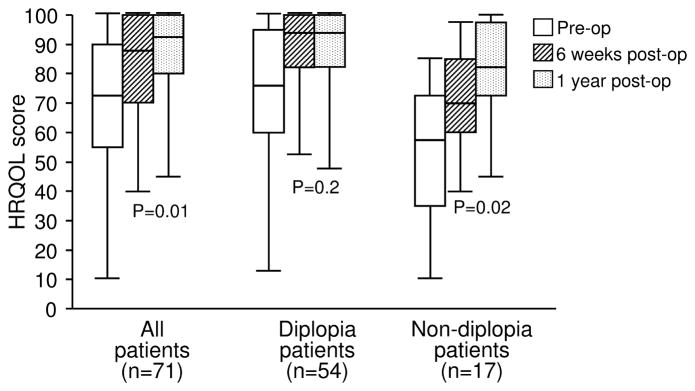
Psychosocial Adult Strabismus-20 (AS-20) scores pre-operatively, 6 weeks post-operatively and 1 year post-operatively in 71 adult strabismus patients successfully aligned at 6 weeks (overall, without regard to success status at 1 year). Scores improved further at 1 year, across all patients and for non-diplopic patients. Boxes represent 1st quartile, median and 3rd quartile values; whiskers represent extreme values. P value represents difference between 6 weeks and 1 year.
Figure 2
Figure 2
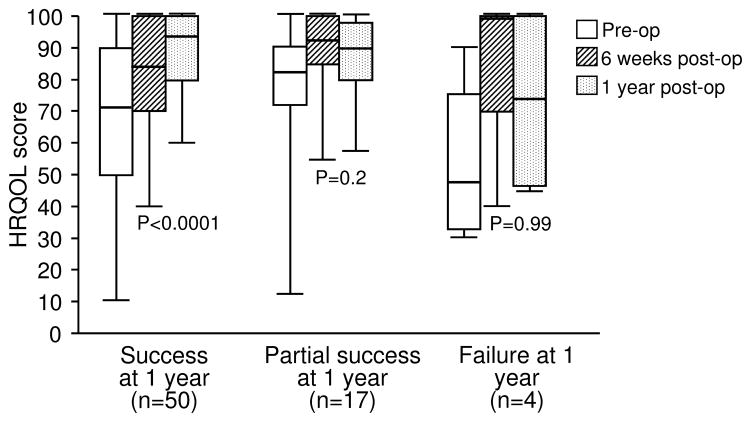
Psychosocial Adult Strabismus-20 (AS-20) scores pre-operatively, 6 weeks post-operatively and 1 year post-operatively in 71 adult strabismus patients successfully aligned at 6 weeks and sub-classified as success, partial success and failure at 1 year. For patients who remained successfully aligned at 1 year psychosocial scores improved further at 1 year. Boxes represent 1st quartile, median and 3rd quartile values; whiskers represent extreme values. P value represents difference between 6 weeks and 1 year.
Figure 3
Figure 3
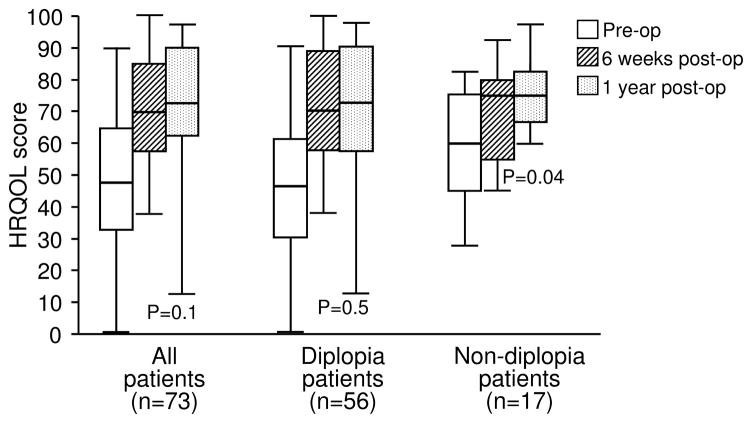
Function Adult Strabismus-20 (AS-20) scores pre-operatively, 6 weeks postoperatively and 1 year post-operatively in 73 adult strabismus patients successfully aligned at 6 weeks (overall, without regard to success status at 1 year). Scores improved further at 1 year in non-diplopic patients. Boxes represent 1st quartile, median and 3rd quartile values; whiskers represent extreme values. P value represents difference between 6 weeks and 1 year.
Figure 4
Figure 4
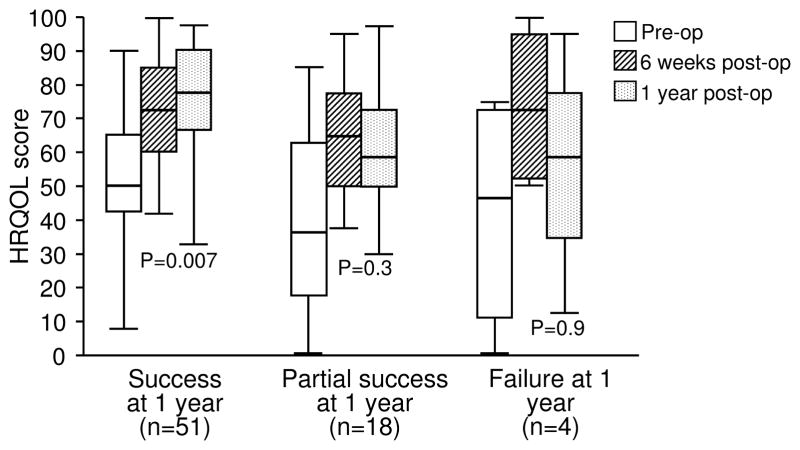
Function Adult Strabismus-20 (AS-20) scores pre-operatively, 6 weeks postoperatively and 1 year post-operatively in 73 adult strabismus patients successfully aligned at 6 weeks and sub-classified as success, partial success and failure at 1 year. For patients who remained successfully aligned at 1 year, function scores improved further. Boxes represent 1st quartile, median and 3rd quartile values; whiskers represent extreme values. P value represents difference between 6 weeks and 1 year.

References

    1. Hatt SR, Leske DA, Bradley EA, Cole SR, Holmes JM. Development of a Quality-of-Life Questionnaire for Adults with Strabismus. Ophthalmology. 2009;116(1):139–144. - PMC - PubMed
    1. Leske DA, Hatt SR, Holmes JM. Test-retest reliability of health-related quality of life questionnaires in adults with strabismus. Am J Ophthalmol. 2010;149(4):672–676. - PMC - PubMed
    1. Hatt SR, Leske DA, Holmes JM. Responsiveness of health-related quality of life questionnaires in adults undergoing strabismus surgery. Ophthalmology. 2010;117(12):2322–2328. - PMC - PubMed
    1. Hatt SR, Leske DA, Bradley EA, Cole SR, Holmes JM. Comparison of quality of life instruments in adults with strabismus. Am J Ophthalmol. 2009;148(4):558–562. - PMC - PubMed
    1. Jackson S, Harrad RA, Morris M, Rumsey N. The psychosocial benefits of corrective surgery for adults with strabismus. Br J Ophthalmol. 2006;90(7):883–888. - PMC - PubMed

Publication types

MeSH terms