Review
. 2012 Mar;33(3):324-34.
doi: 10.1038/aps.2011.187. Epub 2012 Jan 30.

Ice breaking in GPCR structural biology

Affiliations
Review

Ice breaking in GPCR structural biology

Qiang Zhao et al. Acta Pharmacol Sin. 2012 Mar.

Abstract

G-protein-coupled receptors (GPCRs) are one of the most challenging targets in structural biology. To successfully solve a high-resolution GPCR structure, several experimental obstacles must be overcome, including expression, extraction, purification, and crystallization. As a result, there are only a handful of unique structures reported from this protein superfamily, which consists of over 800 members. In the past few years, however, there has been an increase in the amount of solved GPCR structures, and a few high-impact structures have been determined: the peptide receptor CXCR4, the agonist bound receptors, and the GPCR-G protein complex. The dramatic progress in GPCR structural studies is not due to the development of any single technique, but a combination of new techniques, new tools and new concepts. Here, we summarize the progress made for GPCR expression, purification, and crystallization, and we highlight the technical advances that will facilitate the future determination of GPCR structures.


Figures
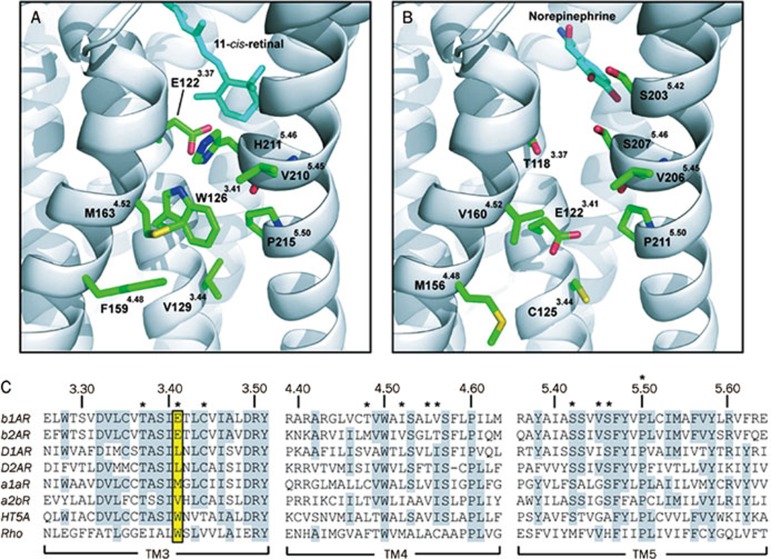
Figure 1
Figure 1
Structural models of the TM4-3-5 interface, indicating the most frequent 3.41 (Ballesteros and Weinstein System) mutation in GPCR structures. (A, B) Rhodopsin inactive state structure (PDB ID code 1U19) and β2AR structure showing residues proximal to 3.41. TM helices are colored grey and side-chains carbon atoms are colored green. (C) Clustal W sequence alignment illustrating the residue conservation in TM3, TM4, and TM5 for the βARs, rhodopsin and several members of the biogenic amine family. Identical residues are highlighted in grey. Key residues mentioned in the text are marked with asterisks. Position 3.41 is highlighted in yellow.
Figure 2
Figure 2
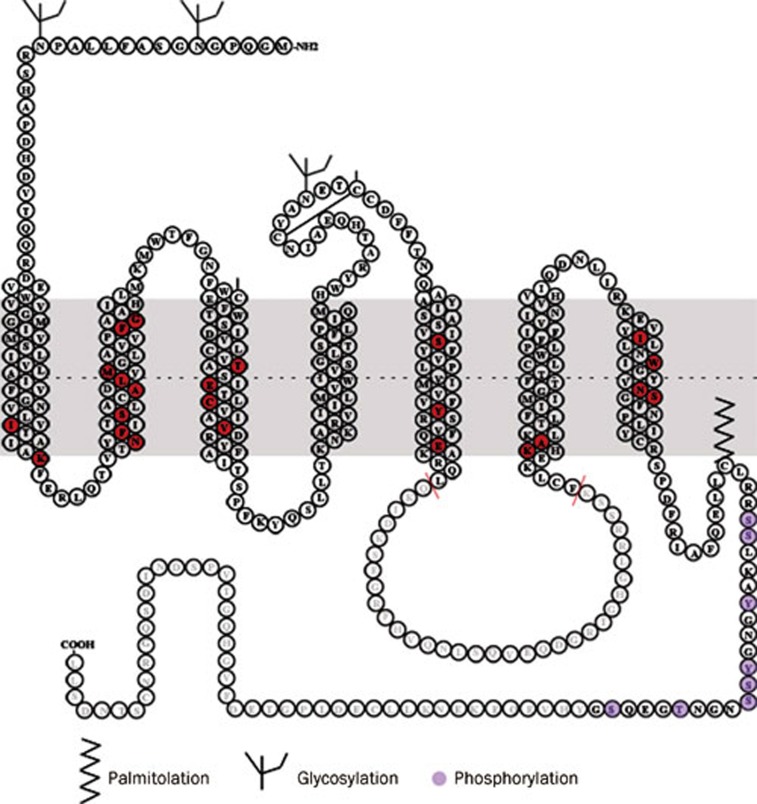
A snake β2AR plot to brief summary of the mutagenesis studies aiming higher GPCR stability, , , , , . The mutations on different receptors are applied to β2AR receptor based on the Ballesteros and Weinstein Number System and labeled in red on the Figure. The post translational modifications such as glycosylation and phosphorylation are labeled as indicated.
Figure 3
Figure 3
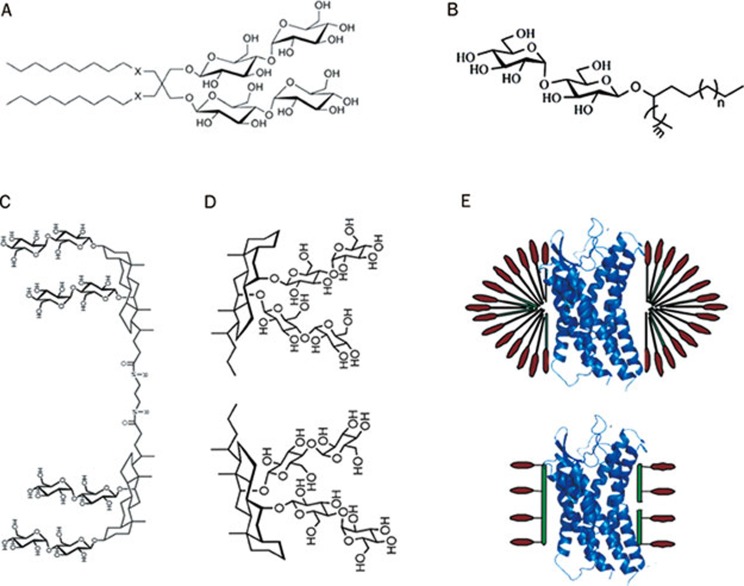
A brief summary of the new detergents to facilitate the GPCR structure study. (A) MNG; (B) branched detergent; (C) tandem facial amphiphiles (TFA); (D) facial amphiphiles; (E) a cartoon about the working hypothesis of facial amphiphiles and tandem facial amphiphiles in compare with conventional detergents.
Figure 4
Figure 4
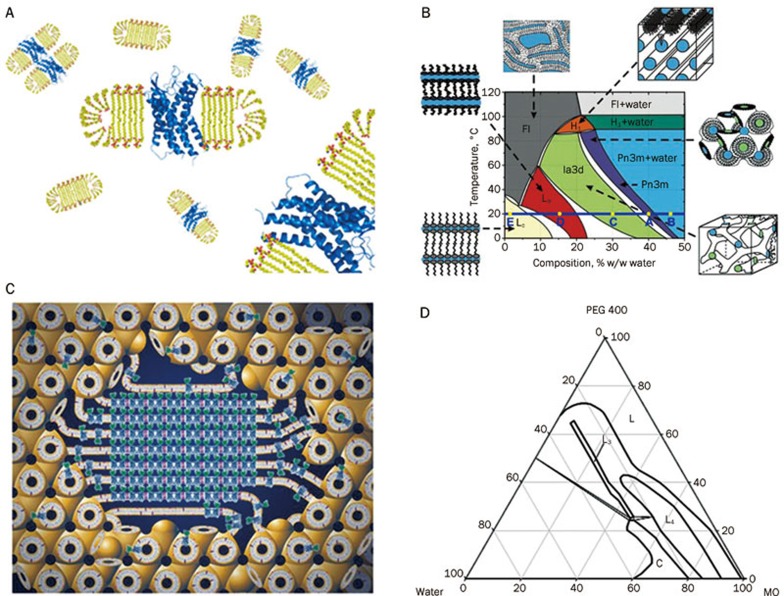
Phase diagram of lipidic cubic phase use Monoolein. A) A representative figure of GPCR in bicelle. The receptor is surrounded by a DMPC lipid bilayer, which is further covered by detergents. The receptor-lipid-detergent is afloat in the solution. D) the phase-temp diagram of Monoolein and water system, the phase will transit as lipid:water ratio or temperature change; C) crystallization of GPCRs in cubic phase, the receptor is in cartoon, the bicontinuous lipid bilayer is drawn in yellow and white and the dark blue represents the water channel and aqueous solution; D) Phase behavior of lipid-water-PEG400 system, representing the influences of additives and lipids on the phase.

References

    1. Palczewski K, Kumasaka T, Hori T, Behnke CA, Motoshima H, Fox BA, et al. Crystal structure of rhodopsin: A G protein-coupled receptor. Science. 2000;289:739–45. - PubMed
    1. Cherezov V, Rosenbaum DM, Hanson MA, Rasmussen SG, Thian FS, Kobilka TS, et al. High-resolution crystal structure of an engineered human beta2-adrenergic G protein-coupled receptor. Science. 2007;318:1258–65. - PMC - PubMed
    1. Jaakola VP, Griffith MT, Hanson MA, Cherezov V, Chien EY, Lane JR, et al. The 2.6 angstrom crystal structure of a human A2A adenosine receptor bound to an antagonist. Science. 2008;322:1211–7. - PMC - PubMed
    1. Warne T, Serrano-Vega MJ, Baker JG, Moukhametzianov R, Edwards PC, Henderson R, et al. Structure of a beta1-adrenergic G-protein-coupled receptor. Nature. 2008;454:486–91. - PMC - PubMed
    1. Wu B, Chien EY, Mol CD, Fenalti G, Liu W, Katritch V, et al. Structures of the CXCR4 chemokine GPCR with small-molecule and cyclic peptide antagonists. Science. 2010;330:1066–71. - PMC - PubMed

MeSH terms