


Development of organ-specific donor risk indices
- PMID: 22287036
- PMCID: PMC3332103
- DOI: 10.1002/lt.23398
Development of organ-specific donor risk indices
Abstract
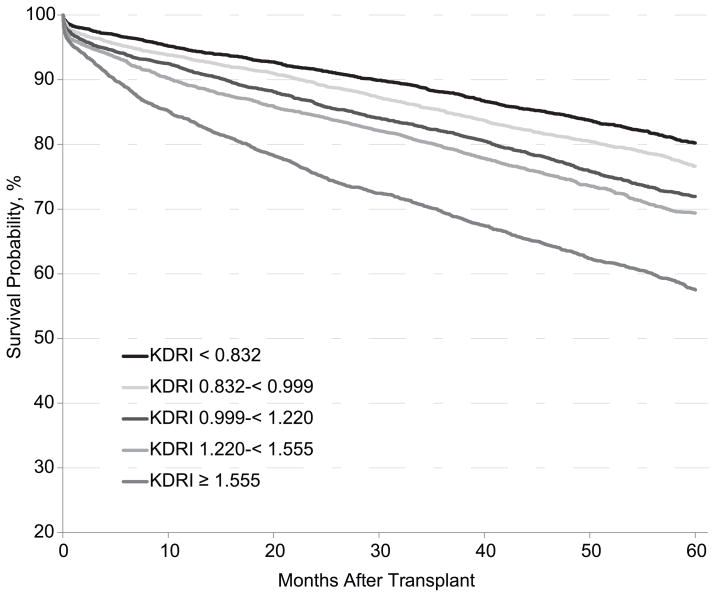
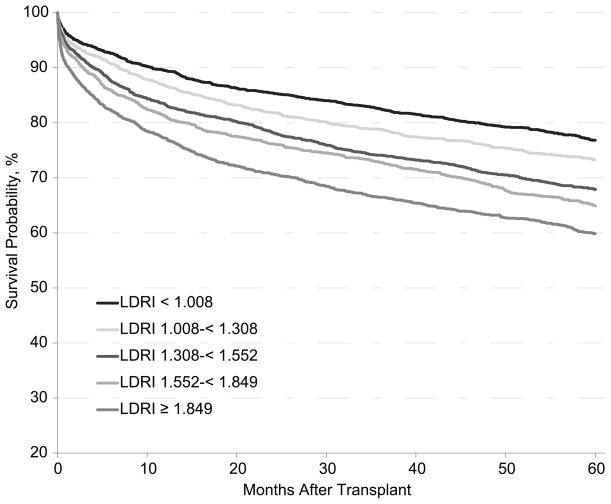
Because of the shortage of deceased donor organs, transplant centers accept organs from marginal deceased donors, including older donors. Organ-specific donor risk indices have been developed to predict graft survival with various combinations of donor and recipient characteristics. Here we review the kidney donor risk index (KDRI) and the liver donor risk index (LDRI) and compare and contrast their strengths, limitations, and potential uses. The KDRI has a potential role in developing new kidney allocation algorithms. The LDRI allows a greater appreciation of the importance of donor factors, particularly for hepatitis C virus-positive recipients; as the donor risk index increases, the rates of allograft and patient survival among these recipients decrease disproportionately. The use of livers with high donor risk indices is associated with increased hospital costs that are independent of recipient risk factors, and the transplantation of livers with high donor risk indices into patients with Model for End-Stage Liver Disease scores < 15 is associated with lower allograft survival; the use of the LDRI has limited this practice. Significant regional variations in donor quality, as measured by the LDRI, remain in the United States. We also review other potential indices for liver transplantation, including donor-recipient matching and the retransplant donor risk index. Although substantial progress has been made in developing donor risk indices to objectively assess donor variables that affect transplant outcomes, continued efforts are warranted to improve these indices to enhance organ allocation policies and optimize allograft survival.
Copyright © 2012 American Association for the Study of Liver Diseases.
Conflict of interest statement
The authors have no conflicts of interest with its subject matter.
Figures
References
-
- Miranda B, Fernandez Lucas M, de Felipe C, Naya M, Gonzalez-Posada JM, Matesanz R. Organ donation in Spain. Nephrol Dial Transplant. 1999;14 (Suppl 3):15–21. - PubMed
-
- Rao KV, Kasiske BL, Odlund MD, Ney AL, Andersen RC. Influence of cadaver donor age on posttransplant renal function and graft outcome. Transplantation. 1990;49:91–95. - PubMed
-
- Terasaki PI, Gjertson DW, Cecka JM, Takemoto S, Cho YW. Significance of the donor age effect on kidney transplants. Clin Transplant. 1997;11(5 Pt 1):366–372. - PubMed
-
- Rosengard BR, Feng S, Alfrey EJ, Zaroff JG, Emond JC, Henry ML, et al. Report of the Crystal City meeting to maximize the use of organs recovered from the cadaver donor. Am J Transplant. 2002;2:701–711. - PubMed
-
- Port FK, Bragg-Gresham JL, Metzger RA, Dykstra DM, Gillespie BW, Young EW, et al. Donor characteristics associated with reduced graft survival: an approach to expanding the pool of kidney donors. Transplantation. 2002;74:1281–1286. - PubMed
Publication types
MeSH terms
Grants and funding
LinkOut - more resources
Full Text Sources
Medical