Review
. 2014 Jan 28;342(2):170-7.
doi: 10.1016/j.canlet.2012.01.020. Epub 2012 Jan 27.

Epigenetic biomarkers in skin cancer

Affiliations
Review

Epigenetic biomarkers in skin cancer

Edward S Greenberg et al. Cancer Lett. .

Abstract

Epigenetic aberrations have been associated with cutaneous melanoma tumorigenesis and progression including dysregulated DNA gene promoter region methylation, histone modification, and microRNA. Several of these major epigenetic aberrations have been developed into biomarkers. Epigenetic biomarkers can be detected in tissue and in blood as circulating DNA in melanoma patients. There is strong evidence that biomarkers in cutaneous melanoma will have an important role as companions to therapeutics and overall patient management. Important progress has been made in epigenetic melanoma biomarker development and verification of clinical utility, and this review discusses some of the key current developments and existing challenges.

Keywords: BC; BCC; BM; Biomarker; CAE; CIMP; CTC; CTCL; ChIP; CoBRA; CpG island methylator phenotype; DNA methyltransferase; DNMT; Epigenetics; IHC; LINE-1; MCC; MINT; MSP; Melanoma; Methylation; MicroRNA; OS; PCR; Prognosis; ROC; SBM; SCC; TMZ; TRG; UTR; basal cell carcinoma; biochemotherapy; biomarker; capillary array electrophoresis; cell-free circulating nucleic acid; cf-CNA; chromatin immunoprecipitation; circulating tumor cell; combined bisulfite restriction analysis; cutaneous T-cell lymphoma; immunohistochemistry; long interspersed nuclear element-1; merkel cell carcinoma; methylated-in-tumor; methylation-specific realtime PCR; miRNA; micro-RNAs; overall survival; polymerase chain reaction; receiver operating characteristics; sodium bisulfite modification; squamous cell carcinoma; temozolomide; tumor-related genes; untranslated region.


Conflict of interest statement

Conflict of Interest: All authors disclose no financial/commercial conflict of interest.

Figures

Figure 1
Figure 1
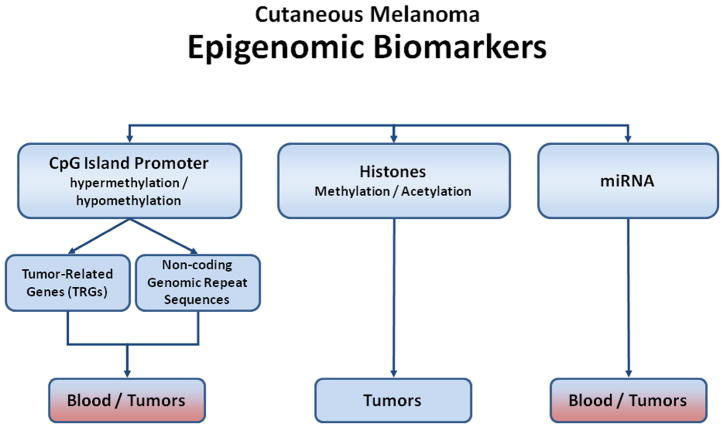
Epigenomic BMs and studied applications.
Figure 2
Figure 2
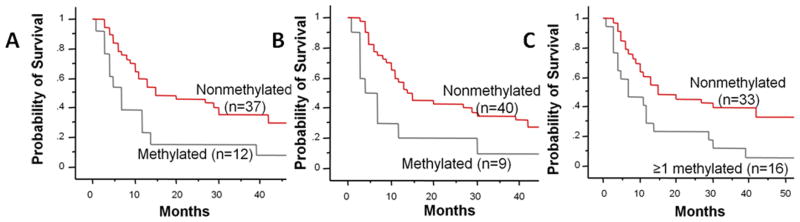
(A) Kaplan-Meier survival curves of biochemotherapy (BC) patients: Correlation of pre-BC serum RASSF1A methylation BM with overall survival (log-rank test, P = .013). Methylated: Patients with serum methylation of RASSF1A. Nonmethylated: Patients with no serum methylation of RASSF1A. (B) Correlation of pre-BC serum RARβ-2 methylation status with overall survival (log-rank test, P = .02). Methylated: Patients with serum methylation of RARβ-2. Nonmethylated: Patients with no serum methylation of RARβ-2. (C) Correlation of pre-BC serum methylation of at least one BM with overall survival (log-rank test, P = .01). ≥ 1 methylated: Patients with serum methylation of at least one BM. Nonmethylated: Patients with no serum methylation of genes. Figure reproduced with permission from Mori et al. 2005 [28].
Figure 3
Figure 3
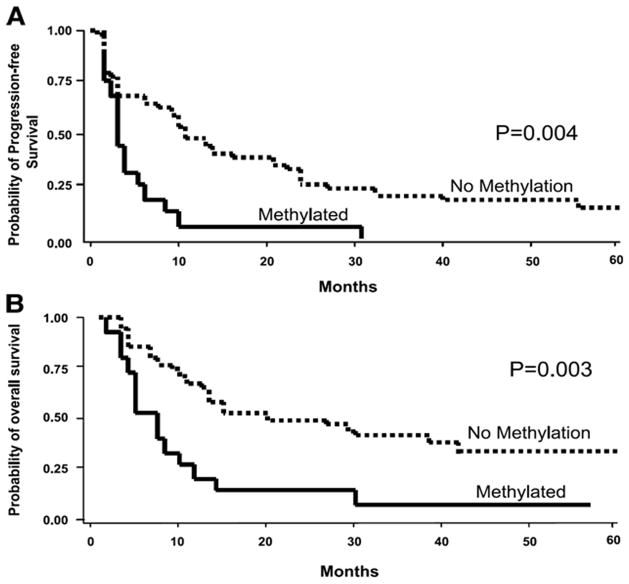
(A) Kaplan-Meier curves showing the correlation of pre-BC serum ER-α methylation status with progression-free survival (Cox proportional hazard, P = 0.004). Methylated, patients with serum methylated ER-α DNA. No methylation, patients with no detectable serum methylated ER-α. (B) Kaplan-Meier curves showing the correlation of pre-biochemotherapy serum ER-α methylation status with OS (Cox proportional hazard, P = 0.003). Figure reproduced with permission from Mori et al. 2006 [10].

References

    1. Schinke C, Mo Y, Yu Y, Amiri K, Sosman J, Greally J, et al. Aberrant DNA methylation in malignant melanoma. Melanoma Res. 2010;20:253–65. - PMC - PubMed
    1. Balch CM, Gershenwald JE, Soong SJ, Thompson JF, Atkins MB, Byrd DR, et al. Final version of 2009 AJCC melanoma staging and classification. J Clin Oncol. 2009;27:6199–206. - PMC - PubMed
    1. Chatzinasiou F, Lill CM, Kypreou K, Stefanaki I, Nicolaou V, Spyrou G, et al. Comprehensive field synopsis and systematic meta-analyses of genetic association studies in cutaneous melanoma. J Natl Cancer Inst. 2011;103:1227–35. - PMC - PubMed
    1. Dahl C, Guldberg P. The genome and epigenome of malignant melanoma. APMIS. 2007;115:1161–76. - PubMed
    1. Goto Y, Koyanagi K, Narita N, Kawakami Y, Takata M, Uchiyama A, et al. Aberrant fatty acid-binding protein-7 gene expression in cutaneous malignant melanoma. J Invest Dermatol. 2010;130:221–9. - PMC - PubMed

Publication types

MeSH terms